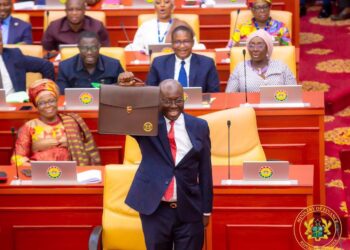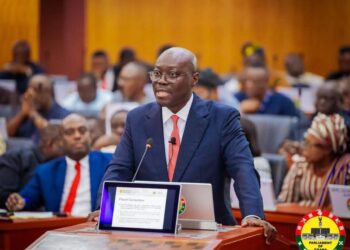
Ghana has targeted its mineral wealth as a new foundation to consolidate the country’s lasting prosperity. The Finance Minister, Dr. Cassiel Ato Forson in the 2027 Budget Statement and Economic Policy unveiled a sweeping structural reform to consolidate Ghana’s extractive revenues and public infrastructure vehicles into a single, powerhouse investment institution.
The Minister announced plans to merge the Minerals Income Investment Fund (MIIF) and the Ghana Infrastructure Investment Fund (GIIF) to establish the Ghana Sovereign Wealth Fund.
The move signals a decisive policy shift aimed at harnessing the country’s natural resource endowments spanning gold, bauxite, lithium, and manganese as the primary anchor for multi-generational economic transformation rather than short-term fiscal consumption.
“Mr. Speaker, Ghana’s mineral wealth and strategic public assets can be the foundation for lasting prosperity. However, fragmented investment arrangements have limited effective strategic coordination, efficient asset management and the long-term planning. To ensure that Ghana derives greater and more sustainable value from its mineral wealth and strategic public assets, Government will merge the Minerals and Income Investment Fund and the Ghana Infrastructure Investment Fund to establish the Ghana Sovereign Wealth Fund.”
Dr. Cassiel Ato Forson
Under the new architecture, the unified fund will serve as the state’s central investment vehicle, pooling mineral royalty streams and strategic state-owned equity under one roof.
By eliminating institutional duplication, the government intends to sharpen capital allocation, strengthen governance, and deploy patient equity into high-impact industrial and infrastructure projects.
Crucially, the new sovereign fund is positioned to act as the lead public equity partner for the flagship 24-Hour Economy and Accelerated Export Development Programme, crowding in private domestic and international capital to accelerate industrialization.
Ending Institutional Fragmentation in Resource Management
For over a decade, Ghana’s state investment landscape operated through separate statutory bodies with overlapping mandates, diluting the scale of public capital available for transformative national development.
Established under the Ghana Infrastructure Investment Fund Act of 2014 to mobilize, manage, and provide financial resources for infrastructure, GIIF operated independently from MIIF, which was created under Act 978 in 2018 to monetize mineral royalties and manage the state’s equity interests in mining operations.
While both institutions recorded pockets of success, operating in silos constrained balance-sheet leverage and created administrative inefficiencies in project origination.
Industry analysts and extractive sector watchers have long argued that spreading sovereign capital across multiple sub-scale vehicles weakens Ghana’s bargaining power when negotiating co-investment deals with global institutional investors.
In his address to lawmakers, Dr. Forson emphasized that the consolidation is designed to correct these structural bottlenecks, noting that the new entity “will consolidate and strengthen the management and investment of our mineral income, improve investment origination and coordination, increase returns, and provide financing for transformative projects.”
Merging MIIF’s steady inflow of mineral royalties with GIIF’s infrastructure project-structuring expertise creates a deeper, more resilient capital pool capable of underwriting large-scale ventures without over-relying on sovereign debt.
Powering the 24-Hour Economy and Export Drive
Beyond administrative streamlining, the establishment of the Ghana Sovereign Wealth Fund is directly tied to the administration’s broader macroeconomic growth strategy.
With the government targeting $10 billion in economic transformation investments between 2027 and 2030 alongside proposed legislation to ring-fence natural resource revenues for major infrastructure, the fund will serve as the primary catalytic financier for private-sector expansion.
By taking strategic equity stakes in viable enterprises, the state aims to de-risk priority sectors and lower the cost of capital for local manufacturers and agro-processors.
The finance minister underscored that the “24-Hour Economy and Accelerated Export Development Programme is a private sector-led initiative“, clarifying that the state will act as an enabler rather than a competitor.
To bridge financing gaps that often stall round-the-clock industrial operations such as reliable energy, logistics hubs, and export-processing zones the “Ghana Sovereign Wealth Fund will be the equity partner for projects under the 24-hour Economy and Accelerated Export Development Programme.”
Through disciplined co-investment structures, the fund will help originate bankable deals, attract foreign direct investment, and expand Ghana’s non-traditional export base.
Strategic Imperatives for the Extractive Sector
For stakeholders across Ghana’s mining and minerals value chain, the creation of a unified sovereign wealth vehicle carries significant implications for local content, downstream beneficiation, and revenue transparency.
Historically, fluctuating global commodity prices have exposed the national budget to boom-and-bust cycles, leaving minimal fiscal buffers for value-addition initiatives in gold refining, bauxite-to-aluminium integration, and lithium processing.
Consolidating mineral income management under a single sovereign mandate provides the long-term horizon necessary to finance midstream and downstream extractive infrastructure.

Furthermore, global best practices from Norway’s Government Pension Fund Global to Botswana’s Pula Fund demonstrate that centralized, rules-based sovereign funds enhance accountability and insulate resource wealth from political spending pressures.
As Parliament prepares to review the enabling legislative amendments to the 2014 GIIF Act and the 2018 MIIF Act, market observers will closely watch the governance frameworks put in place to safeguard board independence and investment discipline.
If executed with strict transparency, the Ghana Sovereign Wealth Fund could permanently transform the nation’s underground wealth into enduring intergenerational prosperity.
READ ALSO: South Sudan Postpones General Elections to February 2027