Ghana is seeking to reposition its agricultural sector as a major destination for commercial investment, with the government prioritising production efficiency, infrastructure development and stronger links between farming and industrial processing.
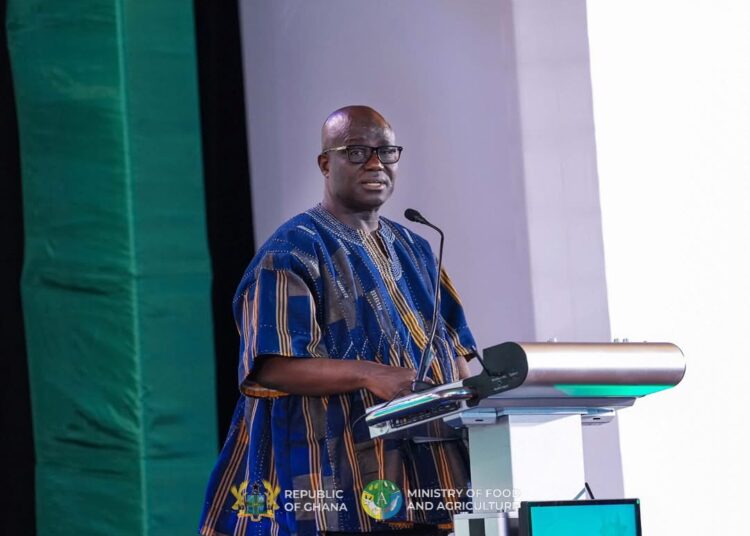
At the Invest Ghana Summit 2026, held at the Kempinski Hotel Gold Coast City in Accra, the Minister for Food and Agriculture, Hon. Eric Opoku, outlined the government’s strategy to move agriculture beyond primary production towards a commercially driven sector capable of supporting industrial expansion, creating employment and increasing farmers’ incomes.
He said the country’s agricultural potential could be better realised through targeted investments in production, irrigation, mechanisation, storage, processing and market development, while encouraging investors to establish partnerships with Ghanaian businesses.
“Ghana’s agricultural transformation requires a shift from traditional primary production towards a commercially driven and industrially connected economy.”
Minister for Food and Agriculture, Hon. Eric Opoku
Agriculture an Economic Investment Potential
The Minister’s appeal comes against the backdrop of agriculture’s significant contribution to Ghana’s national economy. According to the Ghana Statistical Service’s 2025 national accounts, agriculture accounted for 22.8 per cent of nominal Gross Domestic Product (GDP), making it the third-largest sector after services and industry.
The sector recorded an estimated real growth rate of 6.8 per cent in 2025, reflecting its continuing importance to national economic activity and its potential to support further investment.
Hon. Opoku identified grains, poultry, horticulture and tree crops as areas offering opportunities for investment, particularly in production expansion, processing infrastructure and the development of reliable supply chains.
The Minister’s emphasis on commercial agriculture also reflects the need to reduce the structural limitations that prevent farmers from fully benefiting from their production activities.
Feed Ghana Programme Drives Production Expansion
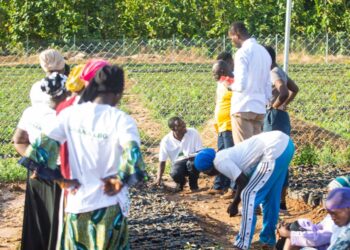
The programme places emphasis on expanding irrigation, improving access to agricultural machinery, strengthening farmer organisations and developing post-harvest infrastructure.
Hon. Opoku highlighted these interventions as important foundations for building a more productive and commercially sustainable agricultural sector.
Also, irrigation development is particularly important in reducing the dependence of agricultural production on seasonal rainfall.
A reliable water supply can support year round cultivation, improve production planning and create opportunities for commercial farming operations.
“Expanding irrigation, mechanisation and storage infrastructure is essential to improving productivity, reducing post harvest losses and strengthening the commercial viability of farming.”
Minister for Food and Agriculture, Hon. Eric Opoku
Beyond infrastructure, the Feed Ghana Programme is designed to improve coordination among farmers through cooperatives and Farmer-Based Organisations (FBOs).
The Ministry of Food and Agriculture’s 2026 budget reports that 63,039 cooperatives and farmer-based organisations, representing more than 661,687 farmers, had registered on its programme portal.
This provides an important foundation for organising agricultural production, facilitating access to inputs and connecting farmers with commercial buyers and processors.
Private Sector Partnerships and Value Addition
The Minister further stressed the importance of private-sector participation in unlocking investment opportunities across Ghana’s agricultural value chains.
He called on investors to collaborate with local businesses to develop sustainable agricultural enterprises, improve market access and establish stronger relationships between farmers, processors and investment institutions.
Such partnerships are important because agricultural transformation requires more than increased production. It also depends on the availability of capital, technical expertise, processing technology, logistics and reliable markets.
For instance, investment in grain processing could strengthen the supply of locally produced raw materials to the food manufacturing industry, while poultry investments could support domestic production, feed manufacturing, processing and distribution.
Similarly, horticultural investments could expand commercial cultivation, cold-chain facilities, packaging and export-oriented production.
Tree crops also offer opportunities for long-term investment through processing and the development of products with higher commercial value.
The emphasis on value addition is particularly relevant to Ghana’s broader industrialisation ambitions. Processing more agricultural commodities locally would enable the country to retain a greater proportion of the value generated from its agricultural resources.
It could also stimulate demand for locally produced raw materials, encourage the establishment of agro-processing enterprises and create employment opportunities across production, manufacturing and distribution.
However, attracting investment into these areas will require a predictable business environment, access to financing, dependable infrastructure and policies that encourage long term private sector participation.
The Minister’s call therefore places responsibility on both government and businesses to establish partnerships that address existing constraints while creating commercially viable opportunities.
“Stronger partnerships between investors, processors and Ghanaian farmers can build resilient value chains, create employment and improve incomes across agricultural communities.”
Minister for Food and Agriculture, Hon. Eric Opoku
The investment agenda outlined at the summit seeks to establish agriculture as a stronger driver of industrial development and economic prosperity.
“Investing in agriculture is not simply about increasing production; it is about creating value, building resilient businesses and generating shared prosperity.”
Minister for Food and Agriculture, Hon. Eric Opoku
Hon. Opoku’s message to investors was therefore a call to look beyond the cultivation of agricultural commodities and consider the wider economic opportunities available across Ghana’s agricultural value chains.
READ ALSO:Theo Acheampong Credits Spending Controls for Ghana’s Economic Recovery