Ghana has intensified efforts to improve its trading environment with the launch of a National Non-Tariff Barriers (NTB) Reporting and Resolution Platform and the inauguration of a dedicated committee to address obstacles affecting the movement of goods and services across the country’s trade corridors.
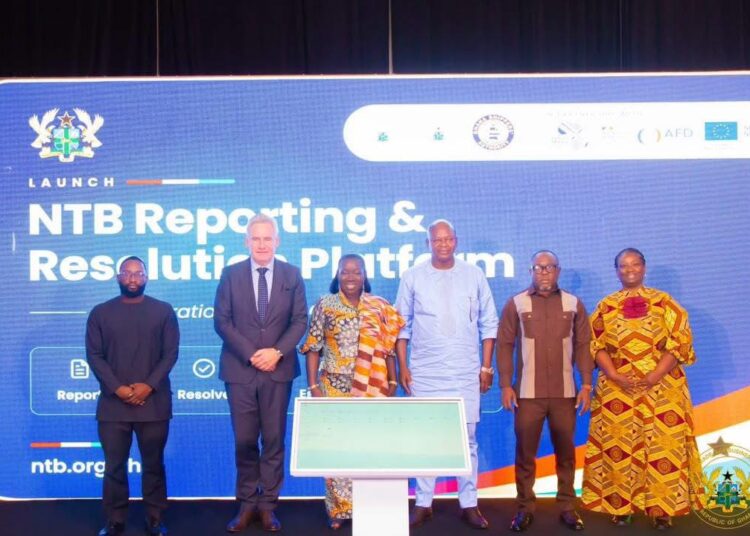
The initiative, launched by the Minister for Trade, Agribusiness and Industry, Hon. Elizabeth Ofosu-Adjare, in Accra, is expected to provide businesses with a structured mechanism to report trade related challenges, monitor complaints and obtain timely interventions from relevant public institutions.
The platform introduces multiple reporting channels, including a dedicated web portal, WhatsApp, social media platforms and Unstructured Supplementary Service Data (USSD) services.
“The platform provides traders and businesses with accessible channels to report trade related challenges and track their resolution.”
Minister for Trade, Hon. Elizabeth Ofosu-Adjare
It also incorporates artificial intelligence (AI) capabilities to facilitate complaint processing, improve coordination among responsible institutions and strengthen accountability in resolving reported trade barriers.
Digital Platform Targets Persistent Trade Bottlenecks
The platform has non-tariff barriers which are among the significant challenges affecting international and regional trade.
Unlike tariffs, which are duties imposed on imported or exported goods, non-tariff barriers include administrative, regulatory and operational obstacles that increase the time and cost associated with moving products across borders.
These challenges may include excessive documentation requirements, unnecessary checkpoints, arbitrary charges, delays in customs clearance, inconsistent application of regulations and difficulties in meeting product standards.
For businesses, particularly small and medium-sized enterprises (SMEs), such obstacles can increase operational expenditure, disrupt delivery schedules and undermine their ability to compete in regional and international markets.
The World Bank’s research on the AfCFTA has identified the removal of non-tariff barriers as an important component of improving intra-African trade and unlocking the agreement’s economic potential.
Similarly, research by the United Nations Conference on Trade and Development (UNCTAD) highlights the economic consequences of non-tariff barriers, particularly in agricultural and manufacturing trade.
Its 2024 analysis found that eliminating such barriers could generate approximately US$1.5 billion in additional economic welfare across Africa.
Against this background, Ghana’s newly introduced platform is expected to improve the visibility of trade related complaints by creating a centralised reporting system through which businesses can communicate challenges directly to the relevant authorities.
Committee to Strengthen Institutional Accountability
As part of the launch, the Trade Minister inaugurated the National Non-Tariff Barriers Resolution Committee, which will support the identification, coordination and resolution of complaints submitted through the platform.
The committee is expected to strengthen collaboration among public institutions responsible for trade administration, transportation, logistics and other regulatory processes that influence the movement of goods.
Its establishment addresses an important aspect of trade facilitation: ensuring that complaints reported by businesses do not remain unresolved because of fragmented institutional responsibilities or inadequate coordination.
Hon. Ofosu-Adjare, who also serves as the Non-Tariff Barriers Ambassador for the sub-region, commended TradeMark Africa, the Agence Française de Développement (AFD), the European Union and other development partners for supporting the development of the initiative.
She also acknowledged the contributions of the Ministry of Transport and the Ghana Shippers Authority, whose collaboration was instrumental in advancing the platform.
“Addressing non-tariff barriers is critical to reducing the cost of doing business, improving trade efficiency and strengthening Ghana’s competitiveness.”
Minister for Trade, Hon. Elizabeth Ofosu-Adjare
The National Non-Tariff Barriers Resolution Committee will therefore be central to translating the platform’s reporting capabilities into practical interventions that improve the trading environment.
Government Targets Efficient Transport and Regional Trade
The Minister for Transport, Hon. Joseph Bukari Nikpe, reaffirmed government’s commitment to improving efficiency across the transport and logistics sectors, recognising their importance to the movement of goods and the overall performance of the economy.
Transport infrastructure and logistics services remain essential components of trade competitiveness, particularly for businesses involved in importation, exportation and cross-border distribution.
Delays along trade corridors, inefficient cargo handling and operational challenges within the transport system can increase the cost of doing business and affect the reliability of supply chains.
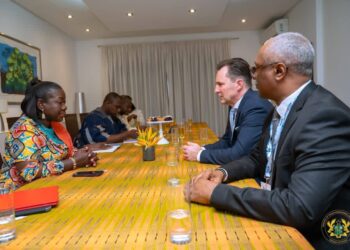
The European Union Ambassador to Ghana, H.E. Rune Skinnebach, also welcomed the introduction of the platform and emphasised the importance of ensuring that complaints submitted through the system receive effective and timely attention.
“The effectiveness of the platform will depend on the timely and effective resolution of complaints reported by traders and businesses.”
European Union Ambassador to Ghana, H.E. Rune Skinnebach
His remarks highlight the importance of moving beyond the establishment of digital reporting infrastructure to ensuring that the institutions responsible for addressing reported challenges deliver measurable results.
For exporters, importers, freight forwarders, transport operators and small-scale traders, an accessible complaint resolution system could help reduce uncertainty and improve confidence in the country’s trading environment.
The launch therefore marks an important step towards a more transparent, accountable and efficient trading environment, with stronger institutional cooperation expected to support Ghana’s ambitions of becoming a competitive regional trade and investment hub.
READ ALSO:Ghana’s US$2.6bn Energy Investment Pitch Faces Bankability Test