Kwame Jantuah, a private legal practitioner and leading member of the Convention People’s Party (CPP), has urged the government to enforce a strict two-year moratorium on ASM to pave the way for comprehensive industry restructuring.
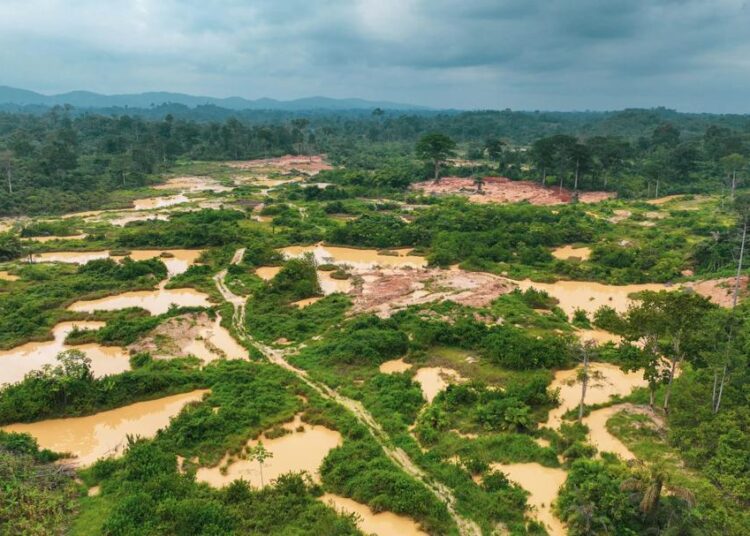
Mr. Jantuah argued that incremental regulatory measures have failed to halt the severe degradation of Ghana’s forest reserves and water bodies.
Addressing the urgency of the crisis, the energy and natural resources lawyer maintained that President John Dramani Mahama must adopt an uncompromising stance against illegal mining, locally known as galamsey.
He pointed to neighbouring Guinea, where authorities recently instituted a sweeping ban on unregulated artisanal gold mining alongside restrictions on hazardous chemicals and heavy excavation machinery to reclaim state control over mineral value chains.
Without a total pause to audit concessions, sanitize licensing regimes, and transition operators into regulated cooperatives, Mr. Jantuah warned that Ghana faces irreversible ecological and public health consequences.
“President Mahama has to be ruthless with galamsey, as ruthless as he can be, because we cannot get a few people trying to kill all of us. And the killing is not even immediate; it is in the long term.”
Kwame Jantuah
The Case for a Structural Moratorium and Cooperative Reform
Ghana’s extractive sector remains a cornerstone of macroeconomic stability, driving foreign exchange earnings and gross domestic product expansion.
However, unchecked proliferation of unlicensed mining has turned a vital economic asset into an existential threat, poisoning major river basins with mercury and cyanide while depleting arable cocoa farmlands.
Mr. Jantuah questioned why successive administrations have hesitated to temporarily suspend small-scale operations to establish a transparent, accountable framework.
“Why governments, both NPP and NDC, do not want to ban artisanal mining for at least two years and restructure this lucrative business, is something I don’t understand,” he remarked during the broadcast.
Rather than permanently disenfranchising local miners, his proposal advocates using the 24-month freeze to organize legitimate operators into traceable cooperative systems.
Under a cooperative model, the state could enforce strict environmental reclamation bonds, mandate mercury-free processing technologies, and monitor gold output from pit to refinery, ensuring that mineral wealth translates into sustainable national development rather than short-term ecological ruin.

Regional precedents underscore both the necessity and complexity of decisive state intervention.
In November 2026, Guinea expanded a nationwide crackdown on illegal artisanal gold mining following an initial ban in its northeastern Siguiri region, deploying joint security forces to seize equipment, arrest facilitators, and curb smuggling.
While regional analysts note that sudden bans require well-structured alternative livelihood programs to prevent socioeconomic displacement, the Guinean example demonstrates the political will required to dismantle entrenched illicit networks.
Escalating National Security Threats and Cartelization
Beyond environmental devastation, the unregulated rush for gold is rapidly evolving into a direct challenge to state sovereignty and internal security.
Illegal mining syndicates have increasingly militarized their operations, deploying sophisticated weaponry to ward off state task forces and forestry guards.
Mr. Jantuah cautioned that allowing armed groups to operate with impunity inside forest zones risks ceding sovereign territory to criminal enterprises.
“Where you get people fighting the army with weapons that the army don’t have, it’s dangerous. Very soon, there will be cartels in different regions, and you cannot approach those regions,” he warned. Left unchecked, these heavily financed networks could mirror the resource-fueled insurgencies and cartel violence witnessed in other unstable mining jurisdictions across West Africa.
Bipartisan Consensus and Upcoming Jubilee House Strategy Review
Tackling a menace deeply intertwined with local politics and elite financing requires transcending partisan divides.
Mr. Jantuah emphasized that no single administration can defeat galamsey in isolation, calling on President Mahama to forge a unified national policy alongside former Presidents Nana Akufo-Addo and John Agyekum Kufuor. A bipartisan compact would strip illegal operators of political protection and guarantee policy continuity beyond four-year electoral cycles.
His intervention comes just days before a high-level government review of anti-galamsey operations.
President Mahama is scheduled to chair a critical Cabinet Subcommittee meeting on Tuesday, December 1, 2026, to reassess the administration’s strategy against illegal mining.
According to an official invitation issued on November 26, 2026, from the Office of the President at Jubilee House, the 3:00 p.m. session in Accra will convene key sector ministers, senior government officials, and heads of the national security apparatus to chart a decisive path forward for Ghana’s extractive governance.
READ ALSO: Saudi Refinery Strike Raises Ghana’s Fuel Supply Concerns