Ghana’s labour market added workers and jobs in 2025, but youth unemployment and informal work remain stubbornly high, according to the Ghana in Numbers, 2025 report published by the Ghana Statistical Service. The figures cover the first three quarters of the year and put national unemployment at 12.8 percent.
Labour force participation climbed to 74.5 percent from 67.1 percent in 2022, and the employment-to-population ratio rose to 65.0 percent from 58.3 percent. Yet more than 70 percent of jobs stay informal, and the report calls for targeted job creation, skills development and the formalisation of work.
“Informality, youth joblessness, and job quality gaps highlight the need for targeted job creation, skills development, and formalization of employment.”
Ghana in Numbers, 2025, Ghana Statistical Service
The share of working-age Ghanaians who are working or looking for work averaged 74.5 percent between the first and third quarters of 2025. That compares with 67.1 percent in 2022, which means more people have entered the labour market in the period.
Government Statistician Dr Alhassan Iddrisu
The report describes a dip in 2024 followed by a strong recovery in 2025. Both participation and employment ratios have improved since 2022, it notes, although the figures say nothing about the quality of the work people have found.
Employment Gains Reach 13.3 Million Workers
An average of 13.3 million people held jobs across the first three quarters of 2025. The employment-to-population ratio of 65.0 percent shows that a larger share of working-age Ghanaians now has work than in 2022, when the ratio stood at 58.3 percent.
The national unemployment rate averaged 12.8 percent over the same period. The report states that this is down from a peak in earlier years, though it does not name the year of that peak.
Informality remains the defining feature of Ghanaian employment. More than 70 percent of jobs are informal, which the report describes as lacking social security, regular pay and job security.
A related measure points the same way. An average of 9.7 million people held vulnerable jobs in the second and third quarters of 2025, which the report links to precarious conditions. The report warns that informal employment limits prospects for income stability and career progression, and it ranks that limit among the main gaps in the labour market.
Youth Unemployment Remains the Sharpest Gap
Young people carry the heaviest burden. Unemployment among those aged 15 to 24 averaged 32.4 percent in the first three quarters of 2025, while the rate for those aged 15 to 35 stood at 21.9 percent. Both figures sit well above the national average of 12.8 percent.
The report reads the numbers as evidence of persistent barriers for young people entering the workforce. A rebound in overall participation, in other words, has not yet translated into jobs for the youngest workers.
The report also tracks young people who are not in employment, education or training, a group known as NEET. The rate averaged 19.1 percent among those aged 15 to 24 and 17.9 percent among those aged 15 to 35.
“Nearly 1 in 5 young people are disconnected from work and skills development.” Women make up more than 60 percent of the NEET youth, the report adds. That share suggests that gender gaps compound the problem for young women, who face obstacles to both work and training.
What the Report Says Must Change
The report’s conclusion points to three priorities. It calls for targeted job creation, skills development and the formalisation of employment, each of which answers one of the gaps in the figures.
Job creation speaks to the youth unemployment rate, since 32.4 percent of those aged 15 to 24 who want work cannot find it. Skills development speaks to the NEET group, whose members sit outside both employment and training. Formalisation speaks to the more than 70 percent of jobs that offer no social security or steady pay.
Government Statistician Dr Alhassan Iddrisu
The figures show a labour market that has grown, with more people at work than in 2022. They also show that growth alone has not delivered the secure, well-paid jobs that young Ghanaians need, and that the next set of quarterly figures will test whether the rebound extends to them.
Ghana’s economy has expanded substantially over the past three decades, but new national productivity evidence raises a harder question about the quality of that growth.
The Productivity, Employment & Growth Report 2025, jointly produced by the Ghana Statistical Service and the International Labour Organization, shows that labour productivity increased by roughly 240 percent over the period examined.
Yet the country’s growth process has relied heavily on adding labour and capital rather than consistently extracting more output from each unit of those resources.
That distinction goes to the centre of Ghana’s development challenge. An economy can raise gross domestic product by employing more people, constructing more buildings, acquiring more machinery or expanding extractive activity.
But sustained increases in living standards ultimately depend on productivity: workers, firms and institutions producing more value with the resources already available. Without stronger efficiency gains, investment can lift output while leaving wages, competitiveness and household incomes behind.
The timing is especially important as government prepares to translate macroeconomic stabilisation into a new phase of production and investment. Ghana’s US$10 billion New Economy programme is being framed around agriculture, agro-processing, infrastructure, jobs and private capital.
Finance Minister Dr Cassiel Ato Forson makes a point during talks with the National Development Planning Commission on the New Economy programme in Accra. Photo: Ministry of Finance
The productivity report suggests that the programme should be judged not only by how much money is mobilised or how many projects are launched, but by whether those resources generate measurable efficiency gains across firms and workers.
Growth Has Relied More on Inputs Than Efficiency
The report, launched during the 2026 National Labour Conference in Ho, covers productivity and employment trends from 1991 to 2022 and provides detailed evidence for 17 economic sub-sectors. Labour productivity increased by about 240 percent between 1991 and 2019, equivalent to average annual growth of roughly 3.2 percent.
Yet multifactor productivity, which captures efficiency gains from technology, innovation, skills and better organisation, contributed only about 0.5 percentage point to annual growth on average. The contrast suggests that Ghana has expanded output faster than it has improved the efficiency with which labour and capital are used together.
This matters because input-driven growth eventually confronts limits. More capital can raise output when workers lack equipment, infrastructure or technology, and a growing labour force can expand production when jobs are available.
However, if technology, skills, management quality and institutional efficiency do not improve at the same time, each additional unit of investment tends to generate smaller gains. The economy then requires increasingly large injections of capital simply to sustain the same growth rate.
Government Statistician Dr Alhassan Iddrisu
For fiscal policy, the implication is equally important. Public investment should not be assessed primarily by the size of allocations or the number of projects completed.
Roads, irrigation systems, industrial parks, digital infrastructure and training programmes justify their economic cost when they reduce production constraints, lower unit costs and enable private firms to produce more competitively.
Productive Sectors Employ Too Few Workers
The report also exposes a structural mismatch between where Ghana generates high levels of productivity and where most Ghanaians work. Agriculture’s share of employment fell from about 53 percent in 2000 to 33 percent in 2021, while services rose from roughly 32 percent to 53 percent. Industry remained near 15 percent.
Across the sub-sectors examined, the highest-productivity activities still tend to employ relatively small shares of the labour force. Industrial output has expanded strongly, helped by mining and petroleum, but these capital-intensive activities do not absorb labour on the scale required by Ghana’s growing workforce.
This is why headline GDP growth can coexist with persistent employment pressure. A cedi of additional output generated by an extractive project can raise national income without creating the same number of jobs as expansion in competitive manufacturing, agro-processing or modern services.
The report identifies manufacturing, electricity and water supply, transport and storage, and commercial agriculture among the areas where productivity and employment have advanced together.
Dr Cassiel Ato Forson, Minister of Finance, interacting with traders at the Makola Market
These are especially important because the policy challenge is not simply to move workers out of low-productivity activities, but to expand productive sectors that can absorb workers at scale.
The same concern already sits behind the government’s effort to shift policy from stabilisation towards production. As Vaultz News previously reported on the New Economy consultations, the real test will be whether investment creates productive capacity that survives beyond public support.
The new productivity evidence makes that test more demanding: job creation should be accompanied by rising output per worker, better technology use and stronger firm-level competitiveness.
Informality Weakens the Productivity-Income Link
Nearly eight out of every ten Ghanaian workers remain in informal, low-productivity employment, according to the report. That concentration limits the speed at which national productivity gains translate into higher incomes because many informal firms operate with little capital, limited access to finance, weak technology adoption and narrow markets.
The report further indicates that earnings have not kept pace with labour productivity. Economically, a persistent gap between what workers produce and what they earn can weaken the household channel through which growth becomes improved living standards.
It can also complicate wage bargaining: firms cannot sustainably raise real wages faster than productivity over long periods, but workers are unlikely to experience growth as inclusive when productivity advances without comparable gains in purchasing power.
Closing that gap requires more than administratively raising wages. The durable route is to strengthen the productive base underneath wages by improving skills, technology, access to reliable infrastructure, business formalisation and firm expansion. Higher productivity creates the economic space for wages to rise without automatically increasing unit labour costs or weakening competitiveness.
New Economy Spending Needs Productivity Scorecards
The productivity report should therefore influence how Ghana evaluates the next cycle of public and private investment. Large headline commitments can attract attention, but the appropriate economic scorecard is the return generated from each cedi of capital, each worker employed and each public intervention.
For agriculture and agro-processing, that means tracking yields per hectare, post-harvest losses, processing utilisation, value added per worker and the ability of firms to compete without permanent protection.
For infrastructure, it means measuring reductions in transport time, logistics costs, power interruptions and other bottlenecks that affect production. For skills programmes, the relevant outcomes include employment, earnings and worker productivity after training rather than enrolment alone.
The National Development Planning Commission’s expected oversight of the New Economy programme creates an opportunity to embed these measures from the start. If productivity indicators are absent, Ghana risks repeating a familiar pattern in which investment raises the capital stock but does not sufficiently improve the efficiency of the economy.
Ghana Needs Efficiency-Led Growth
Ghana’s 240 percent increase in labour productivity over three decades is significant, but the broader evidence warns against treating that achievement as proof that the growth model has fully transformed.
Productivity gains remain uneven, high-productivity sectors employ too few people, informality remains dominant and earnings have not captured the full benefit of rising output per worker.
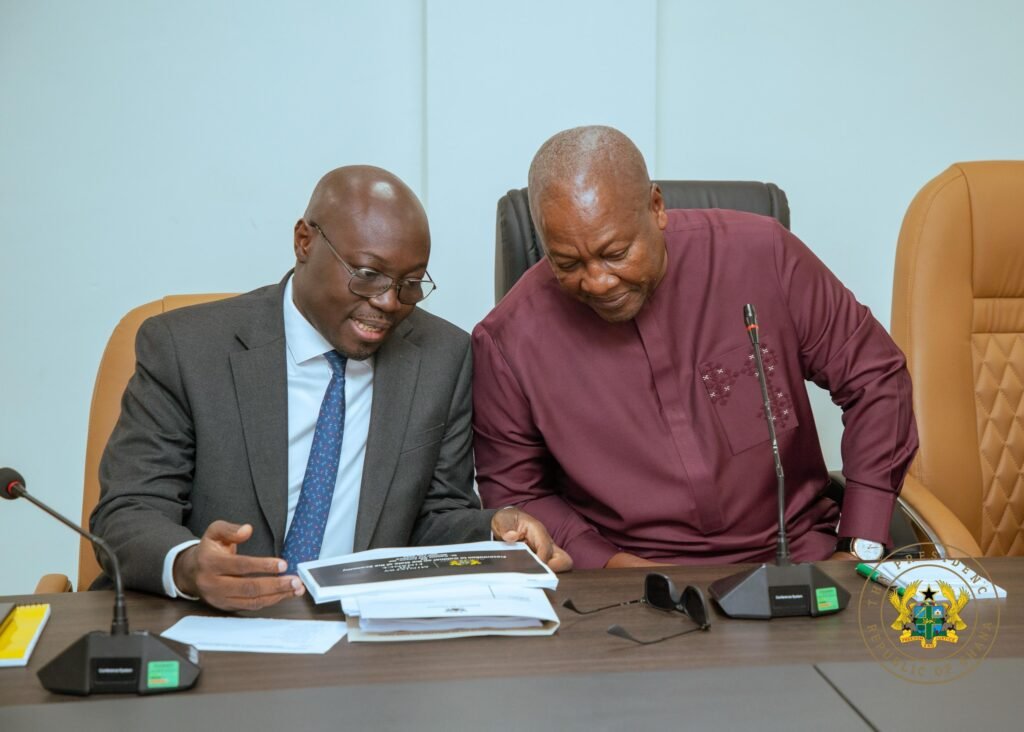
President John Dramani Mahama (R) and Finance Minister Dr Cassiel Ato Forson (L)
The next stage of economic policy therefore has to move beyond accumulating inputs. Capital must be paired with technology, skills and better management; infrastructure must lower the cost of production; public spending must crowd in competitive private investment; and workers must be able to move into firms and sectors where their labour generates more value.
That is the productivity test facing Ghana’s growth strategy. The country does not merely need a larger economy. It needs an economy that converts each cedi invested, each hour worked and each technological improvement into more output, better jobs and stronger real incomes.
If the New Economy programme can deliver that shift, Ghana’s next phase of growth will be built less on adding resources and more on using them better.