Ghana’s economic policy is beginning to move from repairing macroeconomic imbalances towards a harder task: converting greater stability into production, private investment and jobs.
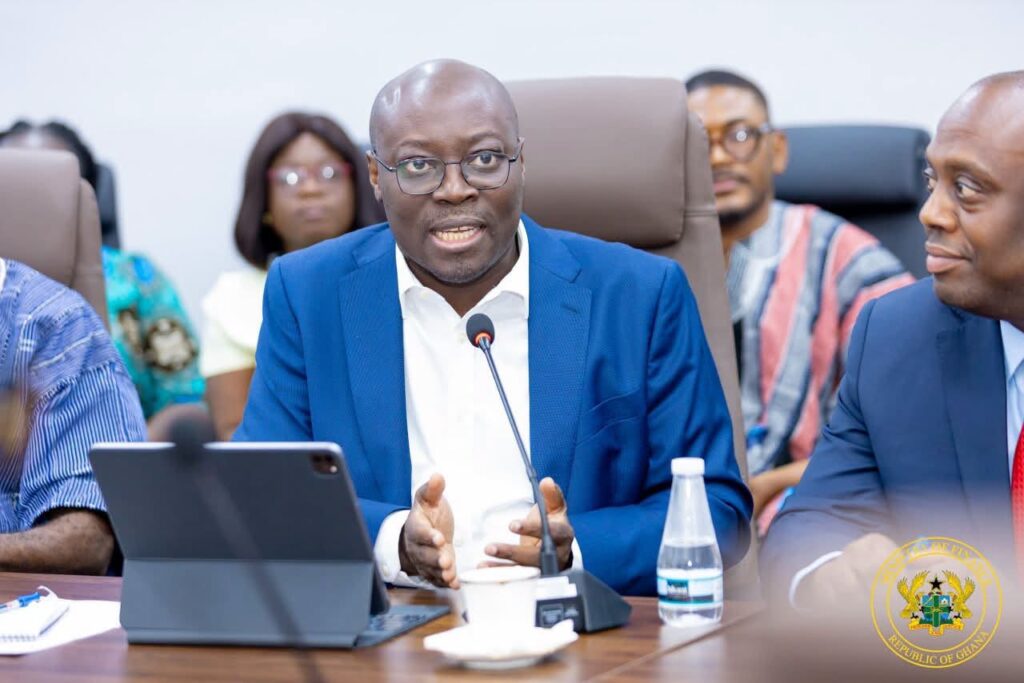
Finance Minister Dr Cassiel Ato Forson has begun consultations with key ministries on the government’s proposed New Economy programme, starting with the Ministry of Trade, Agribusiness and Industry. The consultations are expected to feed into a programme whose full details will be presented in the 2027 Budget in November, with government indicating that about US$10 billion of investment could be involved in key sectors of the economy.
The significance of the consultations goes beyond another government policy announcement. Ghana has spent much of the recent period trying to restore stability after severe pressures from inflation, public debt, fiscal imbalances and exchange-rate volatility. The next test is whether those improvements can create an economy in which firms invest more, domestic production expands and growth becomes less dependent on a narrow group of commodities.
Stability Creates Room, But Does Not Guarantee Transformation
Recent economic indicators give government some basis for shifting the policy discussion.
Ghana Statistical Service data show that annual inflation stood at 5.0 percent in August 2026, despite rising slightly from 4.6 percent in July. The economy also expanded by 6.4 percent in the first quarter of 2026, while annual real GDP growth reached 6.0 percent in 2025.
These numbers suggest an economy operating under considerably less price instability than in the recent past. Yet lower inflation and stronger headline growth do not automatically resolve weaknesses in productive capacity.
That distinction is important. Macroeconomic stability can reduce uncertainty for businesses, make planning easier and improve the conditions under which capital is allocated. But firms will expand production only when other constraints, including infrastructure, energy reliability, access to finance, market demand, skills and the cost of doing business, permit profitable investment.
The Ministry of Finance appears to recognise this distinction. Dr Forson has described stabilisation as the “price of entry” rather than the final destination of economic policy.
That framing raises the bar for the New Economy programme. Its success will have to be judged less by the size of the announced investment envelope and more by the productive capacity created with it.
Production Must Broaden Ghana’s Growth Base
The composition of Ghana’s external sector illustrates why production and diversification matter.
Bank of Ghana data show that merchandise exports reached about US$18.29 billion during the first half of 2026, producing a trade surplus of approximately US$8.81 billion. Gold alone generated about US$12.50 billion, meaning more than two-thirds of merchandise export earnings came from the metal. Cocoa brought in about US$2.29 billion and crude oil about US$1.71 billion.
Strong gold earnings have helped Ghana build a sizeable external surplus and provided support to the country’s foreign-exchange position. But the figures also expose concentration risk.
An economy whose external strength depends heavily on one commodity remains vulnerable to movements in global prices and production. A wider production base, particularly one that expands agro-processing, manufacturing, tradable services and value addition, would distribute that risk across more sectors while creating employment opportunities outside the extractive economy.
This is where coordination between the Finance Ministry and the Ministry of Trade, Agribusiness and Industry becomes economically important.
Tax policy, public investment and government financing decisions cannot operate separately from industrial and trade policy. A factory may benefit from tax incentives, for example, but still fail to compete if electricity, transport, credit or imported intermediate inputs make production excessively expensive.
The New Economy consultations therefore need to identify where public intervention can lower these constraints without creating another layer of expensive government programmes.
Private Investment Will Be the Real Test
Deputy Finance Minister Thomas Nyarko Ampem also separately argued that Ghana must move towards increased productivity, investment and employment, saying: “We have stabilised the present. Now we must secure the future.”
He placed particular emphasis on a new relationship between government and businesses, under which the state provides stability, infrastructure, regulation and fiscal discipline while private firms respond through investment, innovation, exports and job creation.
That division of responsibility is economically consequential.
If government attempts to finance transformation predominantly through its own balance sheet, large investment commitments could eventually compete with the fiscal discipline that helped restore confidence. Ghana’s 2026 fiscal framework targets a primary surplus of 1.5 percent of GDP on a commitment basis and an overall fiscal deficit of about 2.2 percent of GDP.
The financing structure of the proposed US$10 billion programme will therefore matter.
The eventual 2027 Budget will need to distinguish clearly among direct government expenditure, private capital, public-private partnerships, development finance and other funding arrangements. Without that distinction, the headline investment figure will tell businesses and taxpayers little about the programme’s eventual fiscal burden.
Crowding in private investment would offer a more sustainable route, particularly where government spending removes infrastructure or institutional bottlenecks that currently make otherwise viable private projects unattractive.
Jobs Must Come From Productive Expansion
The employment question will ultimately determine how households experience the shift from stabilisation to transformation.
Inflation falling towards low single digits improves purchasing-power conditions, but households also need income growth. Sustainable increases in income normally require firms to produce more, hire additional workers and raise productivity.
The New Economy programme therefore cannot be assessed simply through GDP growth or the amount of money committed to projects. The more demanding indicators will include new private investment, employment created, export growth outside the traditional commodity sectors, productivity improvements and the survival of businesses after government support ends.
The consultations now underway offer government an opportunity to build those measurements into the programme before implementation begins.
The November 2027 budget provides the first detailed test. Investors, businesses and households will be looking beyond the US$10 billion headline for answers on sector priorities, financing, implementation timelines and measurable economic returns.
Ghana has made progress in restoring stability. The more difficult phase is converting that stability into an economy that produces, invests and employs at scale.
READ ALSO: BoG Urges Banks to Turn Credit Into Growth