• About
  • Advertise
  • Privacy Policy
  • Contact
Saturday, August 22, 2026
  • Login
The Vaultz News
  • Top Stories
  • News
    • General News
    • Education
    • Health
    • Opinions
  • Economics
    • Economy
    • Finance
      • Banking
      • Insurance
      • Pension
    • Securities/Markets
  • Business
    • Agribusiness
    • Vaultz Business
    • Extractives/Energy
    • Real Estate
  • World
    • Africa
    • America
    • Europe
    • UK
    • USA
    • Asia
    • Around the Globe
  • Innovation
    • Technology
    • Wheels
  • Entertainment
  • 20MOBPL2DNew
  • Jobs & Scholarships
    • Job Vacancies
    • Scholarships
No Result
View All Result
The Vaultz News
  • Top Stories
  • News
    • General News
    • Education
    • Health
    • Opinions
  • Economics
    • Economy
    • Finance
      • Banking
      • Insurance
      • Pension
    • Securities/Markets
  • Business
    • Agribusiness
    • Vaultz Business
    • Extractives/Energy
    • Real Estate
  • World
    • Africa
    • America
    • Europe
    • UK
    • USA
    • Asia
    • Around the Globe
  • Innovation
    • Technology
    • Wheels
  • Entertainment
  • 20MOBPL2DNew
  • Jobs & Scholarships
    • Job Vacancies
    • Scholarships
No Result
View All Result
The Vaultz News
No Result
View All Result
in Around the Globe

Arab region accounts for only 4.7 percent of world trade – DDG Wolff

Maynard Championby Maynard Champion
November 9, 2020
Reading Time: 3 mins read
Add as Preferred on Google
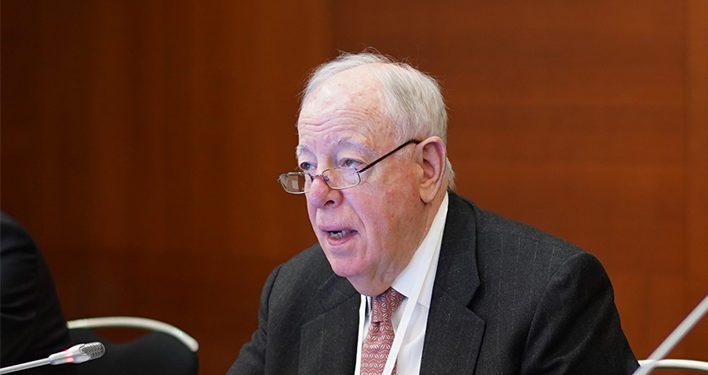
Deputy Director-General -  Alan Wolff

Deputy Director-General - Alan Wolff

Deputy Director-General (DDG) Alan Wolff has stated that even though the Arab region has rich natural resources, its share in world trade is only 4.7 percent.

He stated this on 8th November 2020 whilst Speaking at the High-Level Regional Dialogue on WTO Accessions for the Arab Region hosted by the Arab Monetary Fund and Islamic Development Bank.

According to DDG Wolff, excluding oil, the Arab region’s non-oil exports make up 2% of world exports with low Intra-Arab trade of less than 10%.     

He pointed out that the Arab region is one of the areas of the world with the largest number of countries outside the Multilateral Trading System.  This situation, according to him, partly reflects the fact that many Arab acceding governments are fragile and conflict-affected, suffering or having suffered from the social, economic, and political consequences of conflicts.

ADVERTISEMENT

He noted that it was due to these circumstances that the WTO launched the “Trade for Peace” initiative in late 2017. Through this initiative, The WTO has brought together the trade community and the peace community, so that the pillar of trade could be factored into peacebuilding work, highlighting how economic integration can be a driver for sustainable and inclusive peace.

“The Arab region is remarkably rich with its natural resources and diverse cultures stemming from the earliest cradles of civilization.  With a population of 380 million, the region which comprises 22 Arab countries spans from as far as the Atlantic Ocean in the west to the Indian Ocean in the East. Nevertheless, with so much potential, the share of the Arab region in world trade is only 4.7 percent”.

DDG Wolff further stated that the Arab region has not escaped the dire economic consequences of this pandemic.  For some, the steep fall in oil prices has aggravated existing problems. A crisis, however, also presents opportunities for closer international cooperation to limit the harm from the pandemic and to spur the recovery. 

These issues demonstrate that more, not less, global and regional trade integration is required.  Integration into the world economy goes hand in hand with necessary domestic reforms.  This is where WTO accession makes particularly valuable contributions. Those engaged in the reform-driven accession process are likely to experience a quicker recovery and greater resilience in the future.

Based on evidence from the 36 accessions which have been completed, the WTO accession process has served as an effective external anchor for domestic reforms, acting as a catalyst in realizing the potential of their economies. 

According to the last WTO Director-General’s Annual Report on WTO Accessions, Article XII Members have registered higher growth rates of GDP and trade (exports and imports), as well as increased flows of inward FDI stocks, in the years following their accession compared to the rest of the world. These results indicate that integrated, open economies tend to grow faster.  Besides, by signalling a government’s commitment to international rules, WTO membership appears to also encourage the inflow of foreign investment.

ADVERTISEMENT

The accession process has been used by resource-based countries to diversify their economies. Economic diversification is one of the major priorities for governments in the Arab region.  Our 2016 study examined whether countries’ export structures became more diversified after gaining WTO membership. 

This was true for about half of the recently acceded Members, which increased the number of exported products, measured in HS chapters, accounting for more than 60% of their exports after accession. This was achieved often by re-branding their economies with WTO membership and attracting increased FDI. 

“With this in mind, it is reassuring to see that many acceding governments, including from the Arab world, have remained active during the pandemic on their WTO accession despite numerous challenges on the ground. The primary objective of this High-Level Regional Dialogue is to allow acceding governments to share their experiences and voice their technical assistance needs regarding the accession process to strengthen regional, international, and organizational cooperation.

“For this, sessions such as the experience-sharing roundtable, and the identification of technical assistance, are key and will require active participation from both acceding governments and current Members who are willing to share their experiences, to coordinate more effectively support with regional and international partners”.

ADVERTISEMENT

Sign Up to Our Newsletter

Fresh updates, Straight to your inbox

Please login to join discussion
Previous Post

IMF Approves A US$370 Million Extended Credit Facility to Support the Islamic Republic of Afghanistan

Next Post

US goods worth $4bn Slammed with EU tariffs

Related Posts

A severely cracked and dehydrated landscape experiencing a major drought
Around the Globe

El Niño Set to be ‘Strongest in Living Memory’, Met Office Warns

August 21, 2026
mpox outbreak
Around the Globe

UNICEF: Children Make Up Half of Guinea-Bissau’s Suspected Mpox Cases

August 20, 2026
United Nations
Around the Globe

UN Sounds Alarm as Attacks on Aid Workers Reach Historic Levels

August 19, 2026
A farmer working and watering damaged agricultural land amidst widespread destruction in the Gaza Strip.
Around the Globe

Only 3% of Gaza’s Cropland Remains Accessible and Undamaged, UN Warns

August 18, 2026
ADVERTISEMENT

Sign Up to Our Newsletter

Fresh updates, Straight to your inbox

ADVERTISEMENT

Recent News

Mr Mark Prempeh, Director of Petroleum, Ministry of Energy and Green Transition

Government Pushes GNPC Toward A More Commercial Future

August 21, 2026
Photo from PIAC's 15th anniversary launch

GIZ Urges Ghana To Turn Petroleum Accountability Into Development

August 21, 2026
Kai Harvetz celebrate after scoring against Coventry City at the Emirates Stadium

Arsenal Begin PL Title Defence With Resounding Victory Over Coventry

August 21, 2026
From the left, Mr Patrick Stephenson, Country Director for Ghana, NRGI, the moderator, and the panelists for the engagement, from the left: Mr Michael Aryeetey, Deputy CEO, Exploration&Production, GNPC, Mr Benjamin Boakye, Executive Director, ACEP, Mr Agyemang, Technical Director, PIAC and Dr Steve Manteaw, Co-Chair of GHEITI

GNPC Faces Governance Test As Energy Transition Accelerates

August 21, 2026
From the left: Mr Michael Aryeetey, Deputy CEO, Exploration&Production, GNPC, Mr Mark Prempeh, Director of Petroleum, Ministry of Energy and Green Transition, Mr Kwame Ntow Amoah, CEO, GNPC, Nafi Quarshie, Africa Director, NRGI, Mr Benjamin Boakye, Executive Director, ACEP, Mr Abrokwah, GNPC and Mr Patrick Stephenson, Country Manager for Ghana, NRGI

NRGI, GNPC Convene Dialogue On Future Of Ghana’s National Oil Company

August 21, 2026
ADVERTISEMENT
Next Post
EU Tariffs on US Goods

US goods worth $4bn Slammed with EU tariffs

The Vaultz News

Copyright © 2025 The Vaultz News. All rights reserved.

Navigate Site

  • About
  • Advertise
  • Privacy Policy
  • Contact

Follow Us

Welcome Back!

Login to your account below

Forgotten Password?

Retrieve your password

Please enter your username or email address to reset your password.

Log In
No Result
View All Result
  • Top Stories
  • News
    • General News
    • Education
    • Health
    • Opinions
  • Economics
    • Economy
    • Finance
      • Banking
      • Insurance
      • Pension
    • Securities/Markets
  • Business
    • Agribusiness
    • Vaultz Business
    • Extractives/Energy
    • Real Estate
  • World
    • Africa
    • America
    • Europe
    • UK
    • USA
    • Asia
    • Around the Globe
  • Innovation
    • Technology
    • Wheels
  • Entertainment
  • 20MOBPL2D
  • Jobs & Scholarships
    • Job Vacancies
    • Scholarships

Copyright © 2025 The Vaultz News. All rights reserved.

This website uses cookies. By continuing to use this website you are giving consent to cookies being used. Visit our Privacy and Cookie Policy.