

The future of Ghana’s national oil company is increasingly being defined by a difficult question: how can the Ghana National Petroleum Corporation become more commercially powerful while remaining accountable for assets and revenues ultimately belonging to the Ghanaian public?
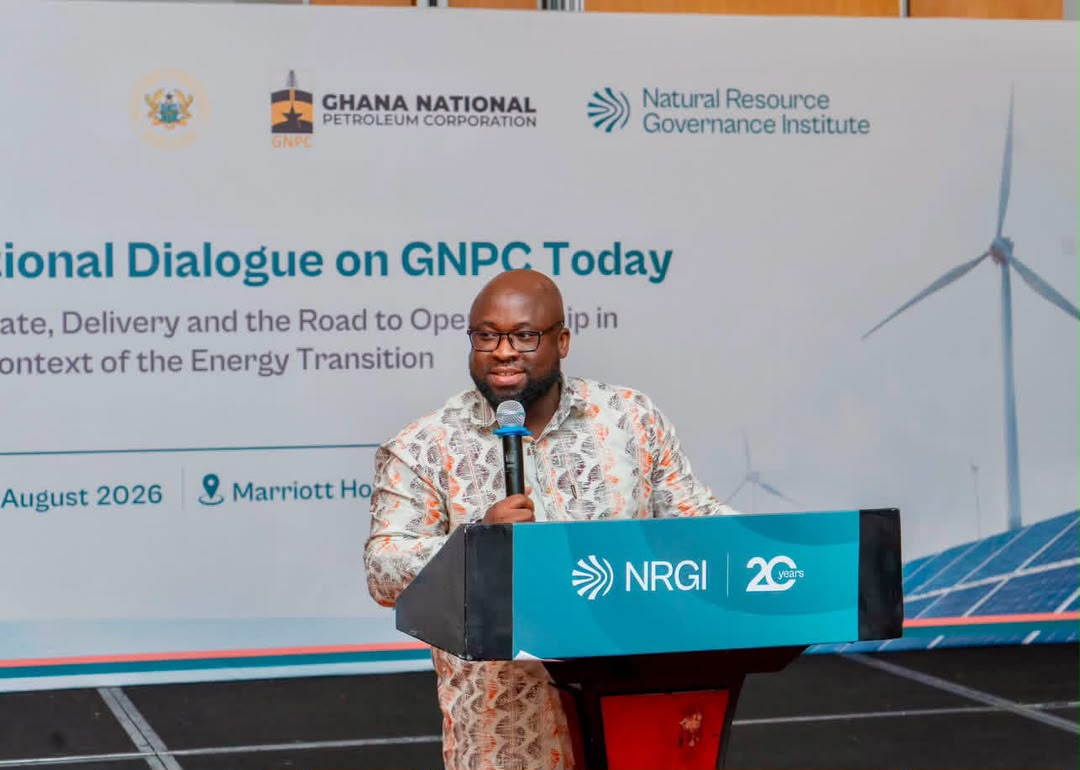
That question featured prominently at the GNPC Today stakeholder dialogue, where civil society, government, financial-sector representatives and GNPC management examined the Corporation’s transformation strategy against the realities of Ghana’s petroleum sector and the global energy transition.
The discussion moved beyond exploration and production to financing architecture, corporate social responsibility expenditure, cash-flow management, governance, operatorship and the Corporation’s ability to remain financially resilient.
Kodzo Yaotse, Head of Petroleum at the Africa Centre for Energy Policy (ACEP), raised questions around the financial framework underpinning GNPC, including the use of corporate resources and the mechanisms through which petroleum-related cash flows are distributed.
Among the figures discussed was an estimated US$160.74 million in CSR spending between 2018 and 2025, prompting questions about how such expenditure should be assessed against GNPC’s commercial and national obligations.
The issue is not simply whether CSR expenditure is legitimate.
For a national oil company operating in a resource-constrained economy, every dollar deployed outside core exploration, production, technical capability and financial sustainability raises the question of opportunity cost.
The Cash Flow Question
The dialogue also examined GNPC’s cash waterfall arrangements and the broader financing architecture supporting the Corporation.
Cash-flow management is particularly important for a national oil company pursuing operatorship because exploration and production require large amounts of capital long before returns are realised.
A commercially ambitious GNPC therefore needs sufficient access to capital to finance exploration and development without creating unsustainable obligations for the state.
That makes the structure of its financing particularly important.
A national oil company can become financially vulnerable when commercial investments, public obligations and policy-directed expenditure are mixed without clear rules governing how each should be funded.
The governance debate consequently cannot be separated from the operatorship agenda.
GNPC’s official strategy identifies financial independence as one of its core objectives, while the Corporation has stated that its operatorship drive is intended to build technical strength, commercial efficiency and financial independence.
The policy question is whether the institutional framework can support those objectives while maintaining adequate public oversight.
From State Corporation To Public Asset
The strongest governance argument emerging from the dialogue was that GNPC should not be understood merely as a state-owned company.
GNPC Deputy Chief Executive for Exploration and Production, Michael Aryeetey, called for continued engagement with civil society and recognised the role of civil society organisations in challenging assumptions and contributing ideas to the Corporation’s transformation.
“Civil society organisations have an important role to play in interrogating the issues, contributing ideas and helping shape the conversations that will move Ghana’s petroleum sector forward.”
GNPC Deputy Chief Executive for Exploration and Production, Michael Aryeetey
The same principle was reflected in the Corporation’s broader message that GNPC represents a national interest rather than the interests of a single asset or project.

That distinction becomes particularly important when considering controversies surrounding petroleum-sector revenue flows and state-owned entities.
The discussion also touched on the JOHL controversy, reinforcing the need for clear boundaries between GNPC’s commercial activities, petroleum revenue management and the state’s wider fiscal architecture.
For Ghana, governance arrangements must therefore evolve alongside GNPC’s commercial ambitions.
Greater commercial freedom without stronger accountability could expose the state to greater financial risk.
Conversely, excessive bureaucratic restrictions could prevent GNPC from competing effectively for opportunities in an increasingly capital-intensive global industry.
The balance is difficult but unavoidable.
Can GNPC Remain Relevant Beyond Oil?
The energy transition introduces another layer of complexity.
GNPC’s core strategic emphasis remains exploration and production, but its published strategy for the later phase of its operatorship programme includes research and development in low-carbon technologies and renewables.
That creates an important strategic question for the Corporation.

During the dialogue, the question was put directly: if GNPC’s core mandate remains petroleum exploration and production, while its longer-term strategy identifies low-carbon technologies and renewables, what is the intended pathway for moving from an upstream-focused national oil company to one that remains commercially relevant in Ghana’s post-oil energy system?
There is no simple answer.
Moving too aggressively away from petroleum could weaken GNPC’s ability to maximise value from resources that Ghana still possesses.
Moving too slowly could leave the Corporation exposed if petroleum demand, investment and financing conditions change faster than expected.
GNPC’s existing strategy appears to favour an evolutionary approach rather than an immediate abandonment of petroleum.
The Corporation intends to strengthen its upstream operating capability while incorporating low-carbon technologies and renewables into research, innovation and longer-term strategic development.
That approach has some logic.
Ghana still needs petroleum and natural gas to support fiscal revenues, industrial activity and electricity generation, while renewable energy investment can progressively diversify the energy mix.
The strategic challenge is making sure that diversification does not become a collection of disconnected projects.
The Law Cannot Replace Institutional Discipline
Benjamin Boakye, Executive Director of ACEP, added a sharper governance dimension to the discussion, warning in his closing remarks that legislation alone cannot guarantee responsible institutional behaviour.
His observation that “the law does not regulate common sense; it regulates misbehaviour” captured a broader concern raised throughout the dialogue: strong laws are necessary, but they cannot substitute for institutional judgement, transparency and professional discipline.

For GNPC, that principle is particularly relevant as the Corporation seeks greater operatorship and commercial independence.
The more capital GNPC controls, the greater the importance of procurement discipline, investment scrutiny, risk management, anti-corruption systems and transparent reporting.
The Corporation has also indicated that it has an anti-corruption policy, while its broader reform agenda includes strengthening governance and accountability.
GNPC has previously said internal and special audits are part of efforts to reinforce accountability.
The challenge is to ensure that these mechanisms become embedded in decision-making rather than remaining formal compliance instruments.
Ghana is entering a decisive period for its national oil company.
Production from mature petroleum assets is under pressure, exploration needs fresh capital, gas remains critical to electricity supply, and the energy transition is changing the investment environment.
GNPC therefore has to become more technically capable, more commercially disciplined and more financially resilient at the same time that expectations around public accountability are increasing.
That is the real significance of the GNPC Today dialogue.
The conversation was not simply about whether GNPC should become an operator.
It was about what kind of national oil company Ghana needs when petroleum resources are finite, capital is expensive and the energy system is changing.
The strongest answer is unlikely to be found in expanding GNPC for its own sake.
It will be found in building a national oil company capable of taking calculated risks, attracting credible partners, protecting public value and eventually deploying the technical and financial capabilities developed through petroleum into a broader energy future.
READ ALSO: SIC Insurance Shareholders Set for GH¢20m Dividend Windfall As Profit Hits GH¢84m