Israel has barred Green Party leader Zack Polanski from entering the country after members of the Green Party of England and Wales voted to formally adopt an anti-Zionist policy.
The decision by Israel came shortly after Green Party members voted 1,022 to 813 at the party’s conference in Brighton to adopt a motion defining Zionism as an ethnonationalist political ideology and supporting the establishment of a single democratic Palestinian state across historic Palestine.
The party subsequently confirmed that the motion had become official Green Party policy.
Israel’s Foreign Ministry described the motion as a “clear antisemitic text” and described the Green Party position as “a stain on the history of the United Kingdom.”
The ban places Polanski, a Jewish leader of a British political party who describes himself as anti-Zionist, at the centre of an international dispute that has increasingly exposed divisions within Britain over the Israel-Palestine conflict.
Polanski did not participate in the vote. He had left the Brighton conference early to campaign in the Holborn and St Pancras by-election, where he is seeking election as the Green Party candidate.
The controversy is rooted in competing understandings of Zionism itself. According to the Green Party motion, Zionism represents an ethnonationalist political project that has been associated with the displacement and dispossession of Palestinians.
The adopted motion argues that “the real, material, manifestation of Zionism has been the historic and ongoing dehumanisation, displacement, dispossession, disenfranchisement and destruction of Palestinians.”
The party’s official statement following the vote indicated that its policy defines Zionism as an ethnonationalist political project and maintains that opposition to Zionism should not be equated with antisemitism.
It also reaffirmed the party’s support for Palestinian self-determination, the right of return, Boycott, Divestment and Sanctions and a full arms embargo on Israel.
Critics, however, argue that the motion collapses a complex political and historical identity into a definition that risks treating Jewish people who identify as Zionists as inherently racist.
The Board of Deputies of British Jews and the Jewish Leadership Council described the motion as an “attack on the Jewish community.”
“Zionism is anti-racism, creating a refuge for Jews in their ancient homeland after millennia of persecution outside it.
“Branding most British Jews and Jewish institutions ‘racist’ stokes anti-Jewish hatred after a year in which British Jews have been murdered attending their synagogue, stabbed in the streets, and seen their community buildings firebombed.”
The Board of Deputies of British Jews and the Jewish Leadership Council
Green Party Divided Over Israel and Palestine
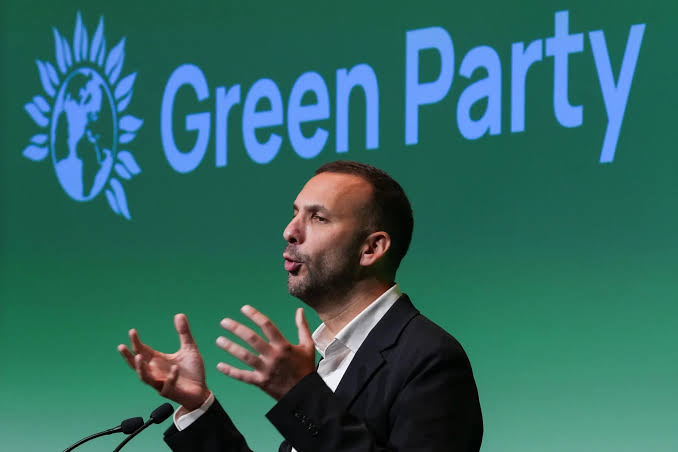
The vote has exposed significant divisions within the Green Party itself, particularly between its rapidly expanding membership and several of the MPs and senior figures who have publicly opposed or sought changes to the motion.
Four of the party’s five MPs, Ellie Chowns, Adrian Ramsay, Carla Denyer and Sian Berry, opposed the motion, with Denyer warning that the wording could alienate a significant proportion of Jewish people. Chowns and former Green Party leader Caroline Lucas also spoke against the proposal during the conference debate.
“I urge you not to support the over-simplification at the heart of this motion – a refusal to accept complexities which is leading to so many Jewish members feeling scared and unwelcome in our party.”
Meanwhile, Deputy leader Mothin Ali supported the motion and argued that its objective was the creation of a democratic political system guaranteeing equal rights.
He indicated that it is calling for “a state that’s democratic, that guarantees the rights of every single person living on that land.”
Ali also stressed that he was “absolutely not” describing all Jewish people who identify as Zionists as racist.
His fellow deputy leader, Rachel Millward, took a different position, describing the motion in its original form as “problematic” and supporting amendments designed to protect Jewish members.
Polanski himself had attempted to navigate between those competing positions.
Asked about the motion before the vote, he stated that: “If your Zionism is the displacement of the Palestinian people then that is clearly racist, and I say that as a Jewish leader of a British political party.”
At the same time, Polanski opposed the motion’s call for a single Palestinian state in its existing form, arguing that neither the Green Party nor the British government should determine the final political settlement.
He also wanted the motion amended to make clear that Jewish members should not face disciplinary action simply because they attended synagogues that described themselves as Zionist.
On the other hand, Vivien Lichtenstein, Chairperson of Jewish Greens, noted that she is considering her future in the party following the vote.
The Conservatives argued that the vote demonstrated that the Green Party is “toxic to its core.”
Labour Chairperson Bridget Phillipson indicated that the vote “crosses a line” and called on Polanski to clarify whether the new position would remain the party’s policy.
She added that, “it is shameful to vote against a two-state solution for Israel and Palestine and to condemn the vast majority of British Jews and Jews around the world as racist for supporting Israel’s right to exist.”
Liberal Democrat MP Luke Taylor also criticised the motion, arguing that it failed to address the threats posed by both Islamophobia and antisemitism in Britain.
READ ALSO: GoldCoast Resource Corp Deal to Cover 53% of Ghana’s total offshore coastline