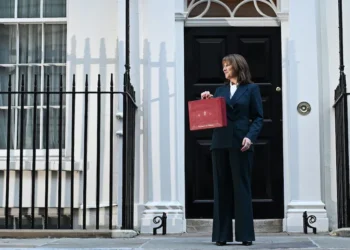
Rachel Reeves has launched a robust defense of her economic strategy, dismissing claims that recent financial market turbulence is a “crisis made in Downing Street” and calling on her critics to “get real.”
The Chancellor faced intense questioning from MPs after the cost of government borrowing surged and the pound’s value fell, putting her financial plans at risk. In response, Reeves acknowledged the need to push “further and faster” in pursuing economic growth.
Despite reaffirming her commitment to the government’s fiscal rules, Reeves did not rule out potential spending cuts, stating she would not draft “five years of budgets in the first six months of a Labour government.”
The fiscal rules mandate that day-to-day expenses must be covered by revenue, not borrowing. However, increasing borrowing costs could compel Reeves to cut spending or raise taxes to stay within these constraints when the budget watchdog updates its forecast in March.
Reeves contended that the rise in bond yields was not unique to the UK, pointing out similar trends in the US, Germany, and France. “I do not believe it is reasonable to suggest that the reason why bond yields in these countries have risen is because of decisions now by this government,” she asserted.
Reeves rebuffed Tory MP Luke Evans, who questioned her understanding of delivering growth in the UK, urging him to “get real.” The Chancellor’s defense comes amid growing calls for her resignation, with her Tory counterpart, Mel Stride, likening her predicament to a Shakespearean tragedy: “To go or not to go? That is now the question.”


Prime Minister Sir Keir Starmer faces mounting pressure to dismiss Reeves, though Downing Street has insisted she will remain chancellor “for the whole of this parliament.” This assurance followed Starmer’s reluctance to confirm her position beyond the next election.
Criticism Over China Trip
Reeves also faced scrutiny over her recent trip to China, with Stride questioning her absence during economic turmoil.
He criticized the government’s handling of the economy, citing a weakened pound, high borrowing costs, stagnant growth, rising inflation, and plummeting business confidence. “This is a crisis made in Downing Street,” Stride declared.
Defending her visit, Reeves argued that “leadership is not about ducking these challenges, it is about rising to them.” She emphasized the importance of her trip to China, asserting that engagement with the world’s second-largest economy is crucial. “Not engaging with China is simply not an option,” she said, linking economic growth with national security.
Reeves highlighted that her visit allowed her to address human rights concerns, including the case of detained British national and pro-democracy activist Jimmy Lai.
Her comments followed criticism from Liberal Democrat Treasury spokeswoman Daisy Cooper, who argued that the chancellor should have secured a commitment for Lai’s release before visiting China.
“I’m not sure how the honourable lady thinks we’re going to raise difficult issues unless we engage with the second-biggest economy in the world. And because I went to China, I was able to raise issues around human rights, forced labour, Hong Kong, and Jimmy Lai, and around the sanctioning of parliamentarians. You can’t raise those issues unless you are in the room.”
Rachel Reeves
Reeves concluded her remarks by stressing the urgency of her economic plan.
“The economic headwinds remind us we must go further and faster to kickstart economic growth. If we get it right, the prize for the British people is immense – the opportunity to make working people better off by making Britain better off. That is the mandate this government has, and this is what we will deliver.”
Rachel Reeves
As such, Reeves’ steadfast defense of her economic strategy, amid both domestic and international challenges, underscores her commitment to steering the UK towards financial stability and growth. Her focus on maintaining fiscal discipline while engaging with global partners like China reflects her broader vision for a resilient and thriving economy.
READ ALSO: FDA Embarks on Education to Promote Smoke-Free Environment