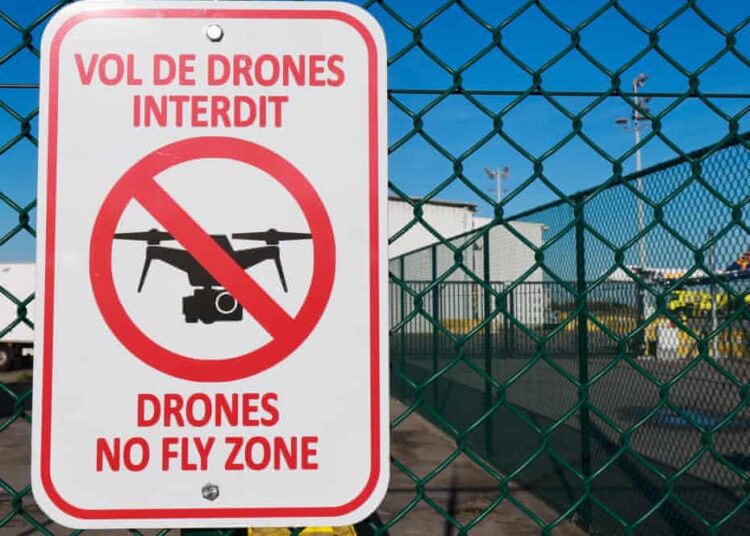
The UK is sending military equipment and personnel to Belgium to help the country combat drone threats, after a spate of disruptive drone sightings forced the temporary closures of two major airports.
Air Chief Marshal Richard Knighton disclosed that the military had agreed to “deploy our people, our equipment to Belgium to help them” after a request from Belgian authorities.
“We don’t know – and the Belgians don’t yet know – the source of those drones, but we will help them by providing our kit and capability, which has already started to deploy to help Belgium.”
Air Chief Marshal Richard Knighton
Knighton did not give details about what sort of equipment would be sent or how many personnel but said that he was “very happy” to act in support of a NATO ally.
In the past week, both Belgium’s main international airport at Brussels and one of Europe’s biggest cargo airports at Liege were forced to close temporarily because of drone incursions.
That came after a series of unidentified drone flights near a United States military base in Belgium where nuclear weapons are stored.

Drone sightings also forced the temporary closures of airports in other countries, including Sweden, on Thursday. The Belgian government held an emergency meeting to address the drone sightings.
Knighton said that it was not known yet who was behind the drone sightings but noted Russia has been involved in a pattern of “hybrid warfare” in recent years.
Russia has been blamed in some cases, but Belgium has not said who has been operating the drones. Russia has denied any connection with the incidents, and there has been no evidence to directly link the drones to Russia.
Belgian Defence Minister, Theo Francken said that he believed some incidents were part of “a spying operation” that could not have been done by amateurs.
Drone incidents have also caused major disruptions across Europe in recent months amid deepening concerns that Russia’s war in Ukraine might spill across Europe’s borders.
Since September, drones have been spotted near civilian airports and military facilities in countries including Denmark, Germany and Norway.
European Commission President, Ursula von der Leyen has called the incursions “hybrid warfare.” While she did not hold Russia responsible for the incidents, she said that it was clear Russia’s aim was to “sow division” in Europe.
In September, Polish and NATO forces shot down drones violating the country’s airspace during a Russian aerial attack on neighbouring Ukraine.
UK Points To Strength In NATO Alliance
In a statement, UK Defence Secretary, John Healey said, “As hybrid threats grow, our strength lies in our alliances and our collective resolve to defend, deter and protect our critical infrastructure and airspace.”
Germany announced last week that it had sent specialist assistance, and Belgian authorities said that France had followed suit. The UK’s help is expected to come from the Royal Air Force’s dedicated counter-uncrewed aerial systems unit.
Last week, Boris Pistorius, the German Defence Minister said that he believed the drone incursions were “likely connected with the fight over the use of Russian frozen assets held by Belgium.”

EU and UK politicians have been discussing how to release Russian central bank assets, held mostly in Belgium, to support a €140bn (£120bn) loan to Ukraine.
Belgium is home to the headquarters of NATO and the European Union as well as Europe’s biggest financial clearinghouse, holding tens of billions of euros in frozen Russian assets.
Many EU countries want to use those assets as collateral to provide loans to Ukraine, but Belgium has so far resisted.
READ ALSO: Mahama Announces Financial Commitment as Feasibility Study for New Green-Smart City Nears Completion