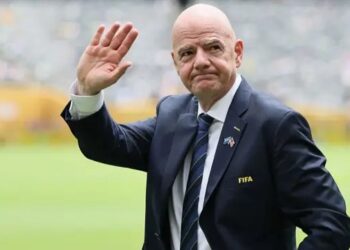
FIFA has launched a forceful defence of President Gianni Infantino amid growing opposition to his leadership, insisting that any attempt to challenge his position must follow the organisation’s established democratic procedures and statutes.
The world football governing body says Infantino retains the mandate given to him by FIFA’s 211 Member Associations and has rejected suggestions that his presidency can be undermined through public pressure, allegations or political manoeuvring outside the organisation’s formal structures.
Infantino has faced intense backlash in recent weeks after the 2026 FIFA World Cup, particularly following his controversial FIFA Forward Enterprise (FFE) proposal, which sought to create a new commercial structure to oversee major FIFA assets and attract outside investment. Although FIFA ultimately abandoned the proposal, the controversy has deepened tensions between the president and several of the organisation’s most powerful stakeholders.

UEFA has emerged as Infantino’s most vocal critic. European football’s governing body has maintained that the withdrawal of the FFE proposal has not restored its confidence in the FIFA president, while European associations have continued to question his leadership.
UEFA has also warned of the possibility of boycotting FIFA-organised competitions, including the men’s and women’s World Cups, if the dispute escalates.
The European opposition stands in contrast to the support Infantino continues to receive from other confederations. CAF and CONMEBOL have backed his continuation in office, while individual associations, including the Royal Moroccan Football Federation, have also expressed support.
FIFA’s latest statement released in the evening of Saturday, August 8, therefore comes against the backdrop of a widening divide over Infantino’s leadership and the direction of the organisation.
FIFA Rejects Attempts To Undermine Infantino
FIFA argued that the president’s position is rooted in a legitimate democratic mandate and warned against efforts to achieve through public campaigns what cannot be secured through established electoral channels.
“FIFA will not support, facilitate or tolerate any process concerning the election of the FIFA President that is inconsistent with FIFA’s Statutes, democratic procedures and established governance framework.”
FIFA
FIFA added that Infantino was “democratically elected by FIFA’s Member Associations” and remains in office with their mandate. The governing body suggested that criticism of the president should not be confused with attempts to circumvent the formal mechanisms through which FIFA leadership is determined.
The statement also accused some of Infantino’s opponents of engaging in a sustained campaign to damage both the president and the institution he leads. FIFA said it had become increasingly clear that there was “a concerted and ongoing effort by some to undermine FIFA and its President.”
It further argued that individuals or organisations without sufficient support among FIFA’s membership should not attempt to secure political outcomes through allegations and misinformation.
FIFA was particularly critical of recent media coverage, claiming that some reports had relied on assertions that were either unsubstantiated or demonstrably false.
The organisation insisted that repeated claims do not automatically become credible simply because they are circulated widely. “Speculation and insinuation should not be presented as fact, and repetition does not make an allegation true,” FIFA stated.
Governing Body Vows To Challenge Inaccurate Reporting
FIFA also sought to place Infantino’s leadership in the context of his long involvement in football, pointing to more than three decades of professional work in European and international football.
According to the organisation, Infantino has played a role in expanding access to football, resources and opportunities across different parts of the world. FIFA acknowledged that the changes introduced under his leadership have challenged established interests, but argued that disagreement with those reforms does not justify attempts to weaken his democratic mandate.
“Change inevitably challenges established interests,” FIFA said, while insisting that opposition to change cannot be used to undermine either the president or FIFA itself.
The governing body maintained that it accepts legitimate scrutiny but drew a distinction between criticism based on facts and reporting it believes is designed to create distractions. “FIFA welcomes legitimate scrutiny,” the statement said. “But scrutiny is not a licence to distort facts, amplify unsubstantiated allegations or manufacture distractions designed to undermine progress.”
FIFA also promised a more aggressive response to inaccurate reporting, declaring that where coverage is misleading, it will “challenge it directly and vigorously.”
The statement ultimately framed the dispute as one extending beyond Infantino personally, arguing that FIFA’s responsibility lies with its 211 Member Associations and football globally.
“We will not be distracted or diverted from strengthening the organisation, delivering for our Member Associations and continuing the work of making football truly global”
FIFA
With UEFA maintaining its opposition and the FFE controversy continuing to cast a shadow over Infantino’s presidency, FIFA’s latest intervention signals that the organisation has no intention of allowing external pressure to determine its leadership. Instead, it is insisting that any challenge to Infantino must be settled through FIFA’s established democratic process.