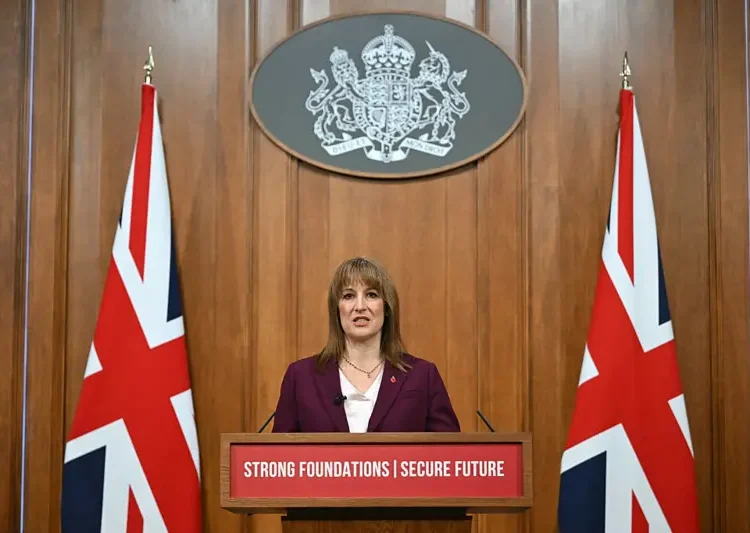
Chancellor Rachel Reeves has asserted that she will make “the choices necessary to deliver strong foundations for the economy,” stating that Britain’s priorities are protecting the NHS, bringing down national debt and the cost of living.
This came as she delivered an unusual pre-Budget speech at a news conference just three weeks before the Budget.
Reeves’s Autumn Budget statement will outline the government’s plans for raising or cutting taxes. It also includes big decisions about spending on public services such as health, education and police. The statement will be made to MPs in the House of Commons on Wednesday, November 26, 2025.
Continuing her speech, Reeves stressed that she believes the principles guiding her choices for the Budget are “right” for the country. “We are a country with considerable economic strength,” she said.

Reeves criticise of the previous Tory government, accusing them of having overseen years of “economic mismanagement.” Reeves said that she is dealing with a £22bn black hole left by the previous government and put public finances back on a “firm footing.”
The British Chancellor noted that since the last Budget, the world has “thrown more challenges our way.” Reeves named tariffs and “slow to come down” inflation as two examples.
Reeves pointed out that the cost of government borrowing has also increased around the world. She added that there have been spending pressures too, she says, including the need to increase defence spending to “protect ourselves from hostile actors” and “protect allies.”
Also, Reeves noted that the welfare system needs reform, adding that there is “nothing progressive” about maintaining a system where one in eight young people are out of education or employment.

Reeves iterated longer-term problems, saying that it is “already clear” that the productivity problem “inherited” from the previous government is “worse than previously thought.”
Reeves noted that the causes of the UK’s economic “underperformance are well understood,” adding that the “chronic stop-go cycle” of investment is detrimental.
She commented on austerity policies under previous governments, calling them a “hammer blow” to the UK’s economy and “gutted” the country’s public services. “The years that followed were characterised by instability and indecision,” she added, saying that previous governments delivered a “rushed and ill-conceived Brexit” and meant the UK was “underprepared” for the COVID pandemic.
Reeves said that she decided to make tax and spending decisions to “get debt down and to fund our public services sustainably” when she became Chancellor.
She talks about various measures taken: crowding in private investment, roads and rail, nuclear power, ripping up planning rules to promote house building, a new visa regime, signing trade deals abroad. Though falling interest rates show results, she said, “real progress takes time.”
Reeves said that she doesn’t expect anyone to be satisfied with economic growth of 1%. “I’m not,” she stated, adding, “That’s why the measures in this month’s Budget will focus on reducing inflation.”
Reeves disclosed that £1 in every £10 of taxpayers money is spent on debt interest. “Not paying that debt down, but just paying the interest,” she said. She stated that the UK’s national debt now stands at £2.6tn – or 94% of the national income.
Reeves Vows To Deliver On Priorities Of British People
Moreover, Reeves stressed that she will continue to deliver on the priorities of the British people in her Budget including cutting NHS waiting lists, national debt and the cost of living.
Stating that the Budget will be for growth “with fairness at its heart,” The Chancellor pledged to do what’s necessary to protect families from high inflation and interest rates, and the country’s public services “from a return to austerity.”
She said, “Our past does not have to determine our future,” noting that the government was elected “to break with the cycle of decline” and will now go further and faster to deliver growth.
Reeves added that the budget will deliver “a Britain with an economy that works for everyone.”