

• About
  • Advertise
  • Privacy Policy
  • Contact
Tuesday, July 14, 2026
  • Login
The Vaultz News
  • Top Stories
  • News
    • General News
    • Education
    • Health
    • Opinions
  • Economics
    • Economy
    • Finance
      • Banking
      • Insurance
      • Pension
    • Securities/Markets
  • Business
    • Agribusiness
    • Vaultz Business
    • Extractives/Energy
    • Real Estate
  • World
    • Africa
    • America
    • Europe
    • UK
    • USA
    • Asia
    • Around the Globe
  • Innovation
    • Technology
    • Wheels
  • Entertainment
  • 20MOBPL2DNew
  • Jobs & Scholarships
    • Job Vacancies
    • Scholarships
No Result
View All Result
The Vaultz News
  • Top Stories
  • News
    • General News
    • Education
    • Health
    • Opinions
  • Economics
    • Economy
    • Finance
      • Banking
      • Insurance
      • Pension
    • Securities/Markets
  • Business
    • Agribusiness
    • Vaultz Business
    • Extractives/Energy
    • Real Estate
  • World
    • Africa
    • America
    • Europe
    • UK
    • USA
    • Asia
    • Around the Globe
  • Innovation
    • Technology
    • Wheels
  • Entertainment
  • 20MOBPL2DNew
  • Jobs & Scholarships
    • Job Vacancies
    • Scholarships
No Result
View All Result
The Vaultz News
No Result
View All Result
in General News

Desk Deficit Imperils Ghana’s Quality Education Goals

Evans Junior Owuby Evans Junior Owu
March 25, 2024
Reading Time: 4 mins read
School Children in Gushegu Municipality, Northern Region

School Children in Gushegu Municipality, Northern Region

In a stark revelation of the challenges plaguing Ghana’s education sector, it has come to light that over one million desks are lacking in the country’s basic education subsector.

Despite successive governments prioritizing basic education, Ghana finds itself grappling with a profound infrastructure deficit, particularly in the provision of essential furniture like desks.

There are also more than 5,000 basic schools resorting to makeshift arrangements under trees, sheds, and dilapidated structures, leaving the very foundation of quality education in the country under threat.

According to recent findings from Africa Education Watch, the desk shortage crisis disproportionately affects regions in the northern part of Ghana, with all six regions exhibiting ratios above the national average.

ADVERTISEMENT

The implications are profound, as evidence involves staggering statistics including 50% of kindergarten pupils, 40% of primary pupils, and 30% of junior high school pupils who lack proper seating and writing places.

This translates to a shocking 40% of basic school pupils nationwide, facing the challenge of studying in environments not conducive to learning.

“Recent data available through the Ministry of Education’s (MoE) Education Management Information System (EMIS) suggests that as of 2021, 50 per cent (596,949) KG pupils, 40 per cent (1,308,479) primary pupils and 30 per cent (425,465) JHS pupils did not have seating and writing places, bringing the total to 2,330,893, representing 40 per cent of basic school pupils”.

Africa Education Watch, 2024

The impact of the desk deficit extends far beyond mere discomfort, as according to the report, students are forced into improper sitting postures, leading to postural overload and hindering their performance in crucial classroom activities such as writing and reading.

Such physical discomfort not only impedes learning but also jeopardizes the overall academic performance of these students.

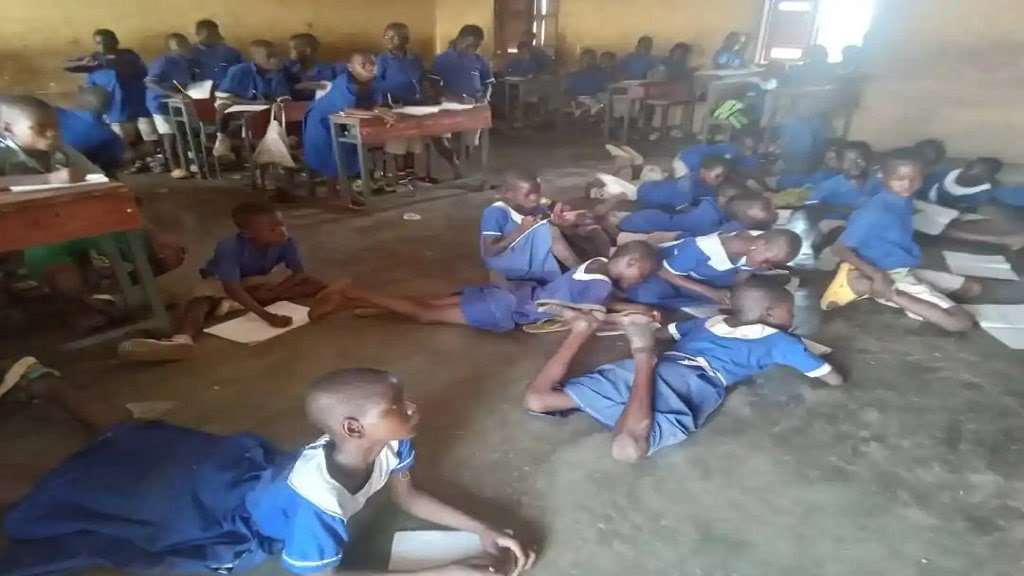
In places like the Gushegu Municipality in the Northern Region, the report revealed that over sixty per cent of schools face desk deficits with several primary school children in the Municipality crammed onto dual desks, with many resorting to sitting on the floor or lying on their bellies to take lessons.

ADVERTISEMENT

At the junior high level, the report showed that the situation worsens, with teachers lamenting the frustration and academic impediments caused by the lack of proper furniture.
Basic School
Some Basic School Pupils In Gushegu Municipality, Northern Region

Furthermore, in places like the Kintampo North Municipality in the Bono East region, the Africa Education Watch’s report showed that the desk crisis in the public basic schools is at a greater height, with some students compelled to buy their own tables and chairs or resort to standing or sitting on windows to write.

It is without doubt that this shortage of desks in the public basic schools across the country not only obstructs access to education but also undermines the quality of learning, thereby hindering the country’s progress towards achieving the Sustainable Development Goal (SDG) on quality education.

ADVERTISEMENT

Desk Deficit Perpetuates Inequalities

Moreover, the desk deficit not only undermines Ghana’s progress towards the Sustainable Development Goal on quality education (SDG 4), which aims to ensure inclusive and equitable quality education for all but also perpetuates inequalities and impedes socio-economic development.

While commendable efforts from the government and some non-governmental organizations like the Star-Ghana Foundation have been made to address the deficit, they fall short of meeting the overwhelming need.

There is therefore the need for an urgent government intervention to address this pressing issue.

The timely disbursement and release of allocated funds, such as the GETFund’s GHS 800 million proceeds earmarked for basic education in the 2024 Budget which has been approved by Parliament is crucial step that must be taken by the government to alleviate the desk deficit syndrome in public schools.

As the custodians of Ghana’s educational aspirations, the government must heed the call to action. Failure to address the desk deficit undermines the fundamental right to quality education for every Ghanaian child and jeopardizes the nation’s pursuit of Sustainable Development Goal four on quality education.

It’s time for decisive and concerted efforts to ensure that every student has access to a conducive learning environment, thereby paving the way for a brighter future for all.

READ ALSO: EduWatch Bemoans The Declining Rate Of Education Financing In Ghana

ADVERTISEMENT

Sign Up to Our Newsletter

Fresh updates, Straight to your inbox

Tags: Africa Education Watchbasic educationdesk deficitGhana Education Trust Fund (GETFund) levyPublic Basic Schools
ShareTweetShareSendSend
Please login to join discussion
Previous Post

Ghana’s Economy ‘on a Treadmill’

Next Post

Sand Dams Tackle Kenya’s Drought Crisis

Related Posts

Basic School Children   in Ghana receiving instructions from their teacher
General News

One in Three Districts in Ghana Faces Severe Teacher Shortages, Report

July 14, 2026
Foster Buabeng (CEO/Fund Administrator)
General News

Teachers’ Fund Directs Members to Verify Names Across Official Records

July 14, 2026
Honourable Nana Agyei Baffour Awuah
General News

Tribunal Bill Not Practicable, Expensive And Could Delay Hearings— Awuah

July 14, 2026
Deputy Director General of GES in charge of Management Services Professor Smile Gavua Dzisi
General News

GES Rollout Practical Entrepreneurship Programme for SHS Students

July 13, 2026
ADVERTISEMENT

Sign Up to Our Newsletter

Fresh updates, Straight to your inbox

ADVERTISEMENT

Recent News

Seal of United States Central Command.svg

US Strikes Iran Again Amid Hormuz Strait Standoff

July 14, 2026
Basic School Children   in Ghana receiving instructions from their teacher

One in Three Districts in Ghana Faces Severe Teacher Shortages, Report

July 14, 2026
CalBank Profit Soars 25% to GHS353.6 Million in Strong First Half Performance CalBank PLC has delivered an impressive financial performance for the first half of 2026, posting a remarkable 25 percent increase in Profit Before Tax (PBT) to GHS353.6 million. The outstanding results highlight the bank's successful strategic transformation and underline its growing strength as one of Ghana's leading financial institutions. The latest figures show that Profit Before Tax climbed from GHS283.2 million in the corresponding period of 2025 to GHS353.6 million, driven by robust growth across the bank's core business operations. The performance reflects improvements in lending, customer deposits, fee based services, trading income, and overall operational efficiency. Unlike previous periods where earnings were significantly supported by impairment recoveries, CalBank's latest results demonstrate that its profitability is now being powered largely by the strength of its underlying banking business. Core Banking Business Drives Exceptional Earnings One of the biggest highlights of the first half performance was the remarkable growth in net interest income, which surged by 83 percent to GHS347.5 million. The increase came despite a relatively lower interest rate environment. Interest income rose from GHS399 million to GHS451.5 million as the bank continued expanding its earning assets. At the same time, funding costs fell sharply, with interest expenses dropping from GHS209 million to GHS104 million. This significant reduction in funding costs improved the bank's profitability and demonstrated stronger balance sheet management. CalBank also recorded exceptional growth from non interest income sources as it continued diversifying its revenue streams. Net fees, commissions, and trading income almost doubled, rising by 99 percent to GHS323.3 million from GHS162.7 million during the same period last year. The strong performance reflects increased customer activity across the bank's retail, commercial, and corporate banking segments. The diversified earnings profile places CalBank in a stronger position to withstand changing market conditions while maintaining sustainable profitability. Stronger Earnings Quality Boosts Investor Confidence Perhaps the most significant aspect of CalBank's results is the improved quality of its earnings. During the first half of 2025, impairment recoveries contributed approximately GHS154 million to profits. However, in the latest reporting period, impairment gains accounted for only GHS7 million. This means the overwhelming majority of profits were generated through normal banking operations rather than one off recoveries. The shift highlights the success of management's transformation strategy and provides greater confidence that future earnings will remain sustainable. Industry analysts often view recurring operating income as a stronger indicator of long term financial health than exceptional gains. Assets and Deposits Record Strong Expansion CalBank also recorded significant growth in its balance sheet during the period. Total assets expanded by 30 percent to GHS13.9 billion from GHS10.7 billion recorded at the end of June 2025. Customer deposits increased by the same margin, rising to GHS10.9 billion. The growth in deposits reflects increasing customer confidence in the bank's brand, improved service delivery, and expanding retail and commercial banking operations. Higher deposits also provide the bank with a stable funding base to support future lending and business expansion. The figures reinforce CalBank's growing position within Ghana's competitive banking industry. Bad Loans Decline Dramatically One of the most remarkable achievements during the first half of the year was the dramatic improvement in asset quality. The bank's Non Performing Loan ratio dropped sharply to 10.10 percent from an exceptionally high 51.60 percent recorded at the end of June 2025. The improvement reflects the successful execution of CalBank's balance sheet remediation programme and disciplined credit risk management practices. A healthier loan portfolio reduces future credit losses while creating additional room for prudent loan growth. The significant decline in bad loans also strengthens investor confidence and enhances the bank's overall financial stability. Capital Position Strengthens After Recapitalisation Following its successful recapitalisation in 2025, CalBank has continued strengthening its financial foundation. Its Capital Adequacy Ratio improved dramatically to 18.17 percent from a negative 7.6 percent recorded a year earlier. The turnaround highlights the success of the bank's recapitalisation efforts and demonstrates its renewed financial resilience. Strong liquidity levels further position the bank to support customers, finance new business opportunities, and meet future regulatory requirements with confidence. The improved capital position also creates greater flexibility for expansion while protecting shareholders against unexpected financial shocks. Management Confident of Even Better Results Commenting on the results, Managing Director Carl Selasi Asem described the first half performance as clear evidence that CalBank's transformation strategy is producing sustainable financial outcomes. He said the bank had achieved strong growth across its core businesses while improving funding efficiency, strengthening profitability, enhancing asset quality, reinforcing its capital base, and expanding its balance sheet. Mr. Asem stressed that the latest earnings were driven by the strength of the bank's underlying operations rather than one time recoveries, reinforcing the quality and sustainability of the results. Looking ahead, he expressed confidence that the momentum built during the first half would enable CalBank to deliver an even stronger performance during the remainder of 2026. Management says the bank remains committed to disciplined execution of its strategic priorities, strengthening customer relationships, maintaining prudent risk management, and creating sustainable long term value for shareholders. CalBank's Transformation Continues to Deliver CalBank's latest financial performance paints the picture of a bank that has successfully rebuilt its foundations and is entering a new phase of sustainable growth. With rising profits, stronger capital, expanding customer deposits, healthier assets, and significantly lower bad loans, the bank appears well positioned to compete aggressively within Ghana's banking sector. As economic conditions continue to improve, CalBank's focus on operational excellence and disciplined execution could make 2026 one of the strongest years in the institution's recent history. READ ALSO: GSE Opens Week with Explosive Trading Activity CalBank Profit Soars 25% to GHS353.6 Million in Strong First Half Performance

CalBank Profit Soars 25% to GHS353.6 Million in Strong First Half Performance

July 14, 2026
Foster Buabeng (CEO/Fund Administrator)

Teachers’ Fund Directs Members to Verify Names Across Official Records

July 14, 2026
GSE Opens Week with Explosive Trading Activity

GSE Opens Week with Explosive Trading Activity

July 14, 2026
ADVERTISEMENT
Next Post
A sand dam under construction in Kenya

Sand Dams Tackle Kenya's Drought Crisis

The Vaultz News

Copyright © 2025 The Vaultz News. All rights reserved.

Navigate Site

  • About
  • Advertise
  • Privacy Policy
  • Contact

Follow Us

Welcome Back!

Login to your account below

Forgotten Password?

Retrieve your password

Please enter your username or email address to reset your password.

Log In
No Result
View All Result
  • Top Stories
  • News
    • General News
    • Education
    • Health
    • Opinions
  • Economics
    • Economy
    • Finance
      • Banking
      • Insurance
      • Pension
    • Securities/Markets
  • Business
    • Agribusiness
    • Vaultz Business
    • Extractives/Energy
    • Real Estate
  • World
    • Africa
    • America
    • Europe
    • UK
    • USA
    • Asia
    • Around the Globe
  • Innovation
    • Technology
    • Wheels
  • Entertainment
  • 20MOBPL2D
  • Jobs & Scholarships
    • Job Vacancies
    • Scholarships

Copyright © 2025 The Vaultz News. All rights reserved.

This website uses cookies. By continuing to use this website you are giving consent to cookies being used. Visit our Privacy and Cookie Policy.