The US has launched early morning strikes on Iran, hours after President Donald Trump said Washington is “reinstating” a blockade on Iran in the Strait of Hormuz.
It comes a day after US and Iran exchanged attacks. The US military’s Central Command said that it struck areas around Abu Musa, Bandar Abbas, Bushehr, Chahbahar, Jask and Konarak, targeting Iranian “coastal defense systems, missile and drone sites and maritime capabilities.” “These strikes will continue imposing a heavy cost on Iranian forces and degrade their ability to attack innocent civilians and commercial shipping in the Strait of Hormuz,” the US military said.
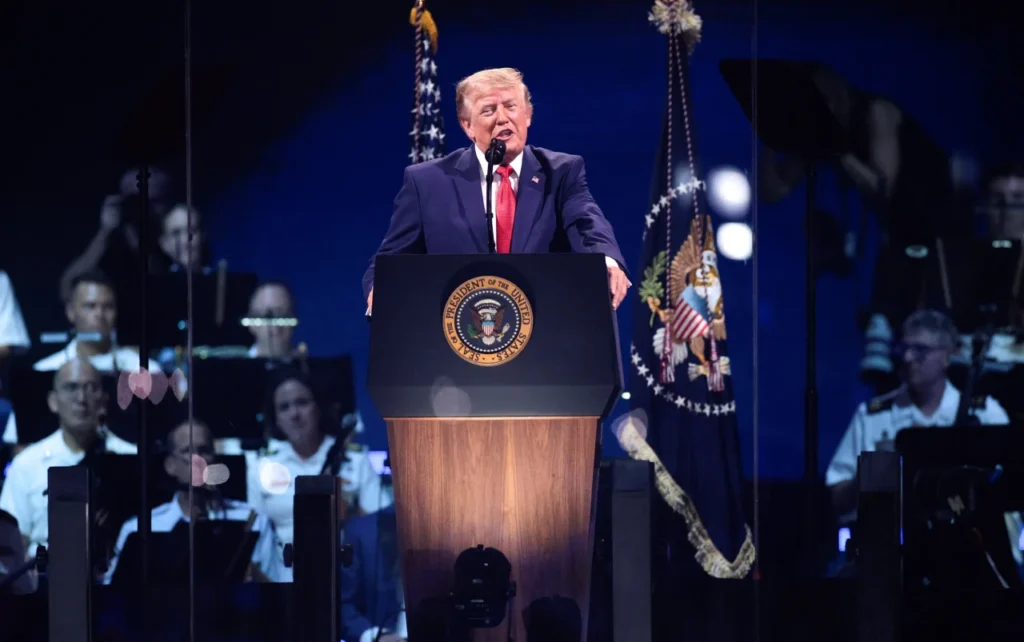
Moments after the military announced the new strikes, Trump told reporters in the Oval Office that it was “another major attack.”
“We’re hitting them very hard. And it’ll continue, and we’ll see what happens. We’re knocking out all of their offensive capability and we’re controlling the straits. We’re putting the blockade back.”
Donald Trump
Trump also provided new details on his suggestion that the US will charge tolls for ships going through the strait, an about-face after previously saying that it wouldn’t. The suggestion that the United States will charge other ships for safe passage, upends hundreds of years of American policy supporting freedom of navigation across the globe.
“We’re protecting a very rich portion of the world. We’re spending money. And so, what we’ve done is, we are going to be reimbursed for protection.”
Donald Trump
It is a change in US policy that, until now, said the strait should remain open to all without tolls — as it was before the US and Israel attacked Iran on Feb. 28. Any attempt by the US or Iran to charge fees would violate global norms on freedom of navigation and raise tensions, likely causing further economic disruption far beyond the region.
The attacks come as Iran and the US vie for control of the strait through which a fifth of all traded crude oil and natural gas once passed in peacetime. The price of benchmark Brent crude oil rose to a one-month high of over $84 in trading early today, still well below the nearly $120 reached at the height of the war but threatening to make costs everywhere higher.
It also further breaches a ceasefire in place from an interim agreement between Iran and the US to end the war. The accord is now almost halfway through the 60-day period in which they were supposed to negotiate a final accord, which also was supposed to address Iran’s disputed nuclear program and other issues.
Iran asserts that it has the right to manage traffic through the strait and potentially charge fees in accordance with the interim peace deal. The US has disputed that. The American military and the United Nations’ International Maritime Organization have tried to establish a route through the strait along the coast of Oman that would be outside of Iranian control.

Iran has attacked ships using that route, saying the US is violating the interim peace deal. The US has attacked Iran in response, drawing Iranian attacks on US-allied Arab states. Exchanges of fire in recent days had already cast further doubt on the interim peace deal.
Washington had lifted a blockade it imposed in mid-April as part of that deal, which also called for the strait to be fully reopened. However, Trump said yesterday that Washington is “reinstating” a blockade on Iran in the Strait of Hormuz. Trump separately suggested the United States will charge other ships for safe passage, upending hundreds of years of American policy supporting freedom of navigation across the globe.
Iran Responds With Attacks
Meanwhile, Iran responded with attacks targeting Bahrain, Jordan and two tankers associated with the United Arab Emirates traveling through the strait, killing one mariner and wounding eight others.
The United Arab Emirates’ Defense Ministry said that Iran attacked two tankers in the Strait of Hormuz, killing one mariner and wounding eight others. The Emirati Defense Ministry said Iran launched two cruise missiles at the tankers Mombasa and Al Bahiyah. The attacks set both tankers ablaze, though the fires were extinguished.Iran’s paramilitary Revolutionary Guard claimed the attack on the tankers, saying the vessels “ignored repeated warnings.” “They chose to pass through a minefield and were subsequently targeted and disabled,” the Guard said.
The Emirati Defense Ministry said the attack on the tankers killed one Indian national and wounded six Indians and two Ukrainians. “The UAE reserves its full right to respond to this escalation and to take all necessary measures to protect its territory, its citizens and residents,” the Defense Ministry added.
The US Embassy in Abu Dhabi and the US Consulate in Dubai alerted Americans early today that consular appointments had been canceled through Wednesday “due to the regional security situation.”
Bahrain also came under renewed attack early this morning as Iran retaliated over the latest round of US airstrikes. Bahrain sounded its missile alert sirens three times, urging the public to seek shelter.
According to a statement carried by the kingdom’s state-run news agency, Jordan’s military said it intercepted four missiles from Iran. Jordan hosts US forces and has come under attack by Tehran in recent days.
READ ALSO: CalBank Profit Soars 25% to GHS353.6 Million in Strong First Half Performance