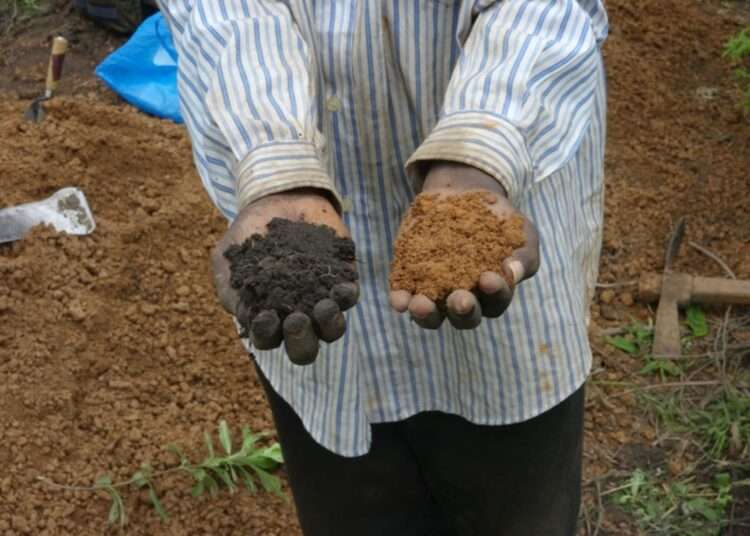
Farmers across Africa are increasingly pointing to chemical fertilizers as a key factor in the deteriorating health of their soil, contributing to the continent’s growing struggle to feed itself.
Despite having 65% of the world’s remaining uncultivated arable land, Africa spends about $60 billion annually on food imports. This figure is projected to surge to $110 billion by 2025 due to rising demand and changing consumption habits, according to the African Development Bank.
Benson Wanjala, a farmer in western Kenya, illustrates this problem vividly. When he started farming 25 years ago, his 10-acre farm produced 200 bags of maize annually. Today, that number has plummeted to just 30 bags. Wanjala attributes this decline to the once fertile soil now rendered nearly lifeless by acidifying fertilizers. Initially, these fertilizers boosted yields, but their long-term effects have proven detrimental. Kenya’s government introduced a fertilizer subsidy in 2008, making chemical fertilizers more accessible to smaller-scale farmers, which, over time, has led to widespread soil acidification.
According to Kenya’s agriculture ministry, 63% of the country’s arable land is now acidic. This has significantly impacted the production of staple crops such as maize, which saw a 4% decline to 44 million tons in 2022. This decrease in productivity extends to Kenya’s leading exports, including horticulture and tea. The ministry has not provided detailed reasons for the decline but has noted the overall negative trend in production.
The situation was exacerbated in April when a scandal involving fake fertilizer, essentially quarry dirt mislabeled as fertilizer, came to light. This fake fertilizer was distributed to farmers through a national subsidy program, affecting approximately 7,000 farmers. President William Ruto has promised compensation with the correct product, but the incident has further shaken confidence in chemical fertilizers.
Africa-Wide Soil Health Summit To Address Issues Of Declining Production
In response to these challenges, Kenya hosted an Africa-wide soil health summit to address issues of declining production, climate change, and food security. Stephen Muchiri, Executive Director of the Eastern Africa Farmers Federation, advocated for a return to traditional farming practices. He emphasized the importance of crop rotation and minimal land disturbance to replenish the soil. “Inorganic fertilizers were never meant to be the foundation of crop production,” Muchiri stated, highlighting the adverse effects of commercially inclined farming practices on soil health.
Experts at the summit noted that soil acidity decreases the availability of essential nutrients, making soil more prone to erosion and degradation. Bridget Mugambe, program coordinator for the Alliance for Food Sovereignty in Africa, recommended phasing out chemical fertilizers. “Soil health goes beyond the quick fixes provided by chemical fertilizers. In fact, chemical fertilizers have extensively damaged our soils in Africa,” she said, urging a holistic approach to soil management.
Despite these calls for change, the African Union (AU) has recommended increased use of both organic and chemical fertilizers. At the summit, AU Commissioner for Agriculture Josefa Leonel Correia Sacko highlighted that the continent loses over $4 billion worth of soil nutrients annually. The AU adopted a 10-year plan to boost local production of fertilizers and increase their use to enhance agricultural productivity.
Kenya, like many African countries, relies heavily on imported fertilizers due to low local production. The main suppliers are the European Union, Saudi Arabia, and Russia. John Macharia, Kenya manager for the Alliance for a Green Revolution in Africa (AGRA), stressed the importance of ensuring the quality of fertilizers available to farmers. He advocated for a combination of chemical and organic fertilizers, tailored to specific soil needs through soil analysis.
Soil degradation is a pressing food security issue across Africa. In Zimbabwe, once a regional breadbasket, about 70% of soils are now acidic. Historically, Zimbabwean farmers used organic manure to maintain soil fertility, but recent droughts have reduced cattle populations, limiting manure availability.
Wonder Ngezimana, a crop science associate professor at Zimbabwe’s Marondera University of Agricultural Sciences and Technology, emphasized the traditional reliance on organic matter to enrich soil, which has been disrupted by modern practices and climatic challenges.
AGRA recommends soil testing and the application of lime to counteract soil acidity, but these solutions are often prohibitively expensive for many farmers. Soil testing services cost between $20 and $40, a significant expense for farmers already struggling to afford seeds and other basic necessities. Wanjala, for instance, cannot afford additional expenses for soil testing or organic manure.
The widespread reliance on chemical fertilizers has highlighted the need for sustainable farming practices and a balanced approach to soil management. As Africa grapples with food security challenges, the shift towards more holistic and traditional farming methods may offer a path to revitalizing the continent’s rich agricultural potential.
READ ALSO:
Ghana’s Reserves Position Remains Strong with Increased Trade Surplus- BoG