
President Nana Akufo-Addo, in his final State of the Nation Address to Parliament, highlighted progress made in the country’s energy sector during his administration.
However, his remarks have sparked debate, particularly around the $2.5 billion energy sector legacy debt inherited in 2017 and the current state of the energy sector.
Commenting on the President’s address, the Executive Director of the Africa Centre for Energy Policy (ACEP), Benjamin Boakye, provided a nuanced critique of the government’s performance in managing the energy sector.
“Are we leaving things exactly as we found them? No. But it’s not a straightforward story of success either,” Boakye noted, highlighting key issues surrounding the management of energy sector debts.
Boakye explained that the energy sector’s $2.5 billion debt in 2017 included liabilities from the downstream petroleum sector, Tema Oil Refinery (TOR), and the power sector.
To address this, the Energy Sector Levy Act (ESLA) was introduced by the then President John Dramani Mahama’s government with a five-year sunset period, intended to clear the debt by 2020.
However, the establishment of ESLA PLC by President Akufo-Addo diverted proceeds to the bond market, complicating the original plan.
“ESLA PLC’s creation meant that instead of clearing legacy debt, proceeds were used for recurring debt servicing.
“This shift made it impossible for ESLA to achieve its initial purpose, leaving the sector vulnerable to further financial strain.”
Benjamin Boakye, Executive Director of ACEP
By 2019, the World Bank and the government projected energy sector under recoveries could climb from $2.7 billion to $12.5 billion if mismanagement persisted. Despite the Energy Sector Recovery Programme (ESRP) introduced to stabilize the sector by 2023, the results were less optimistic.
“The President claims to have averted the projected $12.5 billion in underrecoveries.
“However, by 2023, the projection had risen to $14.5 billion. This reveals a gap between rhetoric and reality.”
Benjamin Boakye, Executive Director of ACEP
Boakye noted that global events like the Russia-Ukraine war temporarily mitigated the energy sector’s debt burden. “The war disrupted LNG supplies, sparing Ghana nearly $1 billion annually in potential debt. Ironically, this external crisis offered some relief to the sector,” he added.
However, he criticized the Ghana National Petroleum Corporation (GNPC) for failing to capitalize on opportunities presented by global market dynamics. “GNPC could have profited from reselling LNG at higher prices in Europe but missed this chance,” he stated.
Structural Inefficiencies Persist
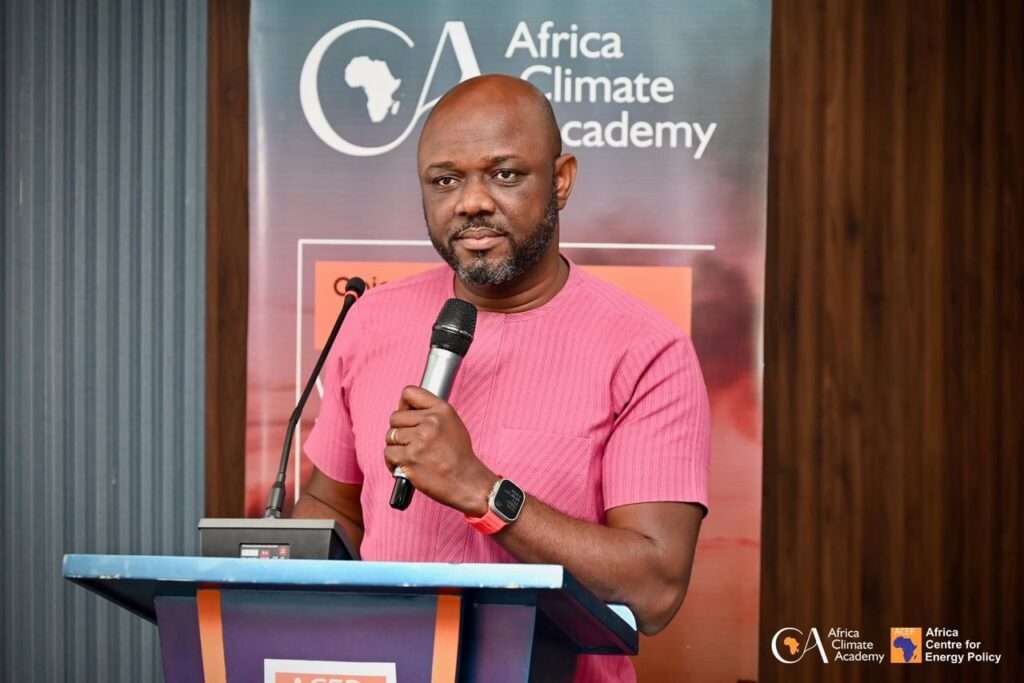
A key focus of Boakye’s critique was the lack of progress in addressing structural inefficiencies within the energy sector.
Boakye criticized the Electricity Company of Ghana (ECG) for continuing to rely on sole-sourced procurements, a practice that undermined cost-efficiency.
He further noted that the administration’s failure to privatize ECG’s operations—a key ESRP initiative—represented a missed opportunity. The failed Power Distribution Services (PDS) deal, which ended in litigation over wrongful termination, exemplified this shortcoming.
Boakye also criticized the heavy financial burden placed on citizens to cover the energy sector’s inefficiencies.
“Through the ESLA’s 49 Pesewas Energy Debt Recovery Levy and 20 Pesewas Energy Sector Recovery Levy, over GHS 3 billion is extracted annually.
“Yet, these efforts have not resolved the sector’s debt crisis.”
Benjamin Boakye, Executive Director of ACEP
Boakye argued that the government’s inability to resolve the legacy debt issue has exacerbated the energy sector’s financial woes. “The cumulative debt has exceeded $12.5 billion, excluding interest and judgment debts,” he added.
As President Akufo-Addo’s tenure ends, Boakye urged the government to prioritize transparency and accountability in the energy sector.
“The public deserves clarity on the true state of the sector, including unresolved debts and ongoing inefficiencies,” he stated.
He also emphasized the need for competitive procurement and private sector involvement to enhance efficiency.
“Without these reforms, the energy sector will continue to drain national resources, stifling economic growth,” he warned.
Ghana’s energy sector remains a cornerstone of the nation’s economy, with significant potential for growth and transformation. However, achieving this potential will require bold reforms, transparent governance, and a commitment to long-term planning.
As the next administration takes office, addressing the sector’s deep-seated challenges will be critical to ensuring a sustainable energy future for Ghana.
In the words of Boakye, the legacy of the past eight years serves as a cautionary tale. “The public’s expectation was not to inherit a $2.5 billion debt and pass it on unchanged after injecting several billions into inefficiencies,” he remarked, urging the next government to prioritize structural reform and fiscal discipline in the energy sector.
REA ALSO: Simons Critiques NPP for Eliminating Roadblocks, Enabling Future Power Shifts