
President John Dramani Mahama has outlined what he described as strong signs of economic recovery under his administration, attributing the country’s recent macroeconomic stability to a new governance model defined by discipline, efficiency, and strategic investment.
Speaking at the Jubilee House during the swearing-in ceremony of the last four deputy ministers of state, President Mahama provided a detailed account of Ghana’s economic turnaround within his first six months in office.
According to the President, his administration’s lean and focused approach to governance is yielding measurable results across several critical economic indicators.
“This new posture of efficiency is not just mere rhetoric. It is already producing measurable gains,” he said, before highlighting improvements in Ghana’s fiscal and monetary health.
Among the most notable achievements, the President pointed out that Ghana’s risk card deficit had shrunk dramatically—from 5.8% of GDP at the end of 2024 to 1.1% by mid-2025. “This is better than our set target of 2.4%,” he noted, adding that this development is a reflection of prudent financial governance.
Ghana’s public debt has also seen a steep decline, falling from GHS 726.7 billion in December 2024 to GHS 613 billion by June 2025. This reduction has consequently brought the country’s debt-to-GDP ratio down from 61.8% to 43.8%.

According to the President, inflation, one of the most pressing challenges for Ghanaian households in recent years, has also dropped significantly—from 23.2% to 13.7%—the lowest since 2021.
The Ghanaian cedi, which depreciated sharply in 2024, has rebounded strongly. “The Cedi has appreciated significantly from GHS 16.2 to $1 in late 2024 to GHS 10.4 to $1 in July 2025,” President Mahama revealed.
Fiscal Discipline Driving Growth
This turnaround, he explained, is being driven by what he termed “fiscal discipline, strong fiscal performance, and investor confidence.” GDP growth has also shown improvement, rising from 3.2% in the first quarter of 2024 to 5.3% in the same period in 2025, while non-oil GDP growth has surged from 4.2% to 6.8%.
President Mahama emphasised that these economic gains have been achieved without resorting to a supplementary budget. Instead, he attributed the progress to improved public financial management, comprehensive payroll audits, tax reforms, and more effective debt operations.
In his address, the President also made it clear that the macroeconomic progress is beginning to make a tangible difference in the lives of ordinary Ghanaians.
“According to GUTA, the Ghana Union of Traders Association and other associations, prices of over 4,500 essential goods have declined due to the strengthening of the Cedi. For most Ghanaians, this is what matters most—relief at the market and relief at the fuel pump.”
President John Dramani Mahama
President Mahama stressed that his government was not only stabilizing the economy but also meeting its statutory and fiduciary obligations on time.
He disclosed that Ghana had paid $700 million in Eurobond obligations and GHS 10 billion to domestic bondholders in the first half of 2025. Other disbursements included GHS 2.9 billion to the District Assemblies Common Fund and GHS 2.7 billion to the Social Security and National Insurance Trust (SSNIT).

He further affirmed the government’s continued support for social interventions. “Nursing and teacher training allowances from January to June 2025 have been paid in full,” the President said.
He also noted that GHS 72.8 million in capitation grants had been released to public basic schools, while 97,421 students, including persons with disabilities, had received full refunds under the government’s “No-Fee Stress Policy.”
Big Push Rollout
President Mahama also gave an update on his administration’s “Big Push” infrastructure agenda. He said that authorisation letters had already been issued for key projects, including the Oti River Bridge at Dambai and major road corridors in the Upper West, Upper East, and Northern regions.
He added that procurement was underway and that sod-cutting ceremonies would soon take place at five selected locations to officially launch the projects.
In a significant economic development, President Mahama revealed that small-scale gold exports through a reformed Gold Board mechanism had more than doubled in tonnage in 2025, with export values increasing by nearly 180%. This surge, he said, had boosted foreign reserves and contributed to the cedi’s recent strength.
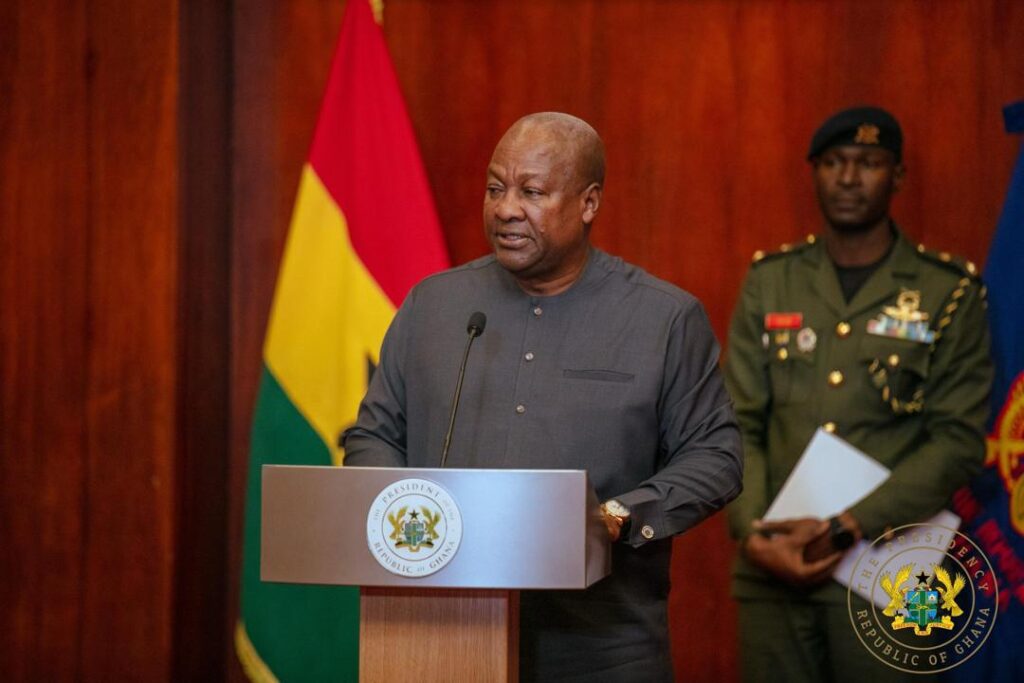
“Through fiscal discipline, we’ve kept expenditure 14% below target. This was driven in part by interest payment savings of GHS 5,100,000,000.0 proved that we are not just cutting costs but we are strategically prioritising spending”.
President John Dramani Mahama
President Mahama’s remarks reinforced his administration’s overarching message of responsible governance, economic recovery, and institutional credibility—an agenda he believes will restore trust and improve livelihoods across Ghana.
READ ALSO: US-Canada Trade Deal Threatened By Canada’s Move To Recognize Palestinian State