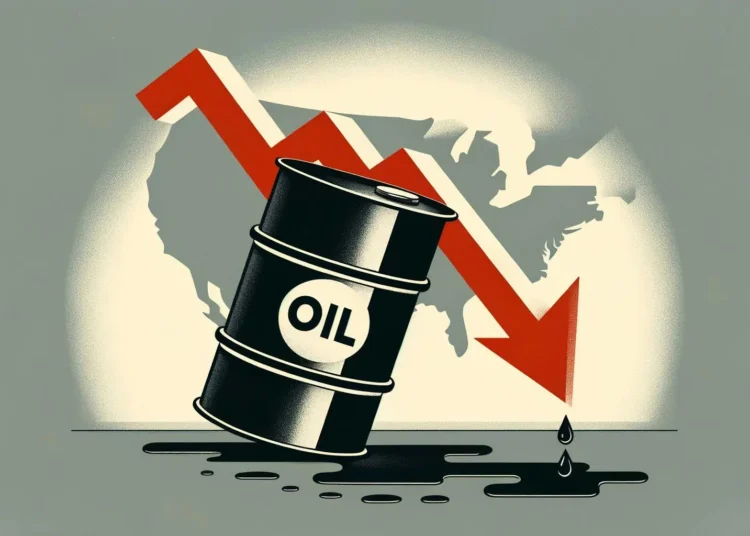
Global oil prices fell for a second consecutive session on Thursday, extending losses of more than 2% from the previous day, as investors turned their focus to this weekend’s meeting of OPEC+ where producers are expected to debate further output hikes.
At the time of writing, Brent crude slipped 1% to $66.87 per barrel, while West Texas Intermediate (WTI) also dropped by 1% to $63.23 per barrel.
The back-to-back declines reflect growing concerns that an increase in supply could exacerbate inventory build-ups at a time when demand indicators appear mixed.
Eight members of OPEC+ will meet on Sunday to discuss whether to raise production targets further in October.
The alliance – which brings together the Organization of the Petroleum Exporting Countries and key allies including Russia – has already agreed to restore 2.2 million barrels per day (bpd) of production between April and September, alongside an additional 300,000 bpd quota increase for the United Arab Emirates.

“The market seems to be absorbing the supply increases relatively well during 3Q high season, but the test for oil prices will be potential inventory build-ups during the winter months.”
Suvro Sarkar, energy sector team leader at DBS Bank
He warned that unless fresh geopolitical shocks emerge to bolster demand, oil prices may drift lower.
Sarkar added, “We do not see too many positive drivers at this point, assuming geopolitical issues stay contained. Support for oil prices could diminish hereon,” projecting that Brent may trade closer to $60–$65 per barrel in the near to medium term.
Despite the global price softness, Middle Eastern crude grades have remained the strongest regional benchmark in recent months.
A report from Haitong Securities noted that this resilience has emboldened producers like Saudi Arabia to push for higher output as they seek to consolidate market share in an increasingly competitive environment.
U.S. Economic Signals Cast Demand Doubts

Adding to bearish sentiment are signs of weakness in the U.S. economy, the world’s largest oil consumer. Overnight data suggested shaky macroeconomic fundamentals, particularly in the labor market.
“Weak labor market conditions in the U.S. are weighing on demand expectations.
“Most of the decline in July’s job openings came from the acyclical parts of the job market, such as healthcare, which has been a major driver of job growth in 2025.”
Kelvin Wong, senior market analyst at OANDA
The combination of slower job growth and a potential rise in crude supply has raised questions about whether demand can keep pace with the anticipated OPEC+ output increases.
Markets are also awaiting fresh U.S. government data on oil stockpiles due Thursday, delayed by a holiday earlier in the week.
Preliminary estimates from the American Petroleum Institute (API) indicated that U.S. crude inventories rose by 622,000 barrels in the week ending August 29, contrary to a Reuters poll in which analysts had expected a draw of about 2 million barrels.

If confirmed by the Energy Information Administration (EIA), the build would suggest a weaker demand picture than anticipated, further pressuring prices.
Meanwhile, the Department of Energy (DoE) reported that crude oil inventories in the Strategic Petroleum Reserve (SPR) rose by 500,000 barrels to 404.7 million barrels during the same week.
Gasoline inventories, however, provided a modestly supportive signal, falling by 4.577 million barrels after a drop of 2.06 million barrels the previous week.
The EIA noted that gasoline stocks are now aligned with the five-year seasonal average, offering some balance against the crude inventory builds.
The OPEC+ decision on Sunday could either tighten the market if output hikes are paused or add further downward pressure if production is increased.
Until then, oil markets remain caught between supply-driven pressures from OPEC+ and broader economic signals pointing to potential demand weakness. As investors brace for the outcome of the weekend meeting, volatility is expected to remain elevated.
READ ALSO: Investors Snub T-Bills As Government Struggles to Raise GH¢6.7bn, Settles for GH¢3.2bn