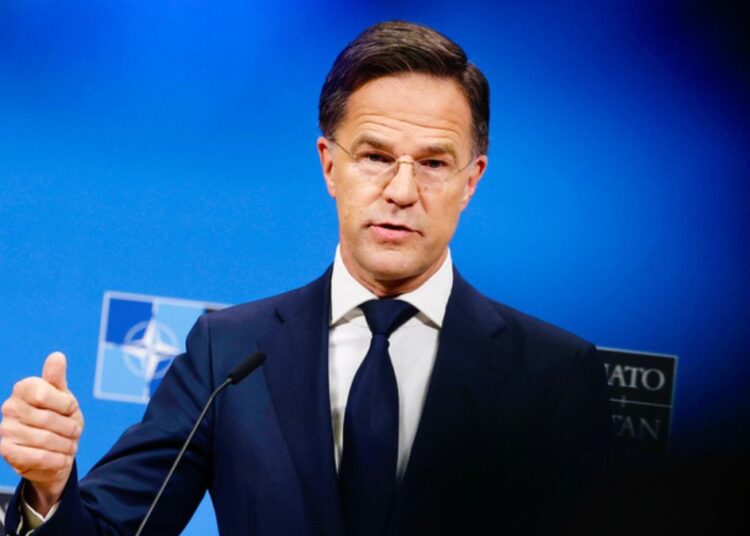
NATO Chief, Mark Rutte has disclosed that the alliance will hold its major annual nuclear exercise next week, with an important part of the drill to focus on protecting the weapons before they are ever used.
The exercise, named Steadfast Noon, will run for about two weeks and will be led by the Netherlands and involve 71 aircraft from 14 NATO countries.
The long-planned drill, which starts on Monday, October 13, 2025, is taking place amid heightened security around military facilities in Europe due to a series of airspace violations by drones, some of them blamed on Russia.
Rutte said in a video statement that the planned annual nuclear exercise needs to take place because “it helps us to make sure that our nuclear deterrent remains as credible, and as safe, and as secure, and as effective as possible.”
“It also sends a clear signal to any potential adversary that we will and can protect and defend all allies against all threats.”
Mark Rutte
Bomber aircraft and fighter jets that can carry nuclear warheads are taking part, but no nuclear weapons or live munitions will be used.
The bulk of the exercise is being held in the North Sea, far from Russia and Ukraine, and will involve military bases in Belgium, Britain, Denmark and the Netherlands.
The United States and the United Kingdom, with their nuclear forces, are key to NATO’s strategic deterrence. France also has nuclear weapons but is not a part of the organisation’s nuclear planning group.
NATO officials would not say what kind of scenarios will be used to test the 32-nation alliance’s nuclear readiness, but they insisted that it is not directed toward any particular country, nor does it relate to current international events.
The United States is providing F-35 jets capable of carrying conventional or nuclear weapons, refuelling planes and other support aircraft. Finland and Poland are sending fighter jets.
Electronic warfare equipment and reconnaissance and intelligence systems will also be used.
Colonel Daniel Bunch, Chief of NATO Nuclear Operations noted at the alliance’s military headquarters in the Belgian city of Mons that a big part of the exercise will focus on protecting nuclear weapons on the ground.
Bunch said that there are “a variety of different threats that we assess and that we must defend against because these are highly protected assets that require the utmost security and safety.”
Commenting on whether drones are a particular concern given the recent incidents, notably near military facilities in Belgium and Denmark, he emphasized that drones are not a new threat to the bloc. “Drones are something we understand,” he added.
“The more frequent incursions are something we’re obviously keeping an eye on. Ultimately, we’re going to stay one step ahead of the adversary.”
Colonel Daniel Bunch
Bunch noted that for the time being, the US is committed, “it hasn’t changed its policies and will be participating in this exercise.”
Bunch emphasized that the US had “signaled thus far no change to their current posture in Europe.”
Russia Not Focus Of NATO Nuclear Exercise
Meanwhile, the Head of NATO’s Nuclear Policy Directorate, James Stokes underlined that Russia is not a focus of the exercise.
Nonetheless, he said that NATO continues to monitor Russian military activities, including its use of dual-capable missiles in Ukraine, which could be fitted to carry nuclear warheads.
He told reporters that despite the Kremlin’s continued and heated rhetoric, the allies “haven’t seen any change in Russia’s nuclear posture” recently.
The Washington Summit declaration agreed by the alliance’s leaders last year states that “the fundamental purpose of NATO’s nuclear capability is to preserve peace, prevent coercion and deter aggression.” It said, “As long as nuclear weapons exist, NATO will remain a nuclear alliance.”
The drills take place every year, involving both nuclear and non-nuclear NATO members.
READ ALSO: IMF Confirms Major Gains in Ghana’s Energy Sector as Reforms Begin