The International Monetary Fund (IMF) has projected that Ghana’s Debt-to-GDP ratio will reach 59.1% by the end of 2025, marginally below the government’s 60% target for the same period.
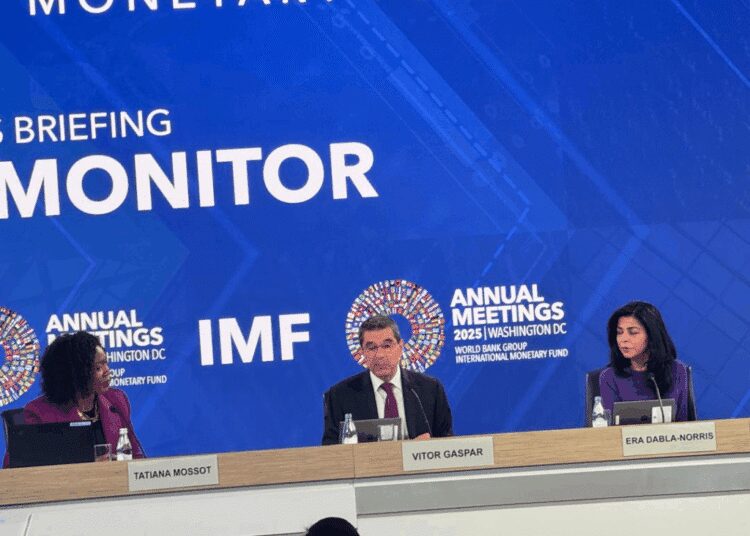
This projection, contained in the October 2025 Fiscal Monitor Report, was released on the sidelines of the ongoing IMF/World Bank Annual Meetings in Washington, D.C.
The report outlines a cautiously optimistic outlook for Ghana’s fiscal trajectory, suggesting that the country’s debt position will continue to improve in the medium term. The IMF anticipates a gradual reduction in the debt ratio to 56.1% in 2026, 53.7% in 2027, and 51.3% in 2028; a path that would position Ghana below the 55% Debt-to-GDP target set under the Extended Credit Facility (ECF) Programme.
This signals progress in Ghana’s debt management and fiscal consolidation efforts, coming at a time when the government has made significant strides in restructuring both domestic and external debts.
Ghana’s Current Debt Position
According to the Bank of Ghana’s Financial and Economic Data released in September 2025, Ghana’s public debt stood at GH¢628.8 billion, equivalent to 44.9% of GDP as of July 2025. The data represents a marked decline from the over 70% Debt-to-GDP ratio recorded before the country entered its IMF-supported debt restructuring programme in 2023.
While the drop reflects progress in debt management, the IMF’s latest projection implies that Ghana’s debt ratio may rise slightly toward the end of the year due to external pressures and exchange rate fluctuations. Nonetheless, the forecasted 59.1% remains within the government’s sustainability threshold and well below the levels that triggered fiscal distress in previous years.
Some analysts believe the modest uptick could be attributed to temporary factors such as inflationary adjustments and delayed fiscal inflows. However, they remain optimistic that ongoing debt restructuring and prudent fiscal management will sustain Ghana’s medium-term debt reduction agenda.
IMF Urges Ghana to Strengthen Fiscal Management
At the Fiscal Monitor briefing, Davide Furceri, Deputy Division Chief at the IMF’s Research Department, underscored the importance of strengthening Public Financial Management (PFM) systems to prevent a recurrence of past debt crises. He emphasised that fiscal discipline must be matched with robust revenue mobilisation to sustain Ghana’s economic recovery.
While Ghana’s progress on debt restructuring is commendable, the long-term debt sustainability depends on stronger fiscal institutions, improved tax compliance, and efficient expenditure control.
He urged the government to enhance tax administration efficiency and broaden the VAT compliance base to create fiscal space for critical development spending. This, he said, would reduce overreliance on borrowing and mitigate future refinancing pressures.
Government’s Debt Restructuring and Fiscal Commitment
In the intervening time, the Ministry of Finance has confirmed that Ghana has completed restructuring agreements with six bilateral creditors and is finalising negotiations with commercial creditors. The restructuring exercise, a key requirement under the IMF programme, aims to restore debt sustainability while maintaining economic stability.
According to the Ministry, the government remains committed to fiscal discipline, ensuring that the country does not revert to unsustainable borrowing patterns. The Medium-Term Debt Management Strategy (2025–2028), as outlined in the Public Financial Management (PFM) Act, provides a clear financing framework to balance growth with sustainability.
The Ministry also reiterated that the government’s debt management approach is guided by continuous Debt Sustainability Analyses (DSA) and reinforced by ongoing IMF-supported reforms.
In the interim, Ghana’s gradual improvement in debt sustainability is beginning to reflect in market sentiment. The successful restructuring of domestic bonds and bilateral debts has restored some confidence among investors, paving the way for renewed foreign interest in the economy.
Economic analysts say the IMF’s projection of a sub-60% Debt-to-GDP ratio by end-2025 indicates a turning point for Ghana’s fiscal outlook, particularly after years of debt distress and currency depreciation. The forecast suggests that with disciplined policy implementation, Ghana could soon re-enter the path of sustainable growth.
Furthermore, the projected 51.3% ratio by 2028 signals that Ghana may outperform the benchmarks set under the ECF programme, further reinforcing the country’s commitment to long-term fiscal stability.
That notwithstanding, despite the encouraging outlook, Ghana faces several fiscal risks. Exchange rate volatility, global oil price fluctuations, and lower-than-expected revenue inflows could undermine the debt reduction trajectory. Additionally, the success of the fiscal framework hinges on political will and policy consistency, especially in the run-up to the 2026 general elections.
If the government maintains momentum on debt restructuring and revenue mobilisation, the coming years could be a turning point toward fiscal stability and investor confidence, reinforcing Ghana’s ambition to build a sustainable, self-reliant economy.
READ ALSO: Fan Milk, Guinness Lead GSE Rally as Market Cap Hits GHS167 Billion Milestone