The World Bank has maintained its forecast for Ghana’s economic growth at 4.8% in 2026, even as the country’s economy continues to show strong activity across key sectors.
The projection, contained in the World Bank’s October 2026 Africa Economic Update, keeps Ghana’s growth outlook unchanged while pointing to a modest improvement in 2027. The Bretton Woods institution expects the economy to expand by 4.9% next year.
The outlook comes against the backdrop of stronger domestic demand, a major increase in investment and continued expansion in services and information and communication technology. At the same time, the World Bank has highlighted signs of uneven performance across the wider economy, particularly in agriculture and parts of the non-oil sector.
According to the World Bank, Ghana’s growth is expected to be driven by the services sector, a recovery in oil and gas activities, and ongoing performance associated with structural and fiscal reforms under national programmes.
“In Ghana, economic activity remained robust in the second quarter of 2026, although growth moderated slightly. Real GDP expanded by 6.0% year-on-year, down from 6.6% in the same period in 2025.”
World Bank
6% Second-Quarter Growth Underpins Outlook
Ghana’s 6.0% year-on-year expansion in the second quarter provides an important foundation for the World Bank’s medium-term outlook.
Although the pace was slower than the 6.6% recorded during the same period in 2025, economic activity remained sufficiently strong to demonstrate continued resilience.
The expenditure figures reveal an economy where spending and investment are playing a major role. Investment surged by 53.0%, while domestic demand increased by 11.2%.
Such figures point to significant activity from both private and public spending. The surge in investment is particularly notable because stronger capital formation can support productive capacity, business expansion and employment when sustained over time.
However, the composition of growth remains important. A rapid increase in investment does not automatically translate into broad-based economic gains if activity remains concentrated in a handful of sectors.
That concern is reflected in the World Bank’s assessment of Ghana’s production side.
ICT Emerges as a Major Growth Force
Services continued to dominate Ghana’s economic expansion during the second quarter, growing by 8.0% and accounting for nearly three-fifths of overall GDP growth.
Within the sector, ICT stood out dramatically. ICT activity increased by 30.9%, reinforcing the growing importance of digital services to Ghana’s economy.
The performance highlights how technology-driven businesses are becoming increasingly relevant to economic activity. Telecommunications, digital platforms, financial technology and other technology-enabled services are creating new channels for production and consumption.
The strength of ICT also provides Ghana with an opportunity to deepen the shift toward higher-productivity activities. Sustaining that momentum, however, will depend on investment in digital infrastructure, skills and an enabling business environment.
Services are not operating alone. Industrial growth also strengthened during the quarter.
Oil and Gas Lift Industrial Performance
Industrial growth accelerated to 4.3%, compared with 2.4% a year earlier. The World Bank attributed the improvement partly to a sharp increase in oil and gas production.
The recovery in hydrocarbons provides another source of support for Ghana’s overall growth outlook, particularly at a time when activity in some parts of the non-oil economy has weakened.
Still, reliance on oil and gas carries its own challenges. Hydrocarbon production can boost output significantly, but the broader economic impact depends on how revenues and investment associated with the sector feed into other productive activities.
The World Bank’s assessment suggests that Ghana’s current growth structure remains heavily linked to services, ICT and hydrocarbons.
That concentration is becoming more evident when compared with developments in agriculture.

Agriculture Loses Momentum
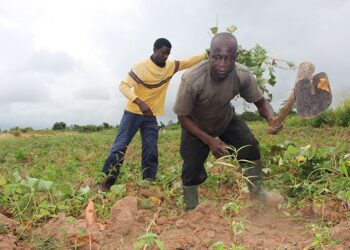
Agricultural growth slowed to 3.9%, sharply below the 7.1% recorded a year earlier.
The decline was linked to a steep contraction in fishing activity, highlighting the uneven nature of Ghana’s economic recovery.
Agriculture remains important to livelihoods, food supply and employment, meaning weaker performance in the sector can have consequences well beyond its direct contribution to GDP.
The divergence between agriculture and services also raises questions about the breadth of Ghana’s expansion. While technology, services and oil production are supporting headline growth, some traditional economic activities are not experiencing the same momentum.
The World Bank therefore described Ghana’s growth as concentrated in services, ICT and hydrocarbons, while momentum weakened across parts of the non-oil economy.
Ghana’s 2027 Outlook Edges Higher
Despite these imbalances, the World Bank expects Ghana’s growth to strengthen slightly to 4.9% in 2027.
The projection suggests that the institution sees continued support from services, recovering oil and gas activity and structural and fiscal reforms.
The broader regional picture provides additional context. Growth in West and Central Africa is projected at 4.5% in 2026, unchanged from 2025, before increasing to an average of 4.7% in 2027 and 2028.
Nigeria, the largest economy in the subregion, remains a major influence on the regional figures. Excluding Nigeria, growth is expected to moderate from 5.4% in 2025 to 5.0% in 2026 before recovering to an average of 5.3% in 2027 and 2028.
Across Sub-Saharan Africa, growth is projected to rise to 4.3% in 2026. Yet the World Bank cautioned that the poverty-reducing impact of this growth is likely to remain limited.
Ghana’s challenge, therefore, extends beyond maintaining a 4.8% growth rate. The bigger task will be ensuring that the expansion reaches more sectors, supports jobs and strengthens household incomes.
With services and ICT accelerating while agriculture and parts of the non-oil economy lose momentum, the quality and breadth of Ghana’s growth could prove just as important as the headline figure.
READ ALSO: Medical Product Trafficking Threatens Health and Security in Central Africa – UNODC