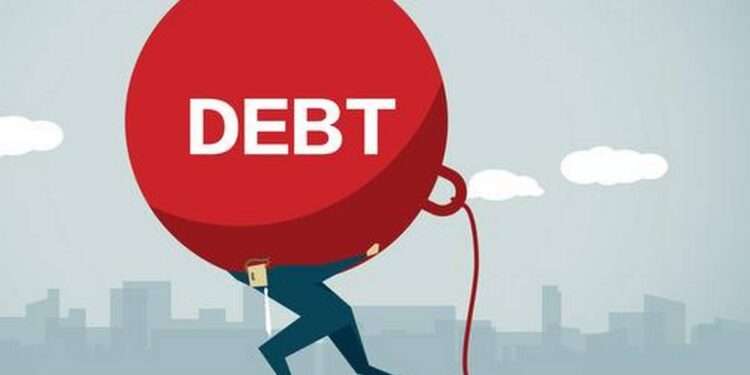
Ghana’s public debt profile has undergone a historic shift as domestic debt has overtaken external debt for the first time in several years.
According to the latest data from the Bank of Ghana, domestic debt stood at GH¢323.7 billion, representing 23.1% of Gross Domestic Product (GDP) as of July 2025. This figure surpasses the country’s external debt, which stood at GH¢305.0 billion, or 21.8% of GDP, marking a significant transformation in Ghana’s debt composition.
The Bank of Ghana’s report attributes the sharp rise in domestic borrowing primarily to the government’s need to honour its coupon payment obligations on both tendered and untendered bonds in February and August 2025. These obligations compelled the government to increase domestic borrowing to build liquidity buffers and maintain stability in the financial system.
The government’s domestic debt surge is largely tied to its Domestic Debt Exchange Programme (DDEP), which restructured billions in local bonds to ease the fiscal burden. However, the deferred coupon payments due in 2025 created renewed pressure on the treasury, forcing policymakers to seek additional funds within the domestic market.
Analysts suggest that the government’s strategy to refinance these obligations domestically reflects both the limited access to international capital markets and the need to protect the cedi from further depreciation. The reliance on local instruments, including Treasury bills and bonds, has therefore intensified, contributing to the steady rise in domestic debt levels.
In February and August, when major coupon redemptions were due, the government significantly increased its issuance of short-term and medium-term securities to meet its payment commitments. This led to what the Bank of Ghana described as a “temporary spike” in domestic borrowing, although it also helped sustain investor confidence in the local debt market.
Total Public Debt Declines Despite Domestic Surge
Interestingly, even as domestic debt soared, Ghana’s total public debt stock declined to GH¢628.8 billion at the end of July 2025, down from GH¢726.7 billion (or 61.78% of GDP) recorded at the end of December 2024. This translates into a notable reduction of GH¢98 billion, bringing the total debt to 44.9% of GDP.
The Bank of Ghana attributed this decline to two key factors; the appreciation of the cedi against major international currencies and a slower pace of debt accumulation in the first half of 2025. The relative stability of the exchange rate, supported by the Bank’s foreign exchange interventions and improved export receipts, helped reduce the value of external debt when measured in local currency terms.
This trend highlights a positive shift in Ghana’s debt sustainability outlook, as the government continues to align its fiscal consolidation efforts with the conditions set under the International Monetary Fund (IMF) Extended Credit Facility programme.
While the reduction in total debt appears encouraging, economists caution that the growing dependence on domestic borrowing could place undue pressure on local financial institutions and crowd out private sector credit.
Meanwhile, while the government’s preference for local borrowing reduces exposure to external shocks, it could also lead to higher domestic interest rates and limit access to credit for businesses.
The government’s strategy to rely heavily on the domestic market might ensure short-term liquidity and control exchange rate risks. However, in the long term, it risks creating competition between the state and the private sector for limited financial resources.
Market watchers have also warned that the government’s growing domestic debt stock could lead to rollover risks if not managed prudently, especially as large volumes of maturing securities need to be refinanced in subsequent quarters.
The government’s fiscal authorities have reiterated their commitment to maintaining debt sustainability while ensuring economic growth and financial stability. The Ministry of Finance has emphasized that ongoing reforms in public financial management, coupled with the IMF-supported programme, will help reduce borrowing costs and restore market confidence.
Furthermore, the government aims to deepen the domestic capital market by diversifying funding instruments and extending the maturity profile of its debt. The introduction of longer-term bonds, improved transparency in debt reporting, and enhanced investor engagement are expected to support this goal.
The Bank of Ghana also continues to play a crucial role by coordinating monetary and fiscal policy efforts to control inflation, stabilize the cedi, and ensure that domestic borrowing remains sustainable without undermining macroeconomic recovery.
READ ALSO: GSE Tumbles as Benchmark Index Sheds Over 20 Points in Midweek Shake-Up