Ghana’s economy has staged a remarkable recovery from its recent debt crisis, marked by sharp disinflation, currency stabilization, fiscal consolidation and a rebound in growth.
In May 2026, Fitch Ratings upgraded the country’s long-term foreign-currency issuer default rating to B from B- and assigned a Positive Outlook. The agency highlighted falling public debt, rising reserves and solid growth prospects averaging around 5 percent through 2027.
Yet emerging data on private consumption, credit expansion and household spending suggest domestic demand could prove stronger than many baseline projections, including those from Fitch and the International Monetary Fund, potentially lifting overall performance above current expectations.
Macroeconomic Stabilization Lays the Foundation
Ghana recorded real GDP growth of 6 percent in 2025, accelerating further to 6.4 percent year-on-year in the first quarter of 2026. Non-extractive activity has been particularly robust, driven by services and agriculture. Inflation, which once exceeded 20 percent, fell dramatically, reaching as low as 3.2 percent in March 2026 before edging up to 5.3 percent by June. The Bank of Ghana responded by cutting its policy rate substantially, bringing it down to 14 percent. Lending rates have declined in tandem, and private sector credit growth accelerated sharply to over 40 percent in mid-2026.
The cedi’s earlier strong appreciation against the dollar reduced imported inflation and improved purchasing power. International reserves rose significantly in 2025, supporting external stability. Public debt declined markedly as a share of GDP, aided by fiscal primary surpluses and nominal growth. These improvements restored confidence among households and businesses after years of hardship.
Fitch expects growth to remain solid near 5 percent, supported by gold mining, recovering consumer confidence and a gradually less restrictive fiscal stance. The IMF projects a more moderate 4.8 percent for 2026 as stabilization gains mature and external uncertainties persist. Both forecasts assume continued discipline. However, the strength of domestic demand indicators points to upside risks.

Evidence of Resilient Private Consumption
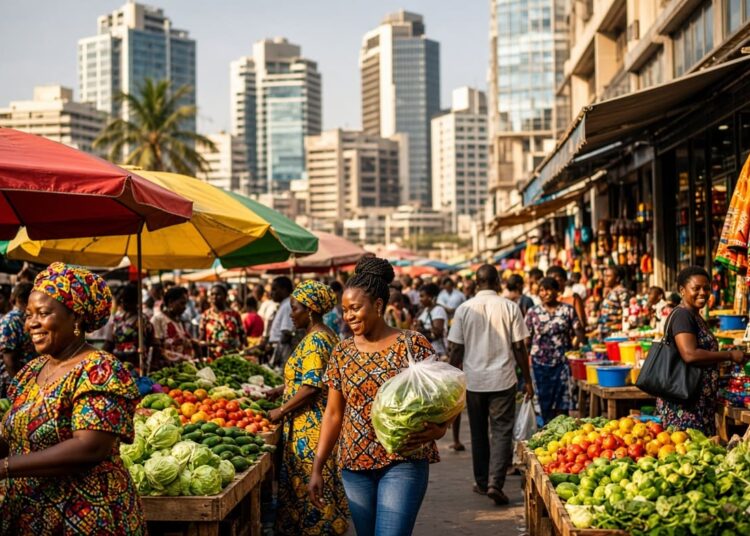
Household consumption forms the largest component of Ghana’s GDP. Recent high-frequency data reveal a clear shift toward consumer-led expansion. In the first half of 2026, fast-moving consumer goods volumes in Ghana rose 8.9 percent while value grew 15.6 percent, outperforming regional peers. Consumers are not merely paying higher prices; they are buying more. Food categories expanded as households rebuilt their baskets following the disinflation cycle. Affordability improved for staples such as edible oils and pasta.
Services, which account for a large share of economic activity, continued to expand solidly into mid-2026. Monthly indicators showed overall growth of 5.1 percent in May, with services contributing the bulk. Lower borrowing costs have supported credit for consumption and small businesses. Average lending rates fell notably from previous highs, while Treasury bill yields dropped sharply. These developments ease financial constraints on households and firms.
Recovering real incomes, combined with improved food supply and moderated transport costs in earlier months, have underpinned this demand recovery. Consumer confidence, though still cautious, has firmed as macroeconomic volatility receded. The result is broader-based activity that reduces reliance on extractive sectors alone.
Investment and Credit Dynamics Amplify the Impulse
Fixed investment is also rebounding from earlier contractions. Private investment has benefited from lower interest rates and greater policy predictability under the ongoing economic program. Credit growth to the private sector has accelerated in real terms, signaling willingness by banks to lend as balance sheets strengthen and non-performing loans stabilize.
Government consumption is expected to provide some support as the fiscal stance eases modestly from the tight primary surpluses of recent years. Yet the primary driver remains private domestic demand. World Bank analysis of 2025 noted that strong private consumption and investment offset weaker public capital spending and higher imports. Similar dynamics appear to be extending into 2026.
This combination creates potential for growth to exceed the roughly 5 percent consensus embedded in many forecasts. Stronger domestic demand can raise non-extractive GDP and sustain momentum even if gold prices or oil output moderate. It also supports revenue collection, reinforcing fiscal targets and debt reduction.
Risks and the Path to Sustained Outperformance
Upside is not guaranteed. Inflation has shown some recent upticks driven by food and non-food items. Global commodity price swings, particularly for oil, or renewed exchange rate pressures could erode real incomes. Fiscal slippage remains a concern if spending accelerates too quickly. Regional security risks in the Sahel and global trade uncertainties add external headwinds.
Nevertheless, the current trajectory of credit expansion, retail volumes and services growth indicates that domestic demand has more underlying strength than conservative projections fully capture. Monetary policy remains data-dependent, with the central bank prioritizing a return of inflation firmly into the medium-term band. Continued reserve accumulation and primary surplus targets provide buffers.
If private consumption and investment maintain their current pace, Ghana could deliver growth closer to or above 5.5 to 6 percent in 2026, challenging the more cautious ends of the forecast range. Such outperformance would further improve debt dynamics, support the Positive Outlook from Fitch and potentially open the door to additional rating upgrades over time.
Implications for Policy and Investors
Policymakers face the task of nurturing domestic demand without reigniting inflationary pressures. Sustaining agricultural productivity, improving logistics and maintaining exchange rate stability will be critical. Structural reforms that enhance the business environment can convert temporary recovery into lasting private sector dynamism.
For investors, the emerging picture is one of a recovering economy with improving fundamentals and a consumption engine that is restarting. Lower interest rates and stabilizing prices create opportunities in consumer-facing sectors, financial services and infrastructure-linked activities. The key is whether Ghana can convert this cyclical rebound in domestic demand into more durable, inclusive growth.
All in all, while Fitch and other institutions project solid but moderated expansion, the observable strength in household spending, retail activity and credit suggests Ghana’s domestic demand may yet surprise on the upside. The coming quarters will test whether this momentum proves durable enough to rewrite the near-term growth narrative.
READ ALSO: More Capital Won’t Stop Ghana’s Next Banking Crisis- Dr Atuahene