Indian authorities have carried out a cloud seeding experiment over smog-choked New Delhi in an attempt to induce rainfall and clear the city’s toxic air.
A plane sprayed chemicals into clouds over some areas of the Indian capital to encourage rain and wash pollutants from the air, which remained in the “very poor” category, according to air quality monitors.
Cloud seeding, a weather modification method that releases chemicals into clouds to trigger rain, has been used in drought-prone regions, such as the western United States and the United Arab Emirates, though experts say its effectiveness remains uncertain.
The method seeks to increase precipitation by adding small chemical particles to clouds around which water droplets form, eventually developing into raindrops.
Environment Minister Manjinder Singh Sirsa said that the trial was done in collaboration with the government’s Indian Institute of Technology Kanpur, with more planned in the coming days.
He said that authorities were expecting a brief spell of rainfall in some parts of the city in the following hours. “If these trials prove successful, a long-term plan will be implemented through February,” he said.
According to reports, the Delhi government had signed a Memorandum of Understanding with the Indian Institute of Technology (Kanpur) in September to carry out five trials, all of which are planned over northwest Delhi, at a cost of Rs 3.21 crore.
The five can take place any time between October 1 and November 30. Indian Institute of Technology (Kanpur) disclosed that it seeded a corridor roughly 25 nautical miles (46.3 km) long and four nautical miles (7.4 km) wide, with the largest distance covered between the neighbourhoods of Khekra and Burari.
The first round involved six flares released at an altitude of 4,000 feet. The second took off at 3.55 pm and deploying eight flares at a slightly higher altitude, around 5000 feet.
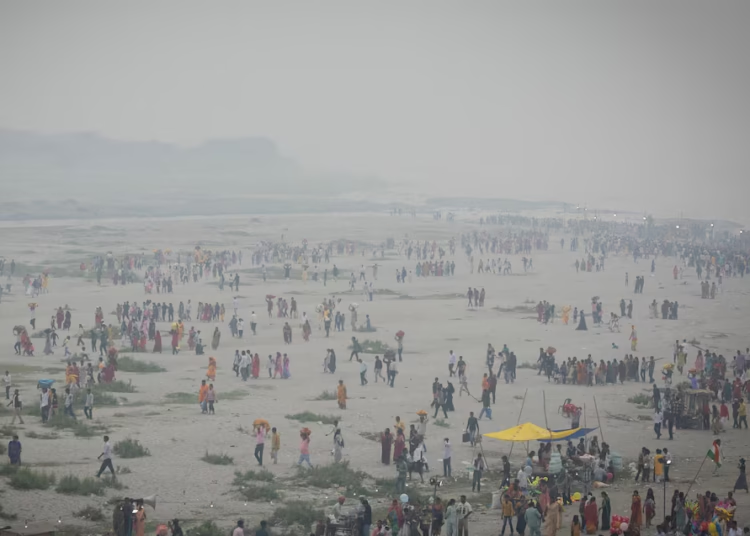
New Delhi and its surrounding region, home to more than 30 million people, routinely rank among the world’s most polluted. Report from Switzerland-based air quality monitoring database IQAir earlier this year states that India has six of the 10 most polluted cities globally, and New Delhi is the most polluted capital.
Air quality worsens in New Delhi every winter as farmers burn crop residue in nearby states and cooler temperatures trap the smoke, which mixes with vehicle and industrial emissions. Pollution levels often reach 20 times higher than the World Health Organization’s safe limit.
Authorities have imposed construction bans, restricted diesel generators and deployed water sprinklers and anti-smog guns to control the haze.
However, critics say there needs to be a long-term solution that drastically reduces pollution itself, instead of actions that aim to mitigate the effects after it has already plagued the region.
The city’s air quality remained in the “very poor” category this afternoon, with a reading of 304, according to the Central Pollution Control Board, which considers an air quality index of 0 to 50 to be “good.”
Cloud Seeding Deemed Ineffective
Meanwhile, Krishna Achuta Rao, Professor at the center for atmospheric sciences at the Indian Institute of Technology, New Delhi, said that seeding clouds to reduce air pollution is ineffective, because it can dissipate pollution only for a few days after which the air quality returns to the state that it was before.
Instead, Rao suggested that implementing strong laws that can result in reducing emissions from all sources, including industries, vehicular pollution and construction, is the only way to clean India’s air.
“Cloud seeding is not really a cure (for pollution). The main purpose appears to be to show people that something is being done.”
Krishna Achuta Rao
Also, Manindra Agrawal, a scientist at IIT-Kanpur, opined that artificial rain triggered by cloud seeding can bring down pollution by as much as 50%, but may need to be repeated.
READ ALSO: Lukashenko Slams Lithuanian Border Closure