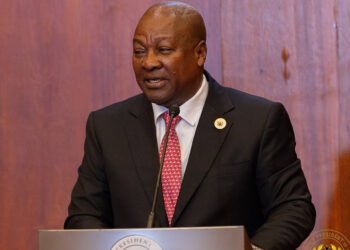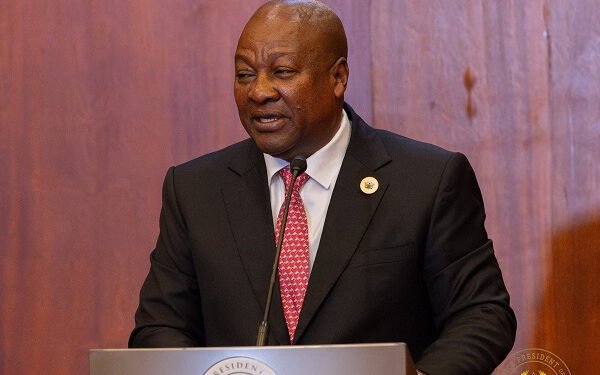

President John Dramani Mahama has delivered an emphatic charge to newly sworn-in Chief Justice Paul Baffoe-Bonnie, urging him to steer a bold and transformative reset of Ghana’s judiciary at a time when citizens are demanding credibility, accountability, and renewed confidence in the courts.
Speaking at the investiture ceremony at Jubilee House, the President described the office of the Chief Justice as “among the most important under our Constitution,” noting that it sits at the heart of Ghana’s democratic architecture and remains essential to the delivery of justice across the country.
According to President Mahama, the Chief Justice does not merely occupy a ceremonial chair. Rather, he serves as the “symbol and guarantor of justice” for the Ghanaian people, presiding over the Supreme Court, chairing the Judicial Council, and overseeing the administration of justice from the highest courts to the most remote districts.
” Our Constitution enshrines the principle that the courts, as outlined in Article 125, shall administer justice in the name of the Republic of Ghana, guided by the principles of freedom, equality, probity, and accountability. And so, as Chief Justice, you are the first guardian of these principles within the judicial arm.”
President John Dramani Mahama
Judicial Independence
The President underscored judicial independence as a cornerstone of Ghana’s democracy, stressing that the balance of power among the executive, legislature, and judiciary must remain intact to sustain public trust.
He pledged what he called his “unwavering commitment to the independence of the judiciary,” adding that judicial independence is not a privilege bestowed by the executive but “a constitutional necessity.” He acknowledged public demand for institutions that not only function effectively but are also trustworthy, insisting that the judiciary “must be above reproach.”

President Mahama highlighted the immense harm a single act of misconduct can inflict on the system, stating that even one corrupt act “can undermine years of hard work.”


He therefore charged the Chief Justice to make integrity a central pillar of his administration, identifying four urgent areas of focus: firm but fair disciplinary standards, transparent case management, strong internal mechanisms for dealing with misconduct, and a professional culture that rewards ethical behaviour. Ghanaians, he emphasized, must know that “justice in Ghana is not for sale.”
Accessibility and Efficiency of the Justice System
Beyond issues of integrity, President Mahama drew attention to the accessibility and efficiency of the justice system. He lamented the continued perception of justice as distant, slow, and expensive for ordinary citizens.
Delays, adjournments, and complicated procedures, he observed, too often turn courts into places of frustration rather than refuge. The Chief Justice, he urged, must prioritise clearing case backlogs through improved case management systems, modernising court infrastructure—particularly in underserved districts—and expanding the use of technology, including e-filing, virtual hearings, and digital recordings.
President Mahama also advocated for simplified procedures, particularly in small claims, family cases, juvenile matters, and labour issues, so that no citizen is excluded from seeking justice due to technicalities or financial strain.

He reaffirmed the government’s willingness to support these reforms with resources, stating that the judiciary must be “adequately equipped to deliver justice in a modern and efficient manner.”
Protection of Rights and Freedoms
Reiterating the judiciary’s role as a refuge for the vulnerable, the President emphasised the courts’ constitutional mandate to protect the rights and freedoms of all persons, especially children, persons with disabilities, the poor, and those facing abuse or oppression.
He expressed confidence that under Justice Baffoe-Bonnie’s leadership, the judiciary would deepen its role in safeguarding rights and ensuring that justice is not skewed in favour of the wealthy or powerful.
He encouraged stronger specialised courts for land, commercial matters, corruption, family welfare, and environmental protection, and urged the expansion of alternative dispute resolution to complement formal litigation.
The President further stressed the importance of continuous learning in a rapidly evolving legal landscape. He encouraged the new Chief Justice to strengthen the Judicial Training Institute into a hub of excellence that promotes ongoing judicial education in ethics, judgement writing, court administration, and emerging legal fields such as cyber law and environmental law.
He also urged the development of clear performance standards that enhance accountability without compromising judicial independence. Importantly, President Mahama highlighted the need for a constructive relationship between the judiciary, the bar, and other justice-sector actors.
While acknowledging the value of robust debate between the bench and bar, he affirmed that such engagement must be rooted in mutual respect and a shared commitment to the rule of law.

He also called for greater public education on how the justice system works, arguing that understanding court processes helps increase respect for judicial outcomes and strengthens citizens’ reliance on lawful dispute resolution.
Though stressing the independence of the judiciary, the President acknowledged the necessity of cooperation among the three branches of government. He said the judiciary requires supportive policies, adequate funding, and an enabling legal framework, while the executive and legislature depend on the courts for impartial and timely interpretations of the law.
Judiciary as Central Pillar in Reset Agenda
He described the judiciary as a “critical partner” in his administration’s Reset Agenda and broader reforms, pledging continuous collaboration “in a spirit of consultation and respect.”
As he concluded, President Mahama reminded Justice Baffoe-Bonnie of the gravity of the office he now holds. Positioned “at the intersection of law, history, and service,” the Chief Justice enters the role with decades of judicial experience and a record of distinguished service.
The President charged him to lead with courage, protect the institutional integrity of the judiciary, inspire colleagues through personal example, and always remember that every case represents human lives and futures. If he serves faithfully, President Mahama said, history will remember him not simply as a Chief Justice, but as “a Chief Justice who made a significant difference.”
With that, he pledged the full cooperation of his government and urged citizens to support the nation’s institutions, resolve disputes peacefully, and defend the Constitution in both word and action.
READ ALSO: ICEG Warns 2026 Budget Falls Short on Lasting Energy Sector Reforms