
A major legal showdown is unfolding in Accra as former Finance Minister Kenneth Nana Yaw Ofori-Atta and several high-ranking officials of the Ghana Revenue Authority (GRA) face criminal charges over the controversial revenue assurance contracts awarded to Strategic Mobilisation Ghana Limited (SML).
The case, filed in the Criminal Division of the High Court in Accra, follows months of investigation by the Office of the Special Prosecutor (OSP), which uncovered what it described as extensive statutory violations and systemic abuse of the public procurement process.
The charge sheet, filed under Case No. CR10106b026 lists eight defendants, including Ofori-Atta; former Acting Commissioner-General of the GRA, Emmanuel Kofi Nti; former Commissioner of the Customs Division, Ammishaddai Owusu-Amoah; former Commissioner of the Customs Division, Kwadwo Damoah; Evans Adusei, identified as the Chief Executive and controlling mind behind SML; and other senior officials.
They are jointly accused of conspiring to influence the procurement process in a manner that gave SML an unlawful advantage in securing a multi-million-cedi contract intended to strengthen revenue auditing across selected economic sectors.

According to Count One of the charge sheet, the accused persons are alleged to have engaged in a scheme to “directly or indirectly influence the procurement process to obtain an unfair advantage in the award of a procurement contract,” an offence contrary to section 23(1) of the Criminal Offences Act, 1960 (Act 29) and section 92(2)(b) of the Public Procurement Act, 2003 (Act 663).
The particulars of the offence cite abuse of office, manipulation of procurement rules, and coordinated actions intended to bypass mandatory statutory procedures.
These charges arise from a damning investigative report by the OSP, led by Special Prosecutor Kissi Agyebeng, which concluded that the SML contracts were riddled with irregularities, illegality, and what the office called “egregious statutory breaches.”
The contracts, signed under the leadership of Ofori-Atta at the Ministry of Finance and senior officials at the GRA, were ostensibly aimed at improving revenue assurance in the petroleum, mining, and other key sectors. Instead, the investigation found that the agreements lacked any genuine justification and were premised on “false and unverified claims.”
The OSP report highlighted that the process of awarding the contracts was characterized by deliberate disregard for established procedures. It concluded that key officials “willfully disregarded mandatory statutory processes, including prior approvals from relevant oversight bodies,” in their urgency to formalize and execute the SML agreements.
This omission, according to the Special Prosecutor, was not accidental; it was indicative of “increased and emboldened impunity” within public financial management systems.
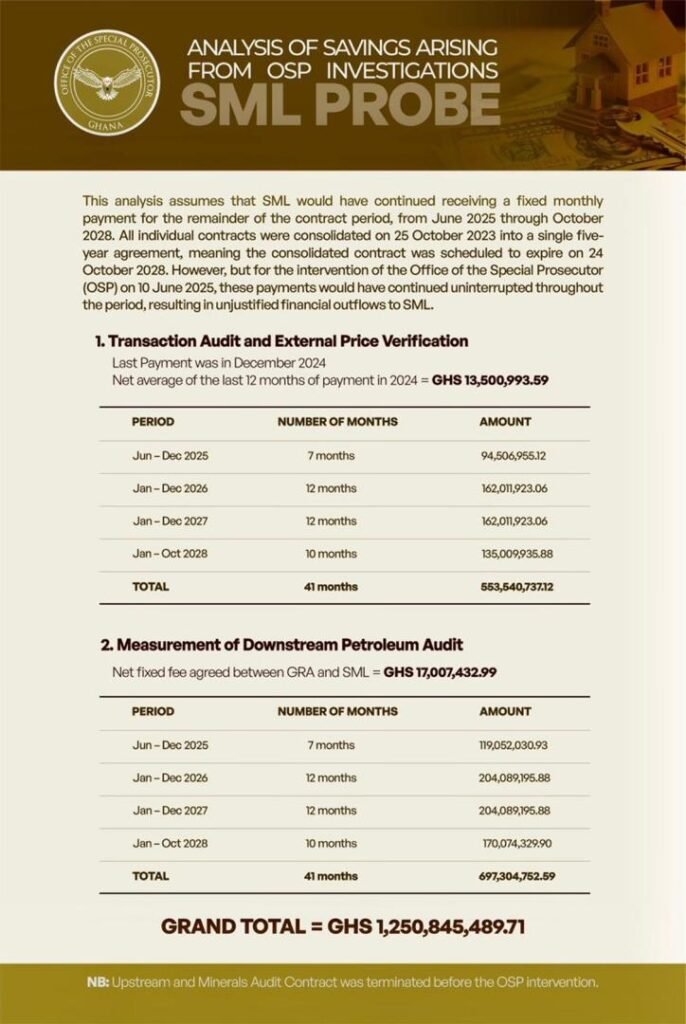
Beyond procedural violations, the investigation uncovered significant structural weaknesses in how payments to SML were administered. The OSP noted that there was no comprehensive financial management system in place to track SML’s performance or determine whether the state received value for money.
As a result, payments to the company were triggered automatically, without verification or assessment of whether contractual obligations had been fulfilled. “The payment channels to SML were set on automatic mode, detached from actual performance, causing financial loss to the Republic,” the Special Prosecutor stated, emphasizing that this arrangement guaranteed SML continuous revenue inflows regardless of actual output.
This automated payment mechanism, the report indicated, created an environment ripe for exploitation and contributed to sustained losses to the state.
The findings have sparked widespread public concern, particularly because the SML contracts had been defended for years as necessary mechanisms to curb revenue leakages. Instead, the OSP’s investigation suggests that the contracts may have deepened the very vulnerabilities they were purported to address.
In the wake of the explosive revelations, President John Dramani Mahama—who assumed office after the investigation concluded—ordered the immediate cancellation of all contracts awarded to SML.
The directive, according to sources within the presidency, reflects a decisive effort to halt what has become one of the most controversial procurement arrangements in recent Ghanaian history. President Mahama’s order signals a broader intention to restore credibility to the public financial system and reinforce accountability in state institutions.

The case is now before the High Court in Accra, where prosecutors are expected to argue that the accused persons acted in concert to manipulate procurement structures for personal and institutional gain. Legal analysts anticipate a complex trial involving extensive documentary evidence and testimonies from current and former public officials.
As the proceedings begin, the SML scandal has reignited national conversations about corruption, procurement reform, and institutional oversight in Ghana’s public sector. For many Ghanaians, the case represents a critical test of the country’s commitment to accountability and the strength of its justice system.
READ ALSO: Cedi Now Respected – Mahama Hails Ato Forson, Asiama over Currency Stability