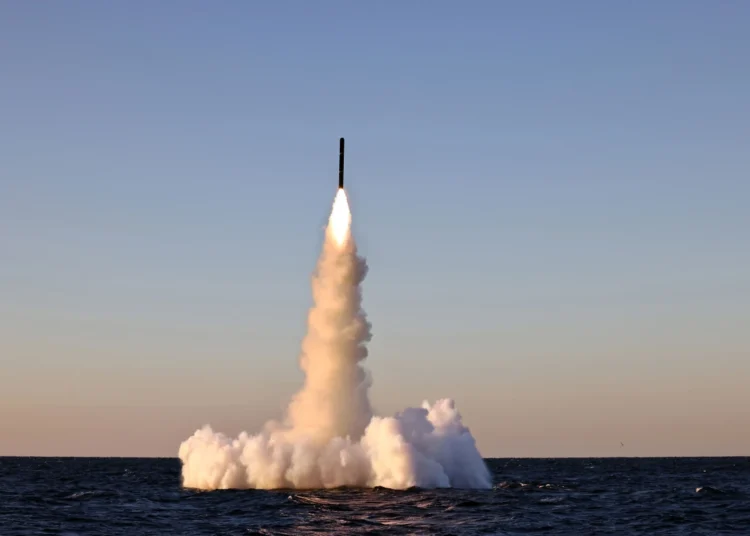
North Korea has conducted its first underwater-launched missile tests in nearly three years, potentially using a submarine designed to carry nuclear weapons, as Pyongyang intensifies its weapons demonstrations.
According to the state-run Korean Central News Agency (KCNA), the tests, conducted on Wednesday in the country’s eastern waters, involved two types of strategic cruise missiles.
KCNA said that the launches were intended to assess the readiness of North Korea’s underwater combat systems and demonstrate the reliability of its nuclear deterrent.
Images released by the agency appeared to show the “Hero Kim Kun Ok” submarine, which North Korea unveiled in September 2023, raising the possibility that the vessel had been used for its first publicly reported weapons tests.
The submarine was presented by Pyongyang as capable of launching tactical nuclear weapons from underwater, although foreign experts previously questioned whether it could operate as described.
If the vessel was involved in Wednesday’s launches, analysts say the tests could indicate that North Korea has begun assessing weapons systems intended for the submarine before its deployment. Such a capability could pose additional challenges for South Korea and the United States because underwater missile launches can be difficult to detect in advance.
South Korea’s Joint Chiefs of Staff confirmed that it had detected the launches and assessed that the missiles were fired from a submarine. According to the South Korean military, one missile was launched through a vertical launch tube and the other through a torpedo tube. The military did not immediately identify the North Korean submarine it believed was involved.
Submarine Tests Raise Questions About Nuclear Capabilities
Before Wednesday’s launches, North Korea’s publicly reported underwater missile tests had been conducted using a submarine in the 2,000-ton class equipped with a single launch tube. Many experts have regarded that vessel as a test platform rather than an operational submarine in active service.
When North Korea unveiled the “Hero Kim Kun Ok,” it claimed that it could launch tactical nuclear weapons from underwater. Images released by state media showed at least 10 missile launch tubes, in addition to its torpedo tubes.
However, foreign experts expressed doubts about the submarine’s capabilities, suggesting it was likely a modified version of an older diesel-powered submarine rather than a vessel designed from the outset for the role claimed by Pyongyang.
The absence of publicly known weapons tests involving the submarine over the following years also raised questions about possible technical difficulties, including its ability to right itself.
Shin Jong-woo, an Analyst at South Korea’s Defense and Security Forum, noted that Wednesday’s tests indicated that North Korea might have addressed those problems and begun testing weapons intended for the submarine.
If confirmed, the activity would mark a significant step in the development of the vessel’s intended weapons capabilities. However, the available information does not establish whether the submarine has entered operational service.
North Korean leader Kim Jong Un has increasingly focused on strengthening the country’s navy after years of prioritising the development of ballistic missiles.

In March 2025, North Korea unveiled its first nuclear-powered submarine under construction. Its completion timeline remains unclear.
The development of underwater launch systems has drawn concern from North Korea’s rivals because missiles launched from submerged platforms could be harder to detect and track before they are fired. Such capabilities could complicate efforts to monitor potential attacks and strengthen regional missile defences.
Missile Demonstrations Add Pressure Amid Stalled Diplomacy
Wednesday’s launches were North Korea’s first underwater testing activities since January 2024, extending a recent series of weapons demonstrations.
The country also tested various hypersonic missile systems on September 20 and October 3. Pyongyang said those tests were intended to advance weapons designed to overwhelm missile defence systems in South Korea and Japan.
The demonstrations come amid continued tensions between North Korea and the United States, with Pyongyang seeking changes to Washington’s approach as a condition for restarting diplomatic engagement.
In August, North Korea rejected what it described as an apparent effort by US President Donald Trump to revive diplomacy with Kim by scaling back a joint military drill involving the United States and South Korea.

Pyongyang argued that reducing the duration of the exercise would not change what it considers the drill’s hostile nature.
North Korea has previously indicated that it could return to negotiations if Washington abandoned its “hostile” policy towards the country and dropped demands for denuclearisation as a precondition for talks.
The latest weapons demonstrations appear to form part of Pyongyang’s broader effort to strengthen its military capabilities while signalling its position to Washington and regional governments.
The tests nevertheless highlight the continuing development of North Korea’s underwater weapons programme at a time when diplomatic efforts remain stalled and security concerns persist across Northeast Asia.
READ ALSO: UCL Wrap: Barca Flex, Brugge Shock Inter, Bayern Held as United’s Woes Continue