Ghana’s solar ambitions must extend beyond installing panels and streetlights if the country is to turn its renewable energy resources into a lasting source of industrial growth, Energy and Green Transition Minister Dr John Abdulai Jinapor has said.
His remarks at the Ninth Session of the International Solar Alliance (ISA) Assembly place a broader economic question at the centre of Ghana’s energy transition: whether the country can build the industrial capacity to produce, assemble and support solar technologies, rather than depend largely on importing equipment to expand its renewable energy infrastructure.
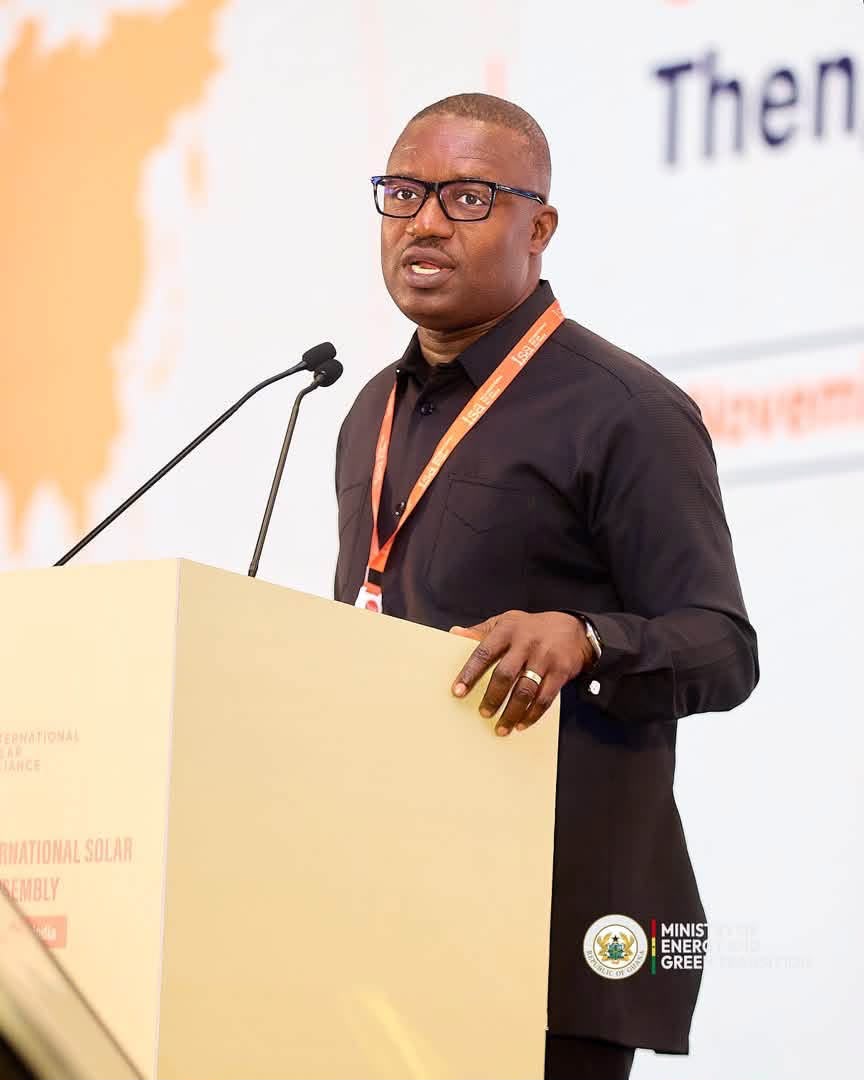
Addressing a discussion on “Global Solar: Then, Now and Next”, Jinapor argued that energy self-sufficiency has become a strategic necessity amid growing geopolitical uncertainty and disruptions in international energy markets.
“In an increasingly uncertain geopolitical environment, energy self-sufficiency is a strategic necessity,” he said.
The minister’s position reflects concerns about the vulnerability of countries that rely heavily on imported fuels and technologies. For Ghana, expanding solar energy could reduce exposure to some external energy-market pressures.
But the more ambitious objective is to ensure that the transition also strengthens domestic production, employment and technological capabilities.
That distinction is important. Increasing solar installations can expand renewable electricity generation, but it does not automatically create a competitive local industry or guarantee that the economic benefits remain within the country.
Energy Security Beyond Fuel Imports
Jinapor’s remarks connect solar development to the wider question of energy security. Recent disruptions in global energy markets, he argued, have demonstrated the risks associated with excessive dependence on imported fuels.
For Ghana, that concern has practical implications. The country’s energy system relies on a combination of domestic and imported fuels, while changes in international prices and supply conditions can affect the cost and reliability of energy provision.
Solar offers an opportunity to diversify the generation mix and reduce the amount of fuel required to meet certain electricity needs.
Distributed systems, rooftop installations and solar-powered public infrastructure can also provide alternatives in locations where extending conventional electricity infrastructure may be costly or difficult.
The minister said Ghana was pursuing this direction through solar streetlight installations, the promotion of rooftop solar and policies intended to transition critical public installations to solar energy.
These measures could contribute to reducing electricity demand from the conventional grid, depending on their scale and implementation.
However, their overall impact will depend on how much capacity is installed, whether systems remain operational and how effectively solar generation is integrated into the wider electricity network.
The policy challenge is therefore to move from individual projects towards a coordinated programme that delivers measurable additions to renewable capacity and improves the country’s energy resilience.
The Bigger Ambition Is To Build A Solar Value Chain
The more consequential part of Jinapor’s message was his call for Africa to develop the entire solar value chain.
“Our ambition must go beyond deployment. We must develop the entire solar value chain, positioning Africa not merely as a consumer but as a producer and value creator,”
The distinction between consuming and producing solar technology has significant economic implications.
Solar deployment requires more than photovoltaic panels. It involves inverters, batteries, mounting structures, electrical components, installation services, maintenance, technical training and financing.
Countries that develop capabilities across these activities can capture a wider share of the economic value created by the renewable energy transition.
For Ghana, this presents an opportunity to connect its energy policy with industrial development. Local businesses could participate in equipment assembly, component supply, installation, system maintenance and engineering services.
Universities and technical institutions could also support research, skills development and technology adaptation.
But building this capacity will require more than political commitment. Domestic manufacturers and service providers need predictable demand, access to affordable credit, appropriate technical standards and opportunities to compete for projects.
Without these conditions, increased solar investment could expand the market while leaving much of the manufacturing and higher-value activity outside Ghana.
Financing And Technology Transfer Remain Major Tests
Jinapor identified technology transfer, local industrial capacity and affordable long-term financing as essential requirements for developing Africa’s solar industry.
The financing issue is particularly important because renewable energy projects often require substantial upfront investment, even when their operating costs are relatively low.
For households and small businesses, the cost of purchasing and installing solar systems can remain prohibitive without accessible credit or appropriate payment arrangements.
Larger projects also require financing structures that match their development timelines and revenue expectations.
Affordable long-term capital could help local companies expand operations, finance equipment purchases and participate in larger installations.
It could also support the development of domestic manufacturing and assembly facilities, where commercially viable.
Technology transfer is equally important. Importing finished solar products may accelerate deployment, but it does not necessarily create the technical expertise or industrial knowledge required to develop a competitive domestic sector.
A more deliberate approach would involve partnerships that build local engineering capabilities, train technicians, support research and create opportunities for Ghanaian firms to participate in production and servicing.
However, local manufacturing ambitions must also be grounded in commercial realities. Ghana will need to assess which parts of the solar value chain can be developed competitively, the scale of demand available and the investment required to make domestic production sustainable.
Ghana Must Connect Solar Policy To Industrialisation
The minister’s call for solar to become a catalyst for industrialisation and job creation raises questions about how Ghana intends to translate its renewable energy ambitions into domestic economic opportunities.
“Our abundant sunshine must become a catalyst for industrialisation, job creation, economic resilience and energy sovereignty,” Jinapor said.
The statement points to a broader development objective: renewable energy should not only change how electricity is generated, but also create productive economic activity around the technologies supporting the transition.
For Ghana, this would require closer coordination between energy policy, industrial policy, investment promotion and technical education.
Solar programmes could create stronger opportunities for local businesses if procurement frameworks encourage domestic participation where firms can meet the required standards and deliver competitively.
The government would also need to ensure that public-sector solar projects are supported by clear implementation plans, maintenance arrangements and transparent assessments of performance.
Installing equipment without providing for its long-term operation risks turning investment into underused infrastructure.
There is also a need to distinguish between expanding solar adoption and achieving energy sovereignty.
Greater use of solar power can reduce dependence on imported fuels, but dependence on imported panels, batteries and other critical components may create a different form of external exposure.
Developing local capacity across selected parts of the value chain could help address that vulnerability over time.
Jinapor’s intervention at the ISA Assembly therefore presents Ghana’s solar transition as both an energy security priority and an industrial development opportunity.
The immediate task is to expand reliable solar deployment, but the longer-term challenge is to ensure that the country develops the financing, skills, businesses and technical capabilities to participate meaningfully in the industry.
Ghana’s sunshine provides a natural resource advantage. Whether that advantage translates into energy sovereignty and domestic economic value will depend on the policies and investments that connect solar installations to a viable local industry.
READ ALSO: Access Holdings Unveils Bold Push to Transform Africa’s Financial Markets