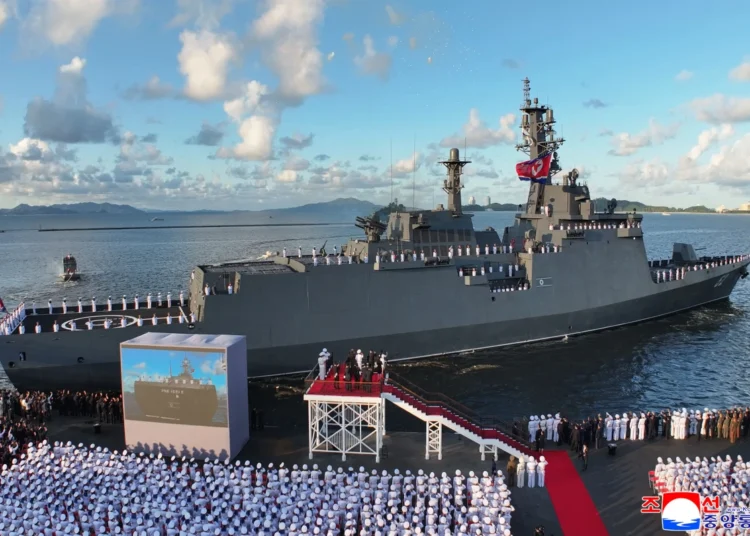
North Korean leader Kim Jong Un has commissioned the country’s second naval destroyer, marking another step in Pyongyang’s efforts to strengthen its maritime military capabilities and expand the role of nuclear weapons in its navy.
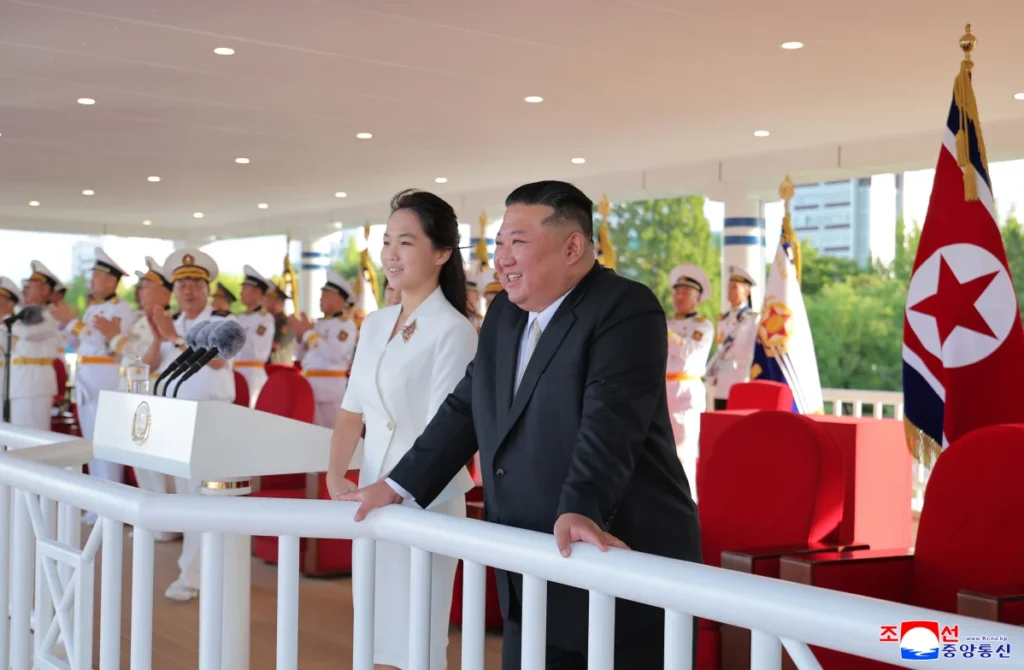
The 5,000-ton destroyer, named Kang Kon, was commissioned at a ceremony in the eastern port city of Wonsan, according to North Korean state media on Monday. Kim attended the ceremony alongside his teenage daughter, whom South Korea’s spy agency has identified as his likely successor.
The commissioning of the Kang Kon comes as North Korea continues to modernise its navy after years of prioritising the development of ballistic missiles and other land-based weapons. The country has increasingly turned its attention to developing larger and more capable warships that can carry both conventional and nuclear weapons.
The Kang Kon is the second of North Korea’s new 5,000-ton destroyers to enter service. The first, the Choe Hyon, was commissioned in June. North Korean state media said both vessels are capable of carrying a range of conventional and nuclear weapons, making them the largest and most advanced warships currently operated by the North Korean navy.
Experts believe the two destroyers were likely constructed with Russian assistance, reflecting the growing military cooperation between Pyongyang and Moscow. North Korea said in July that it had test-fired nuclear-capable cruise missiles from the Kang Kon, highlighting the vessel’s potential role in the country’s nuclear weapons strategy.
The development of the destroyers could significantly enhance North Korea’s offensive and defensive capabilities at sea. Outside experts have said the vessels’ weapons and radar systems represent an improvement over the capabilities of North Korea’s existing naval fleet.
Kim has previously acknowledged shortcomings in the country’s navy, saying it lacked warships capable of adequately carrying out its missions until recent years. The rapid addition of the two destroyers therefore signals a broader effort to transform the North Korean navy into a more capable force, particularly as Pyongyang seeks to strengthen its ability to deploy nuclear weapons from different platforms.
The commissioning also comes amid heightened tensions involving North Korea, the United States and South Korea. North Korea has also increased pressure on Washington after rejecting President Donald Trump’s decision to scale back a major military exercise with South Korea, a move that had been viewed as a possible conciliatory gesture towards Pyongyang.
Analysts believe North Korea’s increasingly assertive military posture could be aimed at strengthening its negotiating position and securing greater concessions from Washington. The latest naval development is particularly significant because a more capable fleet could give North Korea additional options for deploying its nuclear weapons beyond its established land-based missile systems.
Kim Iterates Call For Stronger Nuclear Deterrent
Speaking at the commissioning ceremony, Kim Jong Un said that the addition of the two destroyers demonstrated growing concern among countries North Korea considers its adversaries and called for further strengthening the country’s nuclear deterrent.
Kim stated that the expansion of the navy’s nuclear capabilities would allow North Korea to use its nuclear deterrent in a wider range of circumstances. “Concerns of the enemies will be surely deepened,” Kim said.
He called for the country to establish what he described as a “powerful and reliable nuclear war deterrent” while expanding the ways in which its nuclear combat systems could be used.
“We must establish more clearly a powerful and reliable nuclear war deterrent, to put into practice the diverse and effective operation of our nuclear combat systems and further strengthen our military activities for maritime defense and war deterrence.”
Kim Jong Un
Kim also announced that North Korea was pursuing another “significant” naval development that he said would be unveiled within eight months. The nature of the project was not immediately disclosed, but outside observers believe it could be connected to Kim’s long-standing ambition to acquire a nuclear-powered submarine.
A nuclear-powered submarine would represent a major expansion of North Korea’s nuclear capabilities by potentially allowing its forces to operate farther from the country’s shores and making its nuclear arsenal more difficult to detect and target. The development would also fit into Kim’s broader effort to diversify the platforms from which North Korea could deploy nuclear weapons.
The commissioning of the Kang Kon, following the Choe Hyon earlier this year, suggests that naval modernisation is becoming an increasingly important component of that strategy.
As North Korea continues to develop its naval forces, its neighbours and the United States are likely to closely monitor the capabilities of the new destroyers and any further vessels or submarine projects Pyongyang unveils.
READ ALSO: Kofi Kinaata To Perform at Cape Coast Afahye Highlife Party Tonight