
The Ghana Education Service (GES) has announced that it has finally received financial clearance to facilitate the payment of salaries for 6,249 teachers who were recruited in 2024 but have remained unpaid for months.
The announcement, signed by the Head of Public Relations, Daniel Fenyí, represents a major relief for thousands of frustrated teachers who have been working without salaries despite multiple assurances from education authorities.
According to the official statement, the “financial clearance has been granted for the payment of salaries of the remaining six thousand two hundred and forty-nine (6,249) teachers recruited in 2024.” This approval, the Service said, now paves the way for all internal processes to be concluded so that the affected teachers can begin receiving their long-awaited salaries.
The GES further indicated that although the clearance is valid only until 31st December 2025, Management is confident that the new staff will be placed on the mechanised payroll in time for the November 2025 salary cycle.
The announcement comes at a time when pressure has been mounting on both the GES and the Ministry of Education to address the prolonged delays. For many months, newly recruited teachers—made up of both College of Education graduates and university graduates—have been teaching without pay, a situation that generated widespread frustration across the education sector.
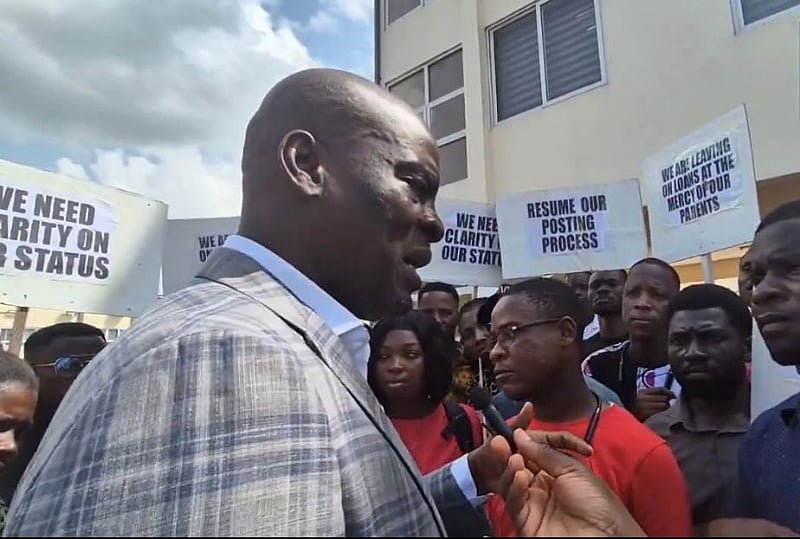
Some teachers have worked for almost a year without receiving a single salary, despite having completed all validation processes and being duly posted to classrooms across the country.
The affected teachers fall into two key groups. The first consists of the 2022 batch of College of Education graduates who were recruited in 2023 but began teaching in January 2024.
Many of them entered the service with the expectation that the usual administrative procedures would be completed promptly, only to find themselves working for months without compensation.
The second group includes university graduates who joined the GES in 2024 and have also endured prolonged delays in accessing their salaries. Both groups have consistently expressed frustration over the impact the delays have had on their livelihoods and morale.
For months, these unpaid teachers shared similar experiences: working full-time, meeting academic expectations, contributing to school programmes, and still having to rely on personal loans, family support, and occasional stipends to survive.
Several complained that the constant uncertainty about when payments would begin made it difficult to plan financially or maintain stability in their personal lives. Others noted that the unpaid months had taken a toll on their motivation, especially as they watched peers who completed their training in previous years receive salaries without similar challenges.

Timely Intervention
While the GES had on various occasions urged patience, citing ongoing administrative processes, many of the affected teachers felt the delays had gone on far longer than necessary.
Their calls for intervention intensified in recent months, with some groups threatening to withdraw their services if the situation was not resolved. It is within this context that the newly announced financial clearance is likely to be received as a welcome, though long-overdue, response.
In the official statement, the GES acknowledged the commitment and perseverance shown by the affected teachers, noting that “Management thanks all staff for their dedication and remains committed to facilitating timely and accurate salary payments.”
The agency emphasised that it is working to ensure that the mechanisation of the payroll is completed swiftly so that the affected teachers do not experience further delays.
The broader issue of delayed salary payments, however, remains a recurring challenge within Ghana’s education sector. Over the past decade, similar incidents have occurred, often linked to bureaucratic bottlenecks, validation delays, or the slow pace of financial clearance from the Ministry of Finance.
Many education stakeholders argue that these repeated occurrences point to the need for deeper systemic reforms to streamline recruitment, posting, and payroll processes. Without such reforms, they warn, the sector risks continuous disruptions, demotivation among new entrants, and potential loss of trained teachers to other industries or countries.
For now, though, the news of the clearance provides some relief. Teachers who have spent months working without compensation can finally look forward to their first paycheque.
As the GES moves to complete the mechanisation process ahead of November, there is hope for the affected teachers that this marks the end of the long and stressful wait for salary justice.
READ ALSO: Ghana to Outshine China and Major Emerging Economies in 2026 Growth Race