Leaders of India’s youth-led Cockroach Janta Party (CJP) have vowed to continue their protests against Prime Minister Narendra Modi’s government after being released from police detention, as demonstrations and a major security crackdown continued in Delhi for a second day.
The party’s founder, Abhijit Dipke, and fellow leaders Saurav Das and Ashutosh Ranka were detained on Saturday alongside thousands of others as authorities moved to prevent protesters from gathering in the Indian capital.
By Sunday morning, a magistrate had ordered the release of the three leaders on the condition that they would not breach the peace for a year.

At a press conference on Sunday afternoon, the CJP leaders Das and Ranka condemned the police and government for turning Delhi into a “war-like situation” and reiterated their message of defiance, saying that “this fight is on.”
Following his release, Dipke launched a sharp attack on Modi in a social media post, accusing the Prime Minister of undermining India’s standing through his response to political opposition.
“Modi, as PM, is an embarrassment to India. Never has this country seen a bigger coward and bully.”
Abhijit Dipke
The protests were organised by the CJP alongside student groups and civil society leaders to demand the resignation of India’s Election Commissioner, Gyanesh Kumar, over a voter roll revision that protesters say threatens democratic participation.
Kumar has faced accusations of overseeing an exercise that removed 130 million names from India’s electoral roll. Critics allege that the revision could disenfranchise minority communities, including Muslims, and strengthen the electoral position of Modi’s ruling Bharatiya Janata Party (BJP).
The government and the BJP have rejected allegations of political interference, maintaining that the revision is a legitimate exercise intended to remove deceased and ineligible voters from the electoral register.
Security Crackdown Triggers Further Anger
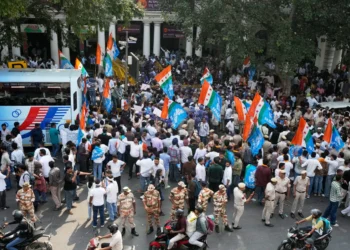
Saturday’s demonstrations were met with a sweeping security operation across Delhi, with more than 25,000 police officers deployed and roads blocked by barricades.
Internet services and public transport were also shut down, while more than 7,000 people were reportedly taken into police custody. Many were detained before reaching the planned protest site in the centre of the capital.

Several senior opposition politicians were among those detained as authorities sought to prevent large gatherings. Despite the restrictions, the protests represented a significant display of dissent against Modi’s government, which has been in power for 12 years and faced repeated criticism from opposition groups over its treatment of political opponents.
By Sunday, central Delhi remained heavily secured, with barricades blocking roads and tens of thousands of police and paramilitary personnel still deployed.
According to the account provided, Supreme Court judges ruled that the government must restore internet access and reopen metro stations in the capital.
Small groups of students and CJP supporters nevertheless attempted to demonstrate again on Sunday. Some were detained, including individuals who had just been released from custody. The continued demonstrations indicated that the arrests and restrictions had not ended the protesters’ campaign.
Protest Leaders Widen Demands

At the press conference thid afternoon, Das and Ranka also broadened their demands, saying that the campaign was no longer focused solely on Kumar but also on Modi and Home Minister Amit Shah.
“The state is at war with its own citizens. An atmosphere of fear has been created in country, it’s clearly being done to save one person. We want to ask Modi and Shah, why are you trying to save Gyanesh Kumar?”
Saurav Das
The protesters have accused the government of using the voter roll revision to influence the electoral landscape in favour of the BJP. However, these allegations have been disputed by the ruling party.
There was no response from Modi to the accusations made by the protesters in the account provided. However, BJP spokesperson Gaurav Bhatia defended the voter roll revision, saying that it was intended to remove deceased and illegal voters rather than interfere with the political process.
“These are baseless allegations being levelled by an irresponsible opposition.
“The claim that democracy is being destroyed and that the constitution is being undermined has no basis and not an iota of evidence.”
Gaurav Bhatia
The demonstrations have also received support from Rahul Gandhi, leader of India’s opposition alliance, who has accused the Modi government of “vote chauri”, or vote cheating, through the voter roll revision.
Gandhi was detained twice the previous week as opposition parties attempted to organise a protest in central Delhi demanding Kumar’s resignation.
On Saturday, he issued a warning to the Prime Minister, signalling that the opposition intended to maintain pressure on the government.
“Mr Modi does not understand that the game is over. We will ensure that Modi pays for the crimes he has committed against the country.”
Rahul Gandhi
The protests have brought together youth activists, students, civil society groups and opposition politicians around concerns about electoral integrity and the role of the election commissioner.
For the CJP leaders, the release from detention has not brought an end to their campaign. Their public statements indicate that they intend to continue challenging the government over the voter roll revision and what they describe as an attempt to undermine democratic accountability.
The government, meanwhile, continues to defend the revision as a lawful administrative process and has rejected claims that it is designed to benefit the ruling party.
As Delhi remains under heightened security, the confrontation shows growing tensions between opposition groups and the Modi administration over electoral procedures, political freedoms and the right to protest.
READ ALSO: Tennessee Suspends Executions After Failed Lethal Injection Attempt