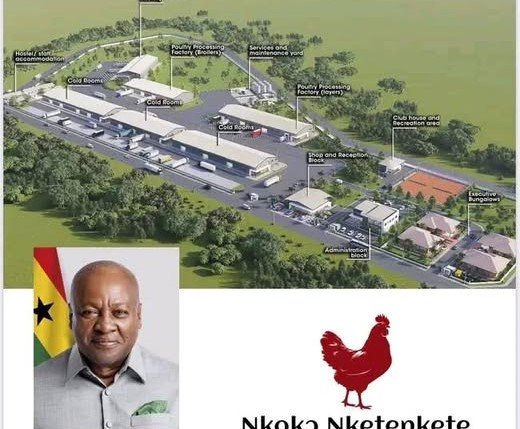
Ghana’s Minister for Food and Agriculture, Hon. Eric Opoku, has announced that the government will complete and commission a major poultry processing plant in Bechem within one year, marking a significant milestone in the country’s broader agenda to revive the domestic poultry industry.
The Minister made the remarks ahead of the official sod-cutting ceremony scheduled for Thursday, 27th November 2025, explaining that the project forms part of a deliberate national strategy to reduce Ghana’s dependence on imported poultry and bolster local production capacity.
Speaking in an interview ahead of the ceremony, Hon. Opoku said the government was fully committed to ensuring that the Bechem project is delivered on schedule, with all funding and implementation arrangements already secured.
“We are getting a lot of private individuals to set up processing plants, and the government is directly intervening in this area, We are setting up poultry processing plants, a big one in Bechem.”
Ghana’s Minister for Food and Agriculture, Hon. Eric Opoku
He explained that the choice of Bechem was strategic, given its proximity to major poultry-producing zones in both the Bono and Ashanti regions. “We chose Bechem strategically,” he stated.
“A lot of Ghana’s poultry is in the Bono and Ashanti, so we decided to locate it in the middle where both the Bono and the Ashanti can easily access.” He further noted that the area benefits from improved transportation links, including the Sunyani Airport, which enhances access to markets and distribution routes.

Contractor on Site
Assuring the public of the project’s timely delivery, the Minister revealed that the contractor is already on site and work is actively underway. “The contractor is already on site; work has started already,” he said confidently.
According to him, the Ministry has left no loose ends in securing the resources required for the plant’s construction. “Everything is set for the project to be commissioned within one year. So there’s no funding gaps, no funding issues, no…” he stressed.
To underline his commitment, he pledged strict oversight. “Trust me, I will monitor and make sure that within one year it is done,” he said. “One year, I will come here with the pictures for you to look at.”
This ambitious project comes on the heels of the Nkoko Nkitinkiti Programme—also known as the Household and Backyard Poultry Production Initiative—launched by President John Dramani Mahama in Kumasi on 11th November 2025.
The initiative represents the administration’s most comprehensive and aggressive intervention in Ghana’s poultry sector in decades. It focuses on empowering households, smallholder farmers, and youth groups to venture into poultry production as a means of improving nutrition, boosting local food systems, and creating employment across communities.
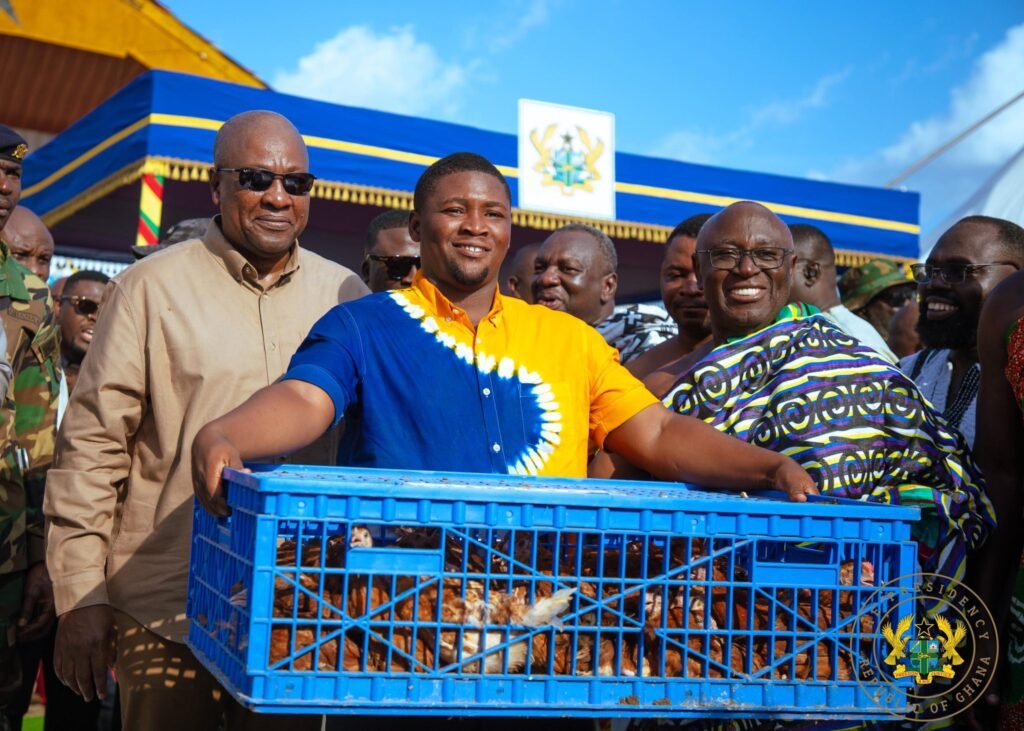
The Nkoko Nkitinkiti Programme is designed to realign Ghana’s poultry value chain by supporting production at both household and commercial levels. Its interventions range from the distribution of starter birds and feed to providing training in best practices, disease control, and small-scale business management.
It also includes a financing model aimed at helping communities establish sustainable micro-enterprises capable of feeding into larger processing plants—including the facility set to rise in Bechem. President Mahama has insisted that Ghana must cut its overreliance on imported poultry, which continues to drain national resources.
In 2023 alone, the country spent more than US$350 million importing poultry products to meet domestic demand—a figure the government considers both unsustainable and counterproductive to the vision of building a resilient, self-sufficient agricultural economy.
The Bechem poultry processing plant, once completed, is expected to be a central pillar of this strategy. It will serve as a major processing hub capable of handling large volumes of poultry supplied by farmers from surrounding regions.
Centralizing Processing Activities
By centralizing processing activities, the government aims to guarantee quality, meet market standards, and create a ready market for tens of thousands of farmers. This is expected to provide stability to the poultry industry, which has long struggled with high input costs, limited access to structured markets, and competition from cheap imports.

The processing plant signals a shift from fragmented small-scale production to a more integrated and commercially viable poultry sector. The facility is anticipated to create hundreds of direct jobs and thousands of indirect jobs across transportation, feed supply, veterinary services, packaging, cold-chain logistics, and retail distribution.
It is also expected to boost local agribusiness, encourage investment, and improve the profitability of poultry farming. Government officials say the new plant will also serve as a training and innovation centre where farmers can receive technical support, learn modern production techniques, and upgrade their operations to meet emerging market demands.
The Ministry of Food and Agriculture believes that supporting farmers with access to technology and structured markets will help raise productivity and improve food safety standards nationwide.
The broader national poultry plan aligns with Ghana’s agricultural transformation agenda, which seeks to enhance food security, reduce imports, and empower rural communities.
The Mahama administration has made the revitalization of the poultry sector a priority, citing its potential to drive rural development, provide affordable sources of protein, and anchor agribusiness growth.
Officials argue that Ghana’s climatic conditions, entrepreneurial population, and growing demand for poultry make it ideal for local production to thrive—provided the right investments and infrastructure are in place.

Hon. Opoku expressed confidence that the Bechem plant would soon become a model for other regions and a demonstration of the government’s commitment to practical, results-oriented action.
He encouraged the public to follow the project’s progress and reassured Ghanaians that both private and public investments will continue to flow into the poultry industry. “We are getting a lot of private individuals to set up processing plants,” he emphasized, noting that government support is creating renewed interest among investors.
As preparations for Thursday’s sod-cutting ceremony advance, expectations are high that the Bechem project will energize the entire poultry value chain. And for the Minister of Food and Agriculture, the one-year deadline is not just an ambition, but a promise he intends to deliver.
READ ALSO: Mahama Urges Africa to Assert Control Over Natural Resource