
In a synchronized push to deepen bilateral economic ties and accelerate national agricultural transformation, Ghana’s High Commissioner to the United Kingdom, Her Excellency Mrs. Sabah Zita Benson, has hosted a high-level cross-sectoral delegation from Ghana’s agribusiness industry at the Mission in London.
The diplomatic engagement occurred as the Ghanaian delegation arrived in the United Kingdom to participate in Cereals 2026, globally recognized as one of the premier technical exhibitions for arable farming, crop management, and breakthrough agricultural innovations.
This high-profile visit marked a deliberate shift by Ghanaian trade diplomats toward utilizing advanced international technology forums to secure cross-border partnerships, scale up non-traditional export volumes, and court foreign direct investment for heavy mechanization projects.
“The delegation, comprising representatives from agribusiness, food processing, poultry farming, media, and local government, engaged the High Commissioner on opportunities to expand the reach of Ghanaian products within the UK market and promote greater investment in modernised agriculture”
Ghana’s High Commission to the United Kingdom
Presenting a unified front to British buyers and agritech developers, the coalition reshaped how Ghanaian agricultural output is viewed in European markets, moving the conversation past raw production toward high-yield, premium-grade processing.

The participation of Ghanaian enterprises in Cereals 2026 highlighted an urgent need to modernize domestic production methods, as the summit provided an intensive showcase of advanced precision farming tools, drone-assisted crop monitoring systems, smart irrigation networks, and next-generation seed technologies.
For the visiting Ghanaian delegates, the primary objective extended beyond exploring international equipment to establishing concrete, long-term technological transfer agreements.
Local processors and poultry farmers explored structural solutions that can optimize yield efficiencies back home, reduce post-harvest resource losses, and stabilize raw material supply chains within domestic production hubs.
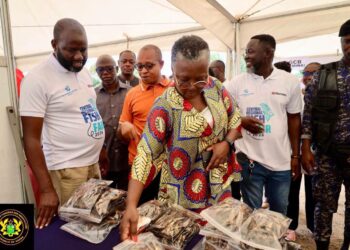
During the diplomatic briefing at the High Commission, members of the delegation presented an assortment of specialized packaged foods and value-added commodities, seeking the direct intervention of the diplomatic mission to navigate the rigorous phytosanitary and regulatory frameworks governing the British retail market.
The integration of local government administrators within the trade group ensured that the insights gained from Cereals 2026 would not remain confined to urban corporate boardrooms.
The regional administrators studied specialized methods to deploy localized agricultural infrastructure, including communal processing facilities and modernized storage warehouses, directly within rural farming communities to support smallholder networks.

Launchpad for Market Penetration
A central pillar of Ghana’s trade diplomacy strategy in Western Europe was the operational deployment of the Ghana Trade House. Addressing the delegation, High Commissioner Mrs. Sabah Zita Benson emphasized that the diplomatic mission functions as a permanent commercial ally rather than just a political outpost.
The Ghana Trade House was highlighted as a functional, state-backed logistical center engineered to provide domestic exporters and small-scale entrepreneurs with a direct warehouse and display hub within the United Kingdom.
This institutional platform drastically lowers the financial entry barriers that traditionally prevent African agribusinesses from gaining retail visibility overseas. To optimize this commercial pipeline, the High Commissioner urged the corporate executives to maintain a close, continuous partnership with the Ghana Export Promotion Authority (GEPA).
As the primary statutory agency tasked with building export readiness, GEPA is positioned to refine product packaging, implement strict traceability standards, and help local manufacturers secure necessary international safety certifications.
Through this combined approach, the government aims to upgrade the global competitiveness of Ghanaian agro-processed goods, transforming them from niche ethnic commodities into competitive items capable of populating mainstream British supermarkets and wholesale distribution networks.
The long-term economic path for Ghana’s agricultural sector requires an aggressive transition away from manual farming methods toward large-scale industrial mechanization, and the meetings at the London mission focused heavily on using the visibility provided by Cereals 2026 to position Ghana as a secure, high-yield investment destination for British agricultural investors, equipment manufacturers, and green energy financiers.

Representatives from the food processing and poultry sectors explained that increased capital inputs are required to construct automated processing plants, specialized cold-chain logistics systems, and regional feed formulation mills.
Furthermore, the participation of specialized agricultural media houses within the delegation ensured a robust domestic documentation of these technical advancements, building an informed public narrative around modern agronomy and attracting Ghanaian youth toward high-tech agribusiness ventures.
As the delegation concluded its initial briefings after the exhibition floor at Cereals 2026, the combined efforts of the High Commission, GEPA, and private sector leaders show a clear blueprint for modern economic diplomacy – one where state resources are actively deployed to turn trade potential into long-term commercial wealth.
READ ALSO: Ghana Gas CEO Showcases Regional Natural Gas Sector Investment Potential