Ghana’s renewed push to resuscitate its declining oil output has ignited a fresh wave of scrutiny, following government’s announcement that the Ghana National Petroleum Corporation (GNPC) will drill its first onshore exploration well in the Voltaian Basin in October 2026.
The project, touted as a flagship intervention in reversing the country’s production downturn, is now facing serious questions from civil society organisations over its readiness, feasibility and value for money.
Policy Lead on Oil and Conventional Energy at the Africa Centre for Energy Policy (ACEP), Kodzo Yoatse, said public confidence in GNPC’s execution capacity has eroded rather than improved.
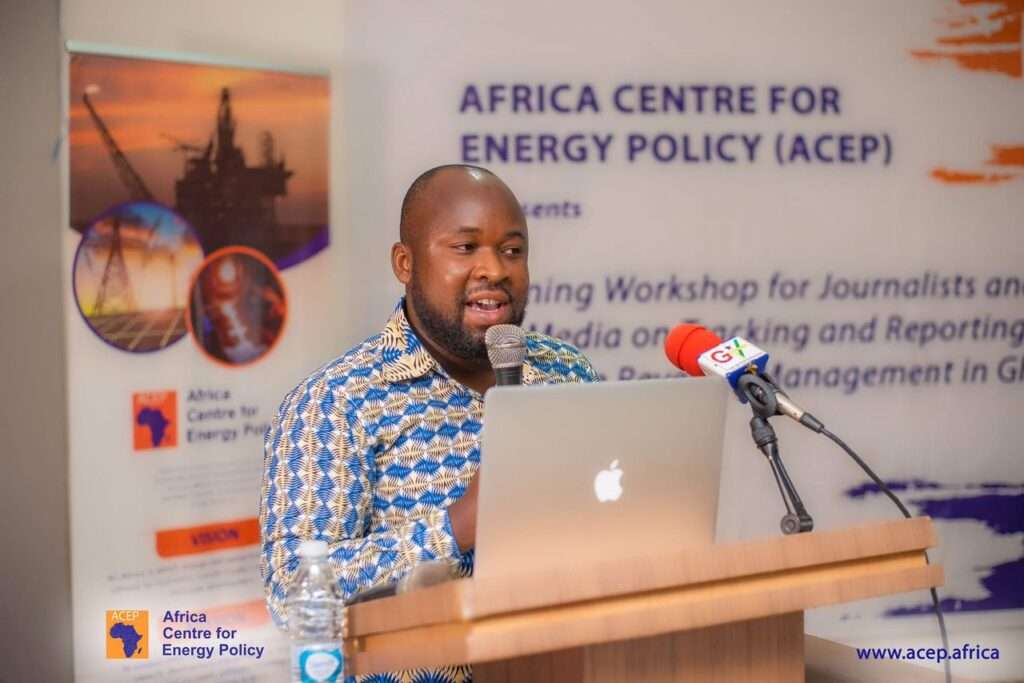
“GNPC has not given us anything to instil confidence about the Voltaian Basin’s prospects.
“Even the timeline for drilling keeps shifting. The Corporation has spent over US$120 million on that basin over the years with nothing concrete to show.”
Kodzo Yoatse, Policy Lead on Oil and Conventional Energy at ACEP
Mr. Yoatse insisted that government should urgently reclaim dormant petroleum blocks currently left idle and reallocate them to qualified operators capable of undertaking active exploration, describing it as a more practical step toward reversing Ghana’s production decline.
Voltaian Basin Won’t Deliver Before 2033

Beyond concerns over GNPC’s preparedness, experts are also questioning the feasibility of the basin itself, particularly its ability to contribute meaningfully to national output any time soon.
The Africa Sustainable Energy Centre (ASEC) issued a blunt assessment, cautioning against any assumption that the Voltaian Basin could support Ghana’s short-term revenue needs.
“Commercial production from the Voltaian Basin is not feasible before 2033–2036. While it remains a long-term strategic asset, it cannot be the country’s answer to current fiscal pressure.”
Dr Elvis Twumasi, ASEC’s Director of Research and Innovation
ASEC’s Director of Research and Innovation, Dr Elvis Twumasi, emphasised that the basin’s true value lies in the distant future, not the present.
“The basin should be viewed as a future pillar of Ghana’s petroleum sector, not as a remedy for present revenue shortfalls.”
Dr Elvis Twumasi, ASEC’s Director of Research and Innovation
He said the national focus should be on stabilising output from existing fields and ensuring transparent management of state oil revenues, areas where he believes GNPC has fallen short.
ASEC expressed deep worry over GNPC’s recent financial conduct, arguing that the state oil company cannot spearhead Ghana’s upstream revival unless it first builds strong internal discipline.
“ASEC is deeply concerned that GNPC has failed to remit US$488.8 million of Explorco lifting proceeds to the Petroleum Holding Fund.
“This represents a breach of transparency and statutory obligations.”
Dr Elvis Twumasi, ASEC’s Director of Research and Innovation
He added that instances of questionable spending, most notably the GH¢4.9 million golf clubhouse expenditure, undermine public trust at a time when national resources must be protected.
“These matters must be under formal review, and government should enforce full accountability before handing over oil fields to its subsidiary, Explorco.”
Dr Elvis Twumasi, ASEC’s Director of Research and Innovation
Government Defends Voltaian Basin Gambit

The renewed debate follows Finance Minister Dr Cassiel Ato Forson’s announcement during the presentation of the 2026 Budget that the state is moving ahead with its Voltaian Basin programme.
He insisted that government is taking “decisive action” to reverse Ghana’s steep production decline.
Crude output has fallen from 71.4 million barrels in 2019 to a projected 36 million barrels in 2026, a sharp drop that has weakened petroleum revenue and aggravated fiscal pressures.
Dr. Forson described early studies on the basin as encouraging. “The prospects look good to expand Ghana’s hydrocarbon production,” he said,
He added that government is reviewing upstream regulatory and fiscal regimes to make the sector “more competitive and transparent.”
But civil society organisations say the state’s optimism needs to be matched with technical evidence and a realistic timeline.
The Corporation had earlier indicated that drilling would commence in 2025. At the 2024 Local Content Conference and Exhibition in Takoradi, GNPC’s Manager for Exploration and Appraisal, Michael Aryeetey, described the basin as a potential “game-changer” capable of unlocking sizable hydrocarbon reserves.
But with timelines shifting yet again, now to 2026, stakeholders say the inconsistencies raise serious questions.
A High-Stakes Gamble for Ghana’s Oil Future
With crude production falling sharply and revenue pressures mounting, Ghana’s gamble on the Voltaian Basin has become a major national conversation.
While government insists the basin holds significant promise, analysts argue that its benefits lie far into the future too far to solve today’s fiscal strain.
Civil society organisations are therefore calling for prudence, accountability, and a pragmatic approach that balances long-term exploration with immediate steps to stabilise production.
Whether Ghana’s first onshore well in 2026 becomes a turning point or another costly experiment will depend on the transparency, technical rigour, and discipline shown in the months ahead.