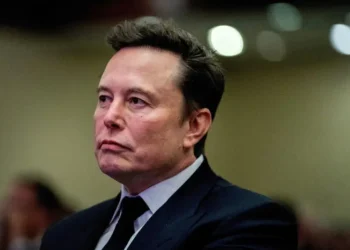
Nearly half of Europeans now consider former US President Donald Trump as “an enemy of Europe,” according to a recent survey conducted across nine countries.
The poll, commissioned by the Paris-based European affairs debate platform Le Grand Continent, paints a picture of a continent deeply anxious about its geopolitical future.
Jean-Yves Dormagen, a political science professor and founder of the polling agency Cluster17, explained the significance of the findings.
“Europe is not only facing growing risks, it is also undergoing a transformation of its historical, geopolitical and political environment. The overall picture [of the survey] portrays a Europe that is anxious, that is deeply aware of its vulnerabilities and that is struggling to project itself positively into the future.”
Jean-Yves Dormagen
The survey revealed a significant variation in perception of Trump across countries. In Belgium, 62 percent of respondents viewed him as hostile, followed by France at 57 percent.
Meanwhile, Croatia reported the lowest level of hostility at 37 percent, and only 19 percent in Poland considered Trump an enemy. Dormagen emphasized that “across the continent, Trumpism is clearly considered a hostile force.” He also noted that the perception of Trump is hardening, with fewer people than in December 2024 describing him as “neither friend nor foe.”

Fear of War with Russia Grows
Alongside concerns about Trump, Europeans are increasingly worried about the possibility of conflict with Russia. The survey found that a relative majority, 51 percent, believe the risk of open war in the coming years is high, with 18 percent considering it very high.
The perception of risk varies depending on geographical proximity to Russia. Poland, which shares a border with Russia, reported the highest concern at 77 percent. France, Germany, Portugal, and Italy recorded lower levels of perceived risk at 54, 51, 39, and 34 percent respectively.
Dormagen highlighted the implications of these findings, stating that “this result would have been unthinkable just a few years ago and signals the shift of European opinion toward a new geopolitical regime in which the possibility of direct conflict on the continent is now widely accepted.”

Low Confidence in National Defense
The survey also revealed widespread doubts about national defense capabilities. Overall, 69 percent of respondents across the nine countries felt their nation was “not really” or “not at all” capable of defending itself against Russian aggression. France was the only country where confidence reached a minority level at 44 percent, while in Poland, 58 percent felt incapable of defending themselves. Dormagen described this sentiment as entering “an age of danger while feeling a persistent sense of national weakness.”
This lack of confidence is compounded by broader feelings of vulnerability. Only 12 percent of respondents said they did not feel particularly threatened by security challenges. Technology and digital security ranked as the most frequently cited concern at 28 percent, followed by military security at 25 percent.
In response to these vulnerabilities, Europeans are calling for stronger protection from the European Union. A majority, 69 percent, expressed support for the EU to play a protective role, reflecting the desire for a united front against both traditional and emerging threats.
The survey also found overwhelming support for continued EU membership. Nearly three-quarters of respondents, 74 percent, said they wanted their country to remain in the bloc. Support was strongest in Portugal at 90 percent and Spain at 89 percent, while Poland and France reported lower levels at 68 percent and 61 percent respectively.
Brexit Viewed as a Failure
Five years after the UK’s departure from the EU, Europeans remain critical of Brexit. According to the survey, 63 percent believed leaving the union had negatively impacted the UK, with just 19 percent rating it as positive, including only 5 percent who considered it very positive. These results suggest a continental consensus that the UK’s exit did not yield the intended benefits and has left the nation less secure.
Overall, the survey underscores a Europe that is simultaneously aware of its vulnerabilities and uncertain about the future. Dormagen’s analysis points to the broader context, noting that the continent is undergoing a historical and geopolitical transformation.
As the survey highlights, Trump is seen as a hostile force, confidence in national armies is low, and fears of war with Russia loom large. At the same time, Europeans continue to place faith in the EU as a stabilizing and protective institution. The continent faces a delicate balance of anxiety and hope, reflecting the challenges of securing a positive and resilient future in an era of uncertainty.
READ ALSO:Cocoa Prices Plunge as West Africa’s Weather Boosts Hopes of a Massive Harvest