The Ministry of Trade, Agribusiness and Industry (MoTAI) has launched a high-stakes industrial offensive to transform the humble cashew apple from a rotting agricultural liability into a cornerstone of Ghana’s manufacturing sector.
At a recent Regional Cashew Apple Valorization Conference and Exhibition, the government signaled a definitive end to the raw export era, reclassifying cashew apples as a strategic raw material to plug a massive economic leak that has historically seen billions of dollars in potential value left to decay on farm floors.
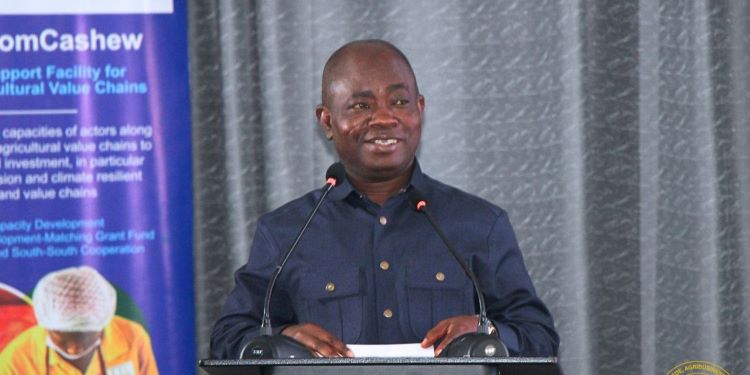
According to Hon. Sampson Ahi, Deputy Minister for Trade, Agribusiness and Industry, representing the Minister Hon. Elizabeth Ofosu-Adjare, this is a calculated shift toward “valorization” – the process of extracting maximum economic utility from every segment of the crop – positioning Ghana not just as a producer of nuts, but as a sophisticated hub for agro-industrial processing.
“Although the cashew sector has grown steadily and become a key contributor to Ghana’s non-traditional exports, a significant opportunity remains untapped in the utilization of the cashew apple, which is often left to waste on farms. The cashew apple should no longer be seen as waste. It should be treated as raw material for industry.
“Its potential for producing juice, concentrates, animal feed, cosmetics, and other industrial products should be tapped into”
Hon. Sampson Ahi, Deputy Minister for Trade, Agribusiness and Industry
MoTAI noted that the current economic reality is stark. While Ghana has established itself as a formidable player in the global cashew nut market, the apple – the fleshy fruit that carries the nut – remains a ghost in the national accounts. Currently, the vast majority of these apples are treated as waste, despite their high nutrient density and industrial versatility.
The Deputy Minister framed this waste as an unacceptable failure of the national industrial strategy, as the path to a “thriving industrial economy” requires the total integration of agricultural output into the domestic manufacturing value chain.

For decades, the Ghanaian cashew sector has been defined by a linear, extractive model: harvest the nut, export it raw, and discard the fruit. MoTAI’s intervention seeks to dismantle this cycle by introducing the infrastructure necessary for “cashew apple valorization.”
This process turns the perishable fruit into useful products. For industry stakeholders, this is “intensification” through technology rather than expansion, a hallmark of the administration’s modern agribusiness philosophy. The transition from “pilot initiatives to commercially viable enterprises” was the primary hurdle identified by stakeholders at the Accra conference.
While the technology for processing cashew apples exists, the logistics of collection and the financing of industrial-scale plants have remained elusive. MoTAI’s strategy involves bridging these gaps through the “Feed the Industry Programme,” a mechanical linkage designed to ensure that if a processor invests in a juice plant, they have a guaranteed, high-quality supply of raw apples from local farms.
Conversely, it provides farmers with a guaranteed market for what was previously discarded, providing an immediate boost to rural household incomes.
Fixing The Trade Loop
One of the most provocative aspects of Hon. Ahi’s address was the candid admission of historical weak linkages between Ghana’s agricultural production and its industrial capacity. This disconnect is the primary reason why Ghana remains vulnerable to global commodity price fluctuations.
When a country exports raw materials, it exports jobs and innovation. Through focusing on valorization, MoTAI is attempting to keep the entire value-creation process within Ghanaian borders. This includes not just the physical processing, but the branding, packaging, and market positioning that command premium prices in international retail markets.
“Ghana must build a more integrated value chain that supports processing, branding, and market access,” the Deputy Minister said, arguing that the cashew sector and the manufacturing sector are not two separate entities, but one continuous industrial engine.

This integration, he added, is essential for the success of the Tree Crop Development Authority (TCDA), which is tasked with diversifying Ghana’s export base beyond cocoa. Targeting the cashew apple will help the TCDA double the potential economic output of every cashew farm in the country.
For MoTAI, this is not just a trade policy; it is a structural adjustment of the rural economy, turning peasant farmers into primary suppliers for sophisticated agro-industrial complexes, with massive economic stakes.
Ghana currently processes only a small fraction of its raw cashew output domestically. The majority is shipped to processing hubs in Vietnam and India, where the value addition – and the resulting profits – are captured by foreign firms.
The loss is even greater when the cashew apple is factored in, as its perishability means it cannot be exported raw; it must be processed locally or lost forever. MoTAI’s move to weaponize this waste is therefore a direct intervention to stop the export of Ghanaian economic potential.
Hon. Ahi noted that the involvement of the European Union and the GIZ (Deutsche Gesellschaft für Internationale Zusammenarbeit) highlights the interest of international partners in this valorization model – since they are increasingly looking to support initiatives that combine economic growth with waste reduction and circular economy principles.
A cashew apple that is processed into animal feed or biofuel is a cashew apple that isn’t producing methane in a landfill or rotting on a farm. This aligns Ghana’s industrial goals with global sustainability mandates, making the sector more attractive to Green Finance and climate-focused investors.
With the Regional Cashew Apple Valorization Conference, the government has laid out the vision, but the private sector must now take the lead in financing the collection and processing hubs.

The shift toward cashew apple valorization is perhaps the most significant change in Ghanaian agribusiness since the introduction of high-yield cocoa hybrids. It represents a move away from the commodity trap and toward a sophisticated, multi-product industrial strategy.
If successful, this initiative will boost GDP and provide a template for how other waste products in the Ghanaian agricultural landscape – from cocoa husks to pineapple crowns – can be reclaimed for national development.
READ ALSO: From Peak to Plummet: Ghana’s 15-Year Oil Journey Faces Critical Turning Point