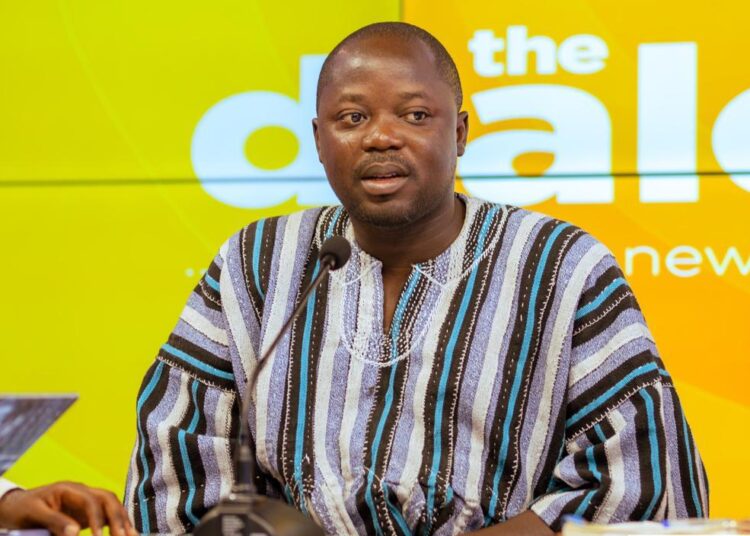
The Executive Director of the Center for Environmental Management and Sustainable Energy (CEMSE), Nsiah Benjamin, says Ghana’s 2026 Budget reflects a more ambitious and optimistic direction for the energy and green transition sector compared with the previous year.
Speaking in an interview with The Vaultz News, he said the substantial allocation to the Ministry of Energy and Green Transition signals that the government is prioritising universal electricity access and strengthening the country’s power generation capacity.
“If you look at the energy sector, I think 2026 looks quite bright compared to 2025 because of the allocations of setting a huge amount of resources to Ministry of Energy and Green Transition in excess of about GHC 2 billion.”
Benjamin Nsiah, Executive Director of CEMSE
According to him, this level of commitment suggests that “government is willing to make electricity very accessible to every person in Ghana.”
Government Prioritises Access and Generation Expansion

Mr. Nsiah highlighted that the government’s approach appears to target both the demand and supply sides of the energy sector. While expanding access remains a priority, he emphasised that the strategy also involves strengthening energy generation capacity.
“It comes not only from the demand perspective, but also from the supply perspective where government also wants to respond [by expanding] generation through the use of natural gas.”
Benjamin Nsiah, Executive Director of CEMSE
He explained that the budget clearly outlines the government’s intent to ramp up power generation and build a more resilient energy ecosystem.
“These are critically explained in the budget, and that shows that government in future is looking at expanding our generation.”
Benjamin Nsiah, Executive Director of CEMSE
The emphasis on natural gas, he noted, aligns with Ghana’s broader goal of transitioning to cleaner, efficient, and more stable power sources while maintaining a reliable energy supply.
Major Projects Lack Clear Funding Plan

Beyond renewables, Nsiah Benjamin’s most significant reservation concerns the financing of two major projects highlighted in the budget: the second Gas Processing Plant (GPP2) and the proposed 1,200-megawatt state-owned thermal plant.
He cautioned, “Our challenge with the budget has to do with the source of revenue for these two mega projects.” Although the budget outlines the government’s intention to pursue both projects, it does not identify how they will be funded.
“The Gas Processing Plant 2 (GPP2) with no specificity with respect to how we are going to fund it, whether it is going to be funded by a GOG or we are going to get funds from development partners or there’s going to be a private public partnership… was not specified.”
Benjamin Nsiah, Executive Director of CEMSE
He raised similar concerns about the 1,200MW thermal plant, which is expected to significantly boost national generation capacity. While the government hinted that petroleum revenue may be used, he believes this approach is risky.
“It’s likely going to be funded by our oil revenue… but looking at the volatile nature of oil prices, our dependence on this fund may not be able to construct these mega infrastructures as proposed.”
Benjamin Nsiah, Executive Director of CEMSE
Mr. Nsiah urged government to provide “clarity on the source of funding” to prevent project delays or financing shortfalls that could undermine implementation.
Concerns Over Missing Renewable Energy Specifics

Despite his positive outlook, the CEMSE Executive Director warned that the budget lacks clarity in key areas, particularly around Ghana’s renewable energy goals.
Under Ghana’s Energy Transition Framework, the country is expected to achieve at least 10% renewable energy penetration by 2030. However, the 2026 Budget, he said, offers limited insight into how this will be achieved.
The absence of specific renewable energy projects, timelines, or financing strategies raises concerns about whether the country is on track to meet its long-standing clean energy commitments.
For an economy pushing toward decarbonisation, he said a robust strategy is essential. Without it, the increased allocation may not fully translate into measurable progress in solar and other renewable sectors.
Moreover, the budget’s silence on private sector participation in renewables was particularly striking. With global financing shifting steadily toward greener energy, analysts argue that Ghana must provide clearer investment pathways for businesses if it is to attract capital and build sustainable energy infrastructure.
Aligning Budgets With a Clear Energy Transition Path

Stakeholders argue that Ghana’s energy transition requires a synchronized approach that aligns financial allocations, policy commitments, and long-term planning. With rising electricity demand, existing generation constraints, and the urgency of decarbonisation, coordinated planning is critical.
As the CEMSE head noted, strong budgetary allocations must be matched with strong strategic direction. While the 2026 budget signals serious political intent, its impact will ultimately depend on execution, transparency, and sustained financing.
Nsiah Benjamin believes Ghana can make substantial progress toward a modern and resilient energy system, but only if the budget’s ambitions are backed by detailed, actionable plans.
As he put it, Ghana’s energy future hinges not only on how much money is allocated, but on how effectively that money is deployed.
READ ALSO: IMANI’s Simons Alleges Procurement Scandal Behind 2026 SIM Re-registration: ‘Katanomics’ Again?