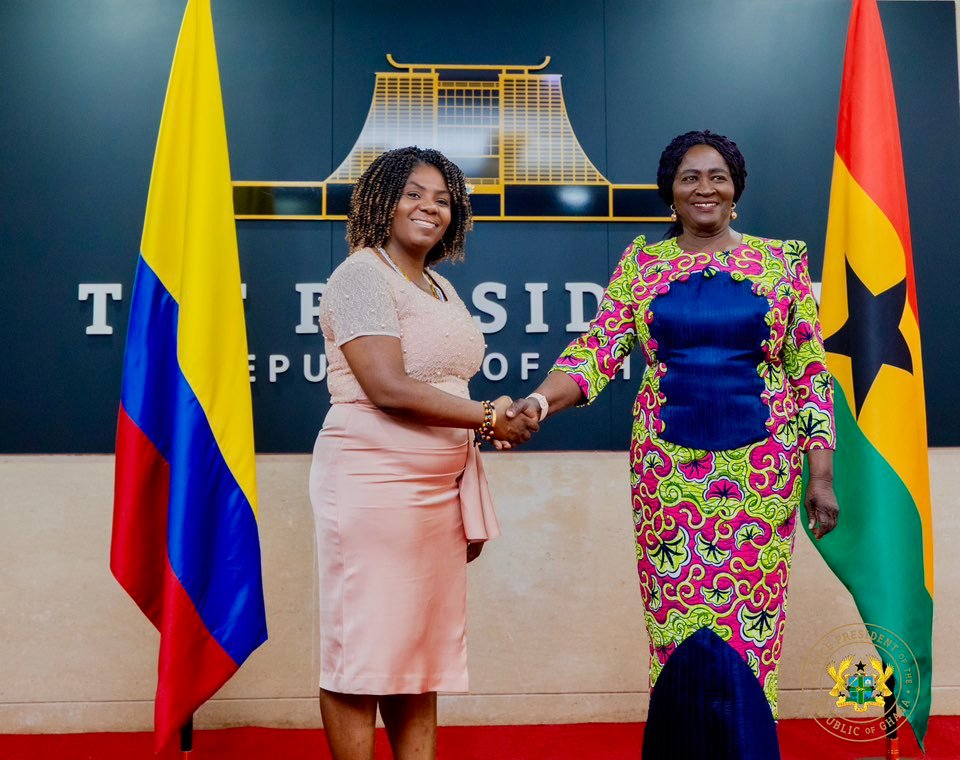
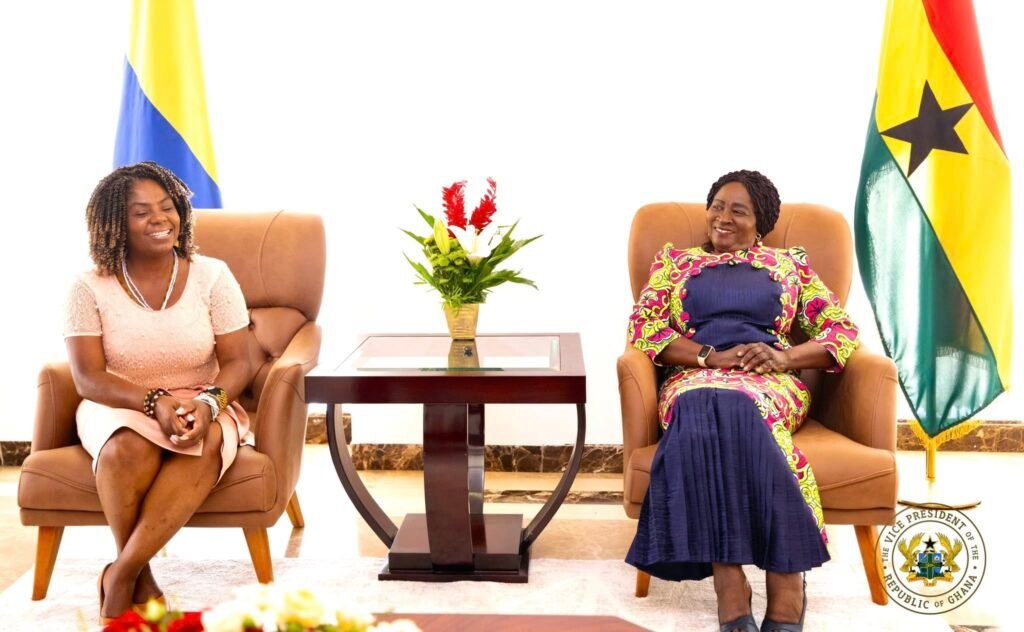
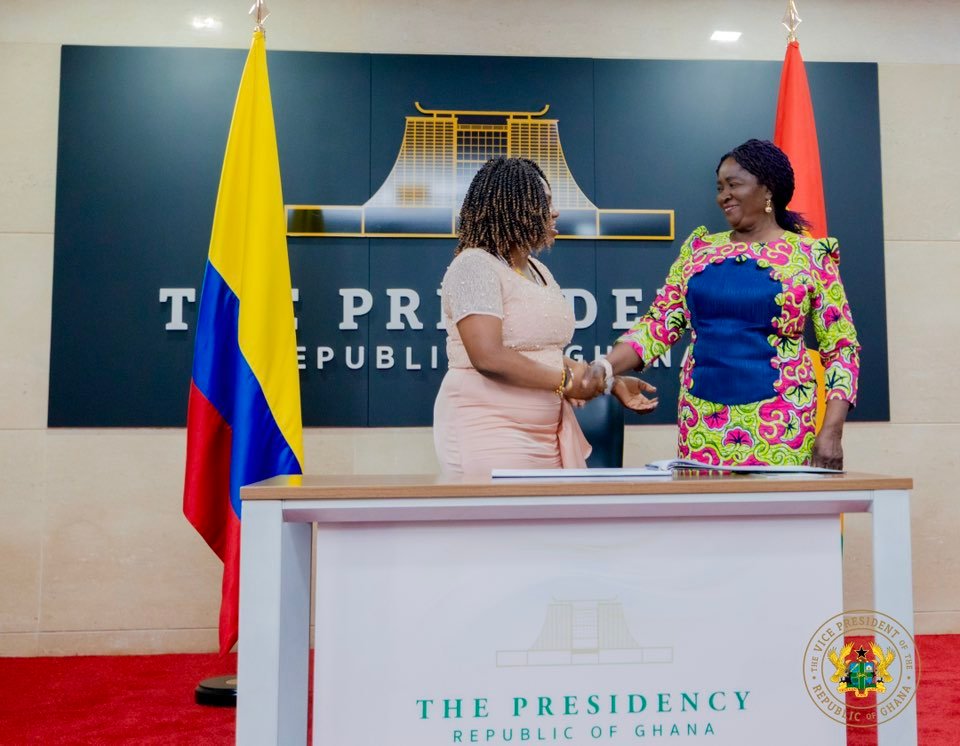
Ghana and Colombia have reaffirmed their commitment to deepening bilateral relations as Ghana’s Vice President, Her Excellency Professor Jane Naana Opoku-Agyemang, welcomed her Colombian counterpart, Her Excellency Francia Elena Márquez Mina, to Accra.
The visit, made on behalf of President John Dramani Mahama, marks the Colombian Vice President’s second trip to Ghana since assuming office, a development Ghana regards as both meaningful and symbolic of the enduring partnership between the two nations.
In her welcome address, Vice President Opoku-Agyemang underscored the significance of the occasion, noting that the return visit by Colombia’s Vice President reinforces “the strong and longstanding partnership between our two nations,” a relationship she described as grounded in mutual respect, shared aspirations, and the bonds of solidarity that have shaped cooperation over the years.
She highlighted that the historic and contemporary experiences of both countries have created a framework for engagement that continues to evolve with clarity and purpose.
Vice President Márquez Mina, widely recognised for her longstanding activism for racial justice, human dignity, and global reparative dialogue, carries a profile that resonates strongly within Latin America and across the international community.
Professor Opoku-Agyemang referenced these contributions as central to Colombia’s political trajectory and as a bridge of shared values between Accra and Bogotá.


She emphasised that Colombia’s stance on advancing reparations for communities historically affected by slavery, marginalisation, and systemic discrimination aligns closely with Ghana’s leadership in global conversations on restorative justice. According to her, these shared priorities give added depth to an already strong diplomatic relationship.
Economic Cooperation
Touching on economic cooperation, Vice President Opoku-Agyemang noted that the Africa Continental Free Trade Area (AfCFTA), headquartered in Ghana, presents an opportunity for Colombia to expand its commercial footprint on the continent.
She explained that the AfCFTA “avails Colombian businesses access to Africa’s single market and provides an opportunity to build sustainable trade and investment links with the continent, using Ghana as a gateway.” This gateway role, she added, strengthens Ghana’s positioning as a pivotal node for countries seeking strategic economic partnerships in Africa.
Both leaders discussed the potential for expanded collaboration in key areas including trade and investment, agriculture, digital innovation, and climate resilience. Professor Opoku-Agyemang stated that the two sides acknowledged the significant prospects available within these sectors and agreed that realising this potential will require strengthened transport connections.
To this end, they concluded that improved air travel and port connectivity between Ghana and Colombia would be essential in facilitating smoother commercial and diplomatic engagement.
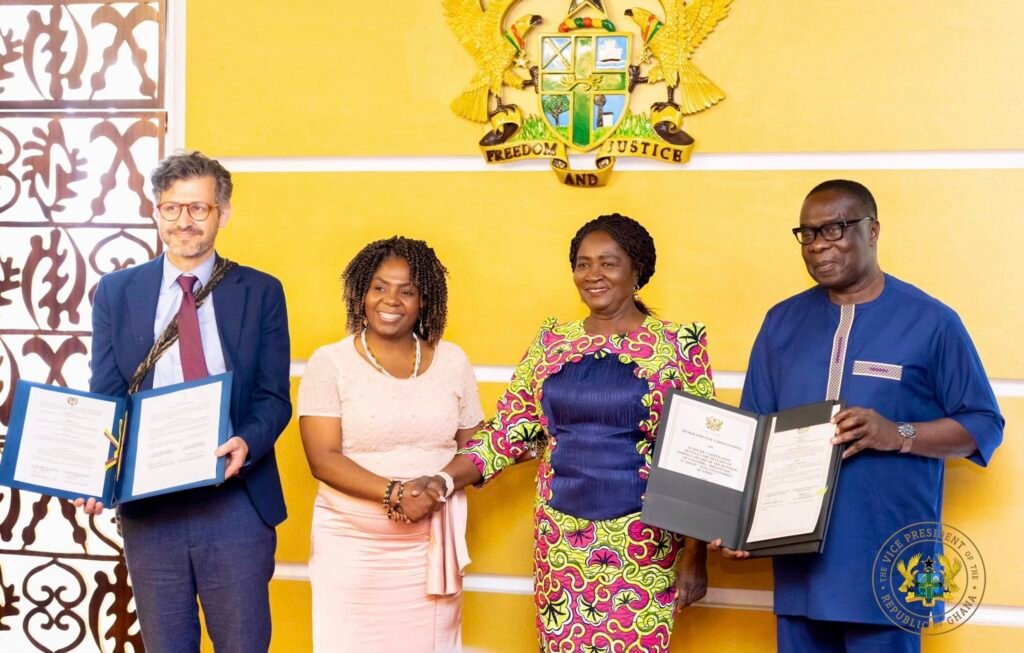
Enhanced logistics, they observed, would anchor the relationship in practical, long-term infrastructure that supports movement, exchange, and investment. In a further demonstration of commitment to deeper cooperation, the two countries signed a Memorandum of Understanding on academic collaboration.
The MoU, concluded between the Diplomatic Academy of Colombia’s Ministry of Foreign Affairs and the Foreign Service Institute of Ghana, is expected to promote knowledge exchange, build capacity among diplomats, and serve as a foundation for sustained institutional partnership.
The agreement reflects both countries’ recognition of diplomacy as an evolving discipline that benefits from shared expertise and continuous professional development.
Vice President Opoku-Agyemang described Ghana and Colombia’s bilateral relations as “an excellent model of South-South cooperation,” noting that both countries have consistently engaged on equal terms, defined by shared challenges and collaborative approaches to global issues.
She emphasised that the cooperation has been shaped not by hierarchy but by parallel histories and common objectives, making it a constructive example of how countries in the Global South can support one another through developmental partnerships.
Both leaders concluded their meeting with a shared resolve to strengthen collaboration in areas of strategic importance. This commitment, they agreed, reflects a future-oriented partnership that recognises the value of solidarity in addressing contemporary global challenges.
Vice President Opoku-Agyemang expressed confidence that the expanding relationship between Ghana and Colombia will continue to produce tangible benefits for both nations, from diplomacy and trade to cultural exchange and knowledge-sharing.
As the Colombian Vice President’s visit drew to a close, it became evident that the engagement was more than ceremonial. It represented a reaffirmation of Ghana and Colombia’s dedication to cultivating a partnership that is multidimensional, resilient, and reflective of shared values.
With growing opportunities under AfCFTA, expanding room for diplomatic cooperation, and a renewed drive toward deepening ties, both sides signalled a commitment to building a stronger future together.
READ ALSO: Ewoyaa Lithium: IMANI Rejects Allocation of Additional Concessions to Barari DV