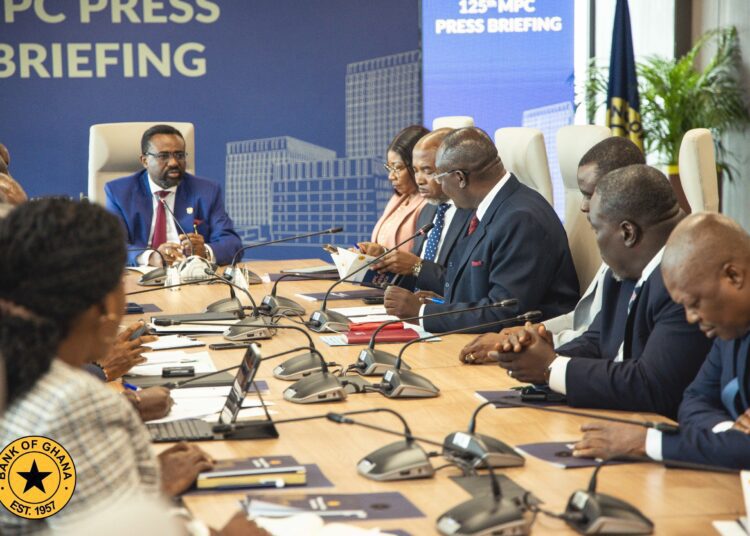
The Bank of Ghana (BoG) has announced its Monetary Policy Committee meetings for 2026 as expectations of a further reduction in the Monetary Policy Rate (MPR) linger.
Released on the Bank of Ghana’s website on Wednesday, 31st December 2025, the schedule provides 6 MPC meeting dates and 9 regular meetings to be held every other month from January. Just like it happened on July 18, 2025, there could be an emergency meeting of the committee in 2026 to complement the official scheduled meetings.
The first meeting in 2026 will be from 26th to 28th of January. The other MPC meetings are March 16th to 18th, May 18th to 20th, July 20th to 22nd, September 22nd to 24th, and November 16th to 18th.
Following the conclusion of the meetings, the MPC will hold a press conference on the last meeting date of the respective dates to communicate the outcome of their deliberations, including the fixing of a new monetary policy rate or its maintenance. The press conference serves as an opportunity for the public, media, and stakeholders to gain insights into the committee’s assessments and reason for the decision made.

The MPC Meetings
The MPC, comprising 7 members – 5 Bank of Ghana employees and 2 external members, with the Governor serving as the committee Chair – is mandated under the Bank of Ghana (Amendment) Act, 2016 (Act 918) to primarily set the Monetary Policy Rate to guide interest rates and anchor expectations. By so doing, the committee maintains price stability, promotes financial stability, and fosters efficient payment systems to support sustainable economic growth.
The MPC will analyze various economic indicators, including inflation rates, GDP growth, exchange rates, and other relevant factors that influence monetary policy decisions. The committee will also take into consideration global economic trends and their potential impact on the Ghanaian economy.
The decisions made by the MPC can have significant implications for the economy, as they can influence interest rates, lending practices, and overall monetary conditions. The committee’s decisions aim to achieve the Bank of Ghana’s objectives of maintaining price stability, supporting economic growth, and ensuring financial stability within the country.
Current Economic Situation
Since the last Monetary Policy Committee meeting in November, where the committee set the Monetary Policy Rate at 18 percent, the economic situation has been quite stable, showing robust and sustained macroeconomic indicators.
The headline inflation for November was 6.3 percent, supported by consistently falling policy rate, fiscal consolidation, tight policies from the Bank of Ghana and Ministry of Finance, and a stable Ghana Cedi.
Following steady disinflation, the Bank of Ghana made bold policy rate cuts – 350 basis point reduction in September 2025 (21.5 percent) and a further cut to 18 percent in November 2025 – beckoning confidence in sustained stability.
In general, the state of the Ghanaian economy is stable, which gives hope that subsequent MPC meetings will lead to either a further cut or it being maintained. These possibilities are derived from the Governor of the Bank of Ghana’s optimism tied to the economic performance and the IMF’s caution to avoid drastic policy changes.
If stability sustains as well or better than it did in 2025, it will most likely be that the policy rate will see further cuts in 2026. 2025 outperformed all expectations by international agencies and the government, making expectations for 2026 higher. The IMF has already established that 2026 will be the true test of the viability and robustness of the Ghanaian economy, measured in its ability to withstand both internal and external shocks.
The mixed bag of uncertainties that awaits 2026 makes the MPC meeting outcomes uncertain, though positive outcomes are expected. However, Ghanaians, the government, and the IMF are optimistic about 2026 as the economy’s structural reforms continue alongside the constant assurances from the economic managers.