Ceuta Mayor, Juan Jesús Vivas has called for the immediate return of thousands of migrants who remain in the Spanish enclave following last week’s unprecedented border crossing from Morocco, warning that the city is still struggling to recover despite the departure of most of those who entered.
Speaking before the European Parliament’s Committee on Civil Liberties, Justice and Home Affairs, Vivas said that between 3,000 and 5,000 migrants continue to occupy reception centres that are operating beyond capacity, leaving the enclave unable to return to normal. “We demand the immediate expulsion of the Moroccans who have entered our city irregularly and who remain here,” Vivas told members of the European Parliament.
The hearing was convened in response to one of the largest migration incidents in the European Union’s history, after an estimated 80,000 migrants crossed into Ceuta by sea over two days in late July. Although Spanish authorities have since facilitated the return of the overwhelming majority of those migrants to Morocco, Vivas argued that the crisis remains far from over. “This in no way allows us to say that our city has returned to normal for its citizens,” he said.
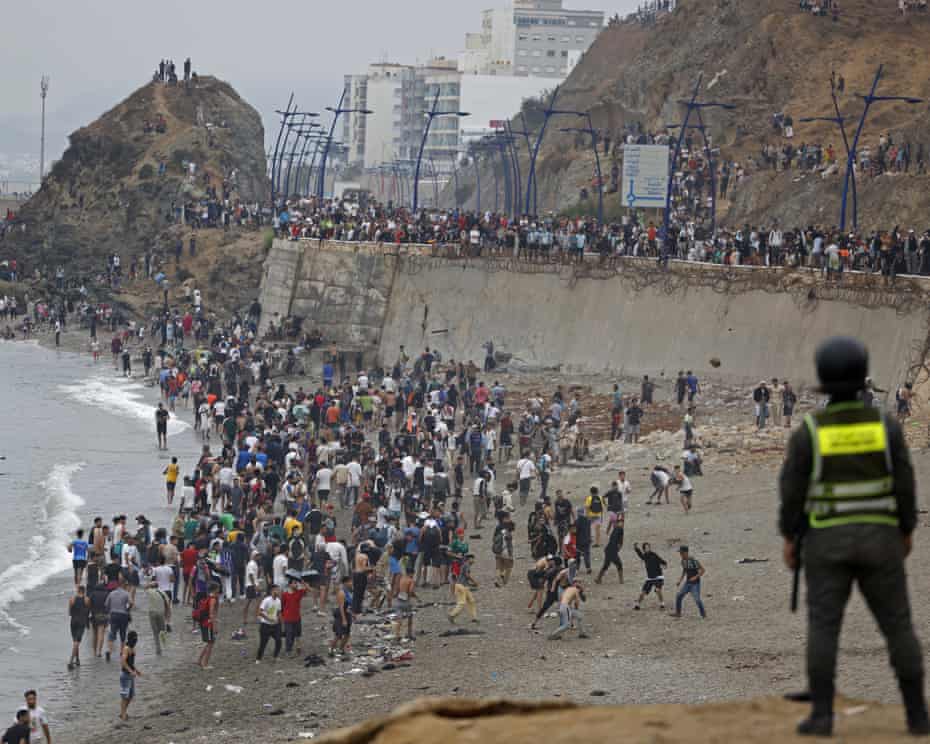
The Mayor explained that local authorities have been unable to determine the precise number of migrants still in Ceuta because of limited resources available to process those remaining in the enclave.
Also, Vivas said the mass arrivals triggered a humanitarian emergency that placed extraordinary strain on the city’s infrastructure and public services. “We faced a humanitarian emergency of enormous proportions, compounded by disturbances to public order and a serious risk to public safety,” he said.
According to the Mayor, local reception facilities continue to face significant pressure as officials work to accommodate those who have not yet been returned. He noted that while Spain can deport adult migrants who entered irregularly, the situation is more complex for unaccompanied minors.
Under existing legal protections, he said, minors may only be returned to their country of origin with their consent and in accordance with applicable procedures. The Mayor urged both Spain and the European Union to ensure that irregular migration does not place an unsustainable burden on border communities such as Ceuta.
He the breach of the Spanish enclave’s border with Morocco as an “invasion.”
“According to the Royal Spanish Academy’s dictionary, the second definition of ‘invasion’ refers to the anomalous or irregular occupation of a specific place. This is precisely what happened on 30 and 31 July, when some 80,000 people – equivalent to the entire population of Ceuta – stormed into our city.”
Juan Jesús Vivas
During his testimony, Vivas revealed that local authorities had alerted Spain’s central government before the large-scale crossings occurred. “We told the ministries about the situation we were experiencing, and we pointed out that there had been an alarming increase in arrival flows,” he said.
He also disclosed that Ceuta had attempted to establish contact with Moroccan authorities ahead of the incident but was unsuccessful. According to Vivas, Moroccan officials declined to engage with the city’s administration despite growing concerns over increasing migration flows.
The experience, he argued, exposed significant weaknesses in border security. “What has become apparent,” Vivas said, “is that our border is porous and vulnerable.”
Calls for European Action
The hearing also focused on the wider implications of the crisis for the European Union, with Vivas arguing that the incident should not be viewed solely as a local or Spanish issue.
Earlier in his testimony, he described the mass crossing as an event that challenged the integrity of both Spain and the EU’s external borders. The Spanish government declined an invitation to participate in the parliamentary hearing. The European Commission was instead represented by Magnus Brunner, the Commissioner responsible for migration, who attended discussions on the bloc’s response to the crisis.
During questioning by lawmakers, Vivas was asked whether authorities believed any individuals linked to extremist groups had entered Ceuta during the mass crossing. “We don’t know from local authorities whether there are any jihadists among those who entered,” he replied, adding that local officials had no information indicating such a presence.
Ceuta and the neighbouring Spanish enclave of Melilla represent the European Union’s only land borders with Africa and have long served as key entry points for migrants attempting to reach Europe. However, the scale of last week’s crossings exceeded previous migration incidents, prompting renewed debate over border management and cooperation between Spain, Morocco and the European Union.
While the return of most migrants has eased immediate pressure on the enclave, Vivas maintained that thousands remain in reception centres and that stronger measures are needed to prevent similar incidents in the future.
His testimony adds to growing calls within Europe for reinforced external border controls, improved coordination with neighbouring countries and a more coordinated response to irregular migration affecting the bloc’s southern frontier.
READ ALSO: Fauci’s Lawyer Slams Senate Contempt Vote