

New polling analysis by Global InfoAnalytics Executive Director Mussa Dankwa points to deepening challenges for the New Patriotic Party, as voter loyalty in its traditional strongholds shows clear signs of strain.
Data tracking voter behavior from November 2024 to December 2025 indicates that the proportion of floating voters in the Ashanti Region has more than doubled, raising questions about the stability of the party’s core support base a year after the 2024 general elections.
According to Dankwa, Ashanti’s contribution to the national pool of floating voters rose sharply from 10 percent in 2024 to 23 percent in 2025. He described this trend as particularly worrying because Ashanti has long been regarded as the NPP’s most reliable electoral base.
In his assessment, a political stronghold producing such a high share of voters without firm party allegiance signals more than temporary dissatisfaction. It suggests a gradual weakening of the emotional and political bond between the party and a section of its traditional supporters.
“You can’t have a stronghold of the main opposition now choosing to align more with floating voters. The danger of floating voters is that they may transition to support other political parties in the future, as we have seen in the Greater Accra, Central and Western region”.
Global InfoAnalytics Executive Director Mussa Dankwa
The changing geography of floating voters further reinforces this concern. Regions such as Central and Western, historically regarded as the heartland of swing voters, now occupy less prominent positions.
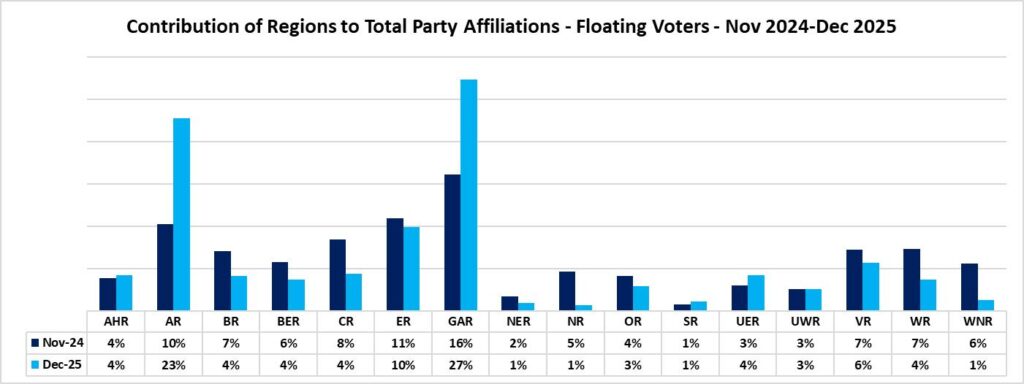
Central Region has fallen to fifth place in its contribution to floating voters, while Western Region has dropped even further, ranking ninth behind the Bono Region.
Mussa Dankwa interpreted this redistribution as evidence that voter volatility is no longer concentrated in traditional swing areas but is spreading into regions once viewed as politically settled.
NPP’s Dominance in Ashanti Region
Despite this volatility, the Ashanti Region remains numerically critical to the NPP. Data showed that Ashanti’s share of total NPP voters increased from 19 percent in 2024 to 24 percent in 2025.
This makes the region the single largest contributor to the party’s national voter base. However, Mussa Dankwa argued that this growing reliance is a double-edged reality.
While the numbers underline Ashanti’s importance, they also mean that any erosion of loyalty there would have outsized consequences for the party’s national performance.
Other regional shifts compound the challenge. The Eastern Region, another area traditionally aligned with the NPP, has seen its contribution decline from 15 percent in 2024 to 10 percent in 2025. In contrast, the Northern Region’s share has risen from 8 percent to 12 percent over the same period.
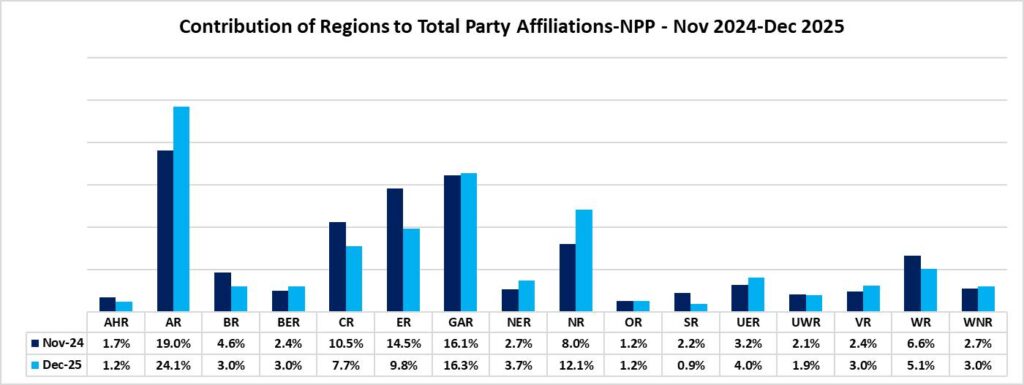
Together, Ashanti, Greater Accra, and the Northern Region now account for 53 percent of all NPP voters nationwide, up from 42 percent in 2024. Mussa Dankwa suggested that this growing concentration reflects a narrowing support base rather than an expanding national reach.
Undisclosed Voters’ Rise in Key Regions
Beyond floating voters, Mussa Dankwa highlighted another revealing category: voters who refuse to disclose their party affiliation. He described this group as an important indicator of brand stress, particularly when such voters are concentrated in a party’s historical strongholds.
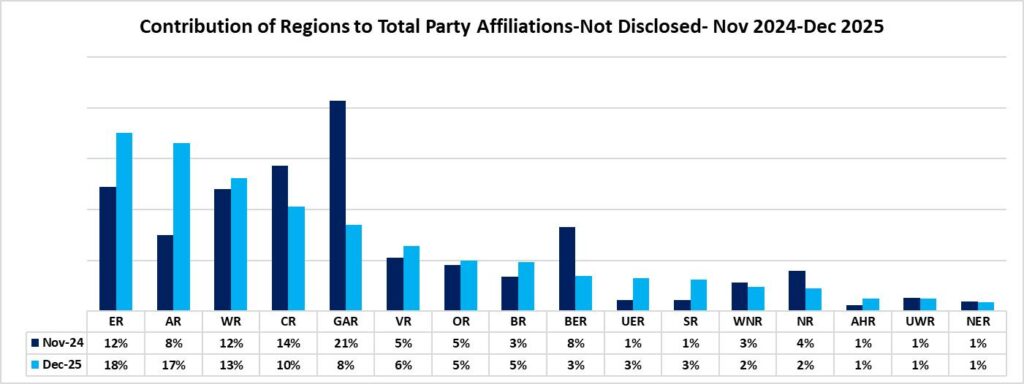
“The data shows that the majority of voters who don’t want to disclose their party affiliations come from Eastern, Ashanti, Central, and Western regions.”
Global InfoAnalytics Executive Director Mussa Dankwa
The Eastern Region accounts for 18 percent of all voters who do not disclose their affiliation, up from 12 percent in 2024. Ashanti has recorded an even sharper increase, rising from 8 percent to 17 percent.
Western Region’s share has edged up from 12 percent to 13 percent, while Central Region has declined from 14 percent to 10 percent. Mussa Dankwa interpreted these shifts as evidence that some voters in core NPP regions are increasingly uncomfortable publicly identifying with the party, even if they have not formally switched allegiance.
Greater Accra presents a different but equally significant development. The region saw a dramatic drop in non disclosed voters, falling from 21 percent in 2024 to just 8 percent in 2025.
According to Mussa Dankwa, this suggests that many voters who previously chose silence in Greater Accra have now moved into the floating voter category. He raised the question of where these voters might move next if current trends persist.
Taken together, the polling data suggest that party affiliation in Ghana is becoming more fluid than in the past. Mussa Dankwa concluded that the patterns emerging a year after the 2024 elections show that political loyalty can no longer be taken for granted, even in long-established strongholds.
For the NPP, the doubling of floating voters in Ashanti and the rise in non-disclosed voters in key regions represent warning signs that demand strategic reflection and engagement.
As voter behavior continues to evolve, the analysis underscores the need for political parties to rebuild trust, reconnect with their bases, and respond to changing expectations.
The data, Mussa Dankwa argued, makes clear that the political landscape is shifting, and past assumptions about secure support may no longer hold.
READ ALSO: MIIF CEO Vows to Consolidate 2025 Economic Gains as Fund Targets World-Class Status in 2026