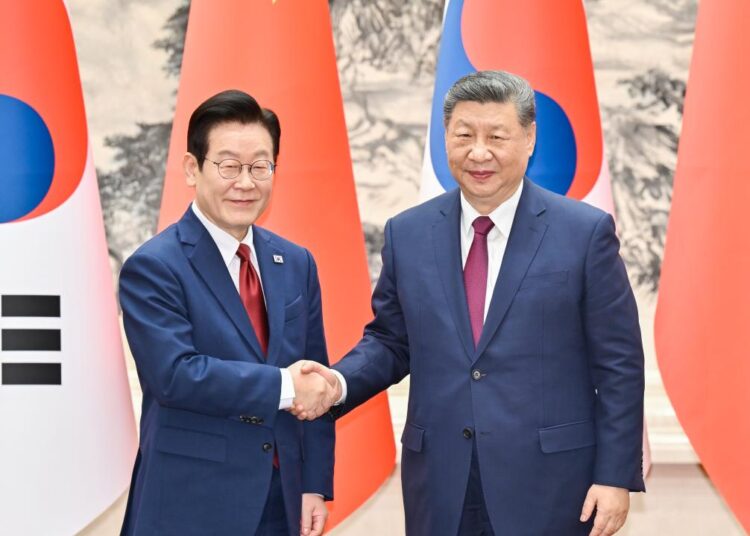
South Korean President, Lee Jae Myung Lee has called for the opening of “a new chapter in the development of Korea-China relations” during “changing times.”
Lee stated that the two countries should make joint contributions to promote peace, which is the foundation for prosperity and growth.
This came as South Korean President Lee Jae Myung met with Chinese President Xi Jinping as part of his four-day trip to China — his first since taking office in June.
As Xi hosted Lee at the Great Hall of the People, the Chinese President stressed the two countries’ “important responsibilities in maintaining regional peace and promoting global development.”
Xi said that China has consistently placed relations with South Korea high on its regional diplomatic agenda and maintained continuity and stability in its policy toward the country.
He added that China is willing to work with the South Korea to firmly uphold the direction of friendly cooperation, adhere to the principle of mutual benefit and win-win outcomes, promote bilateral strategic partnership along a healthy path, effectively enhance the well-being of both peoples, and contribute positively to regional and global peace and development.

The visit comes as China wants to shore up regional support as tensions rise with Japan. Ties between Beijing and Seoul have fluctuated in recent years over previous conservative South Korean governments’ steps to prioritize the US and Japan over China, and allow the US to install a missile defense system on its soil. Lee, a liberal, has promised to improve ties with Beijing, while also strengthening relations with Washington and Tokyo.
China and South Korea maintain robust trade ties, with bilateral trade reaching about $273 billion in 2024.
During their meeting, Xi and Lee oversaw the signing of 15 cooperation agreements in areas such as technology, trade, transportation and environmental protection.
Xi noted that China and South Korea share close economic ties with industrial and supply chains deeply interwoven, and the bilateral cooperation is mutually beneficial.
He said that the two countries should further align their development strategies, strengthen policy coordination, expand the pie of common interests, and achieve more cooperation results in emerging fields such as artificial intelligence, green industries, and the silver economy.
Earlier on Monday, Lee had attended a business forum in Beijing with representatives of major South Korean and Chinese companies, including Samsung, Hyundai, LG and Alibaba Group.
At that meeting, Lee and Chinese Vice Premier He Lifeng oversaw the signing of agreements in areas such as consumer goods, agriculture, biotechnology and entertainment.
South Korea, China To Continue Exploring Ways To Ease Korean Peninsula Tensions

South Korea’s National Security Adviser Wi Sung-lac told a briefing that during the summit, the two countries agreed to continue to explore creative ways to ease tensions on the Korean Peninsula, and confirmed the Chinese resolve to play “a constructive role” in efforts to promote peace.
China is a major ally of North Korea and provides it with an economic lifeline. In past years, China, together with Russia, has repeatedly blocked the US and others’ bids to toughen UN sanctions on North Korea.
Just hours before Lee’s arrival in China, North Korea launched several ballistic missiles into the sea, including, it said, hypersonic missiles, which are designed to travel at more than five times the speed of sound and are very difficult to detect and intercept. Foreign experts doubt that North Korea has developed such a functioning hypersonic weapon.
Lee’s visit also coincided, more broadly, with rising tensions between China and Japan over recent comments by Japan’s new leader that Tokyo could intervene in a potential Chinese attack on Taiwan, the island democracy China claims as its own.
In his meeting with Lee, Xi mentioned China’s and South Korea’s historical rivalry against Japan, calling on the two countries to “join hands to defend the fruits of victory in World War II and safeguard peace and stability in northeast Asia.”
READ ALSO: Venezuelan Crude Flows Face Market Frictions, Not Simple US Shift – Energy Chamber Chair