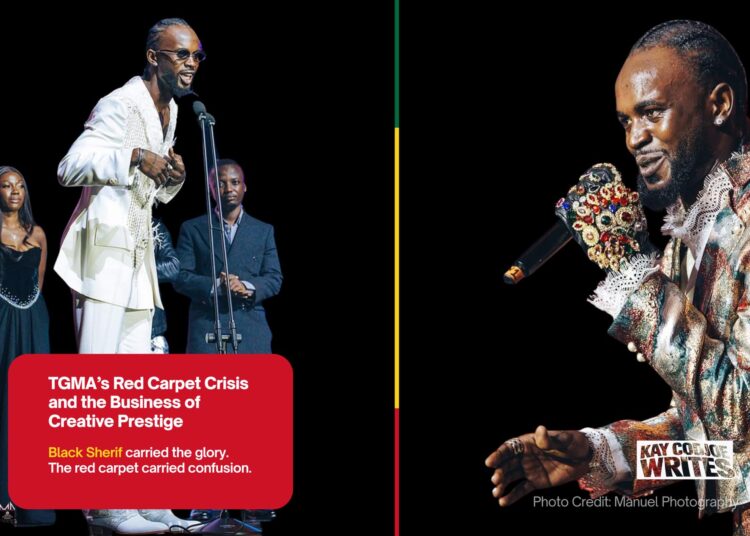
Author: Kay Codjoe, Market Research Consultant and Volunteer Associate at the IMANI Centre for Policy and Education
There was a time when the Ghana Music Awards was not just an awards show. It was a national ritual. Families gathered around bulky television sets. Children stayed up late arguing over who deserved Artist of the Year. Fashion designers waited for Monday morning conversations. Musicians are prepared for career-defining moments. Ghana watched itself.
Fast forward, something feels broken. The most painful part is not even the awards themselves. It is the optics. The atmosphere. The presentation. The collapsing prestige around the ecosystem that should surround Ghana’s biggest music night.
The 2026 TGMA red carpet exposed this brutally. Yes, there were a few commendable looks. Some celebrities showed effort. Some designers delivered admirable pieces. Ghana News Agency itself described the carpet as a “visual spectacle” under the “A Touch of Glitter” theme.
But compare the overall execution to the Africa Magic Viewers’ Choice Awards in Nigeria and the gap becomes painfully obvious. The AMVCA red carpet has evolved into a continental economic engine. Fashion houses prepare months ahead.
Stylists collaborate with luxury brands. Makeup artists, photographers, fabric merchants, jewelry retailers, content creators, hotels, transport companies, PR agencies, influencers, and digital media platforms all feed from the ecosystem.
Nigerian media openly describes the event as Africa’s equivalent of the Oscars, where fashion itself becomes headline material. At AMVCA, attendees understand the assignment.
They do not arrive merely to “show face.” They arrive to market industries. One attendee at the 2026 AMVCA literally wore a gown made from hundreds of loaves of bread to promote her bakery business. Ridiculous? Maybe. Effective? Absolutely. It generated international coverage and commercial visibility. That is how creative economies think.
Meanwhile, in Ghana, too much of the TGMA red carpet still feels improvised, underproduced, unserious, and disconnected from commerce. Sometimes the interviews are more viral than the artistry itself, often for the wrong reasons. The backlash surrounding portions of this year’s carpet reflected a broader frustration with professionalism and quality control.
What makes this even more embarrassing is that a Ghanaian secondary school prom recently demonstrated more ambition, spectacle, and aspirational aesthetics than portions of our premier national entertainment event.
The 2025 Ghana International School prom generated enormous online attention because students understood modern visual culture. Luxury arrivals. Coordinated styling. Cinematic presentation. Viral moments. Branding consciousness.
Think about that carefully. Teenagers preparing for prom appeared to understand prestige branding better than parts of an industry worth millions. That should alarm every stakeholder in Ghana’s creative economy. Because red carpets are not frivolous. They are economic infrastructure.
A properly executed entertainment awards scheme stimulates local fashion production, textile demand, tailoring, beauty services, hospitality, luxury transport, digital media engagement, tourism visibility, sponsorship confidence, and international cultural relevance.
Nigeria understands this. South Africa understands this. Even smaller African entertainment markets are beginning to understand this. Ghana still behaves as though glamour is accidental.
The tragedy is that Ghana has the raw ingredients to dominate culturally. We have musicians. We have the designers. We have the photographers. We have stylists. We have globally respected creative talent.
What we often lack is coordination, ambition, investment discipline, and obsessive attention to detail. Prestige is engineered. No globally respected awards scheme survives on nostalgia alone. Not the Grammy Awards. Not the BET Awards. Not the AMVCA. And certainly not the TGMA.
If Ghana wants its flagship entertainment platforms to become true engines of economic and cultural power, then the industry must stop treating production quality as optional decoration.
Because when a school prom begins to outperform a national awards scheme in cultural excitement, visual ambition, and aspirational branding, the problem is no longer fashion. It is institutional decline.
READ ALSO: President Mahama Arrives in Nairobi for Africa Forward Summit