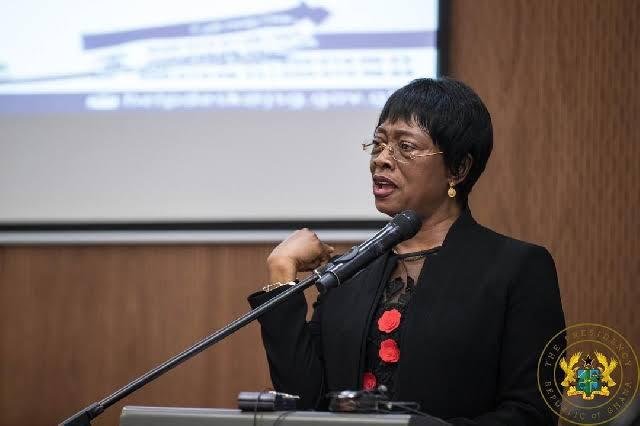
Justice Sophia Akuffo, a Fellow at the Institute of Economic Affairs (IEA) and former Chief Justice of Ghana, has issued a stirring call for a paradigm shift in Ghana’s extractive sector, asserting that full state ownership of natural resources is the primary catalyst for economic value addition and revenue growth.
Speaking during an IEA press briefing in Accra, she argued that the prevailing “Guggisberg model” which relies on meager royalties from foreign entities has historically failed to halt poverty, unlike the “open countries” such as Norway, Botswana, and Chile that have successfully leveraged resource sovereignty.
By transitioning to a model anchored in state ownership and service contracts, Ghana can reclaim its wealth, bolster the local currency, and secure the “national security dividends” that come with managing one’s own sovereign assets.
“Ghana’s natural resources are sovereign assets held in trust, a principle firmly grounded in our constitution as well as in international instruments, including the UN General Assembly Resolution 1803 of 1962. Therefore, any arrangement that seeks to transfer ownership for whatever period of time to someone else under the guise of attracting investment indeed ought to be considered unlawful. We cannot be caught in a time warp, looking to the past instead of to the future.”
Justice Sophia Akuffo
Sophia Akuffo emphasized that the era of “international colonialism” has ended and Ghana must no longer be caught in a “time warp” of outdated foreign-dominated arrangements.
The proposed ownership restructuring seeks to redirect resource wealth toward long-term structural transformation, including job creation, technology transfer, and community development.
According to Her Ladyship, the strategy involves the government refusing to renew or extend expiring mining leases, choosing instead to implement a new trajectory that prioritizes “Ghana first” without breaching existing legal contracts.
This approach challenges the “discredited system” that has long exploited the continent’s wealth under the guise of investment, aiming instead to make the Ghanaian Cedi a strong foreign exchange asset for others.
Bridging the Economic Gap: The High Cost of the Royalty Model
Ghana’s economic trajectory has been significantly hampered by a lack of direct ownership, resulting in a “wealth drain” where the majority of mineral value leaves the country.
While Ghana remains one of the world’s leading gold producers, the state often captures only a fraction of the total value through a 5% royalty and 35% corporate tax regime.
This reliance on the “old colonial paradigm” has historically led to insufficient revenue mobilization, forcing the nation into cycles of external debt and IMF bailouts.
Experts suggest that under the current model, billions of dollars in “secondary benefits” such as value-added processing and industrial linkages are lost to foreign corporations, leaving the local population impoverished despite the vast mineral wealth beneath their feet.
State ownership of these minerals is projected to bridge this fiscal gap by ensuring the nation retains 100% of the produced resource, paying only for the “technical capacity” or “service” provided by miners.
This shift would allow the government to dictate the terms of value addition, such as local gold refining and bauxite-to-alumina processing, which tremendously impacts the economy by multiplying export values.
By managing these resources as “sovereign assets,” Ghana can stabilize its currency and ensure that revenues are redirected into national development projects rather than “exporting our wealth and keeping us poor.”
Leveraging Local Expertise for National Prosperity

The Institute of Economic Affairs (IEA) dismisses assertions that Ghana lacks the “technical capacity, capital or expertise” to manage its own resources, calling such claims a mere defense of the status quo.
On the contrary, Ghana boasts a “credible cadre of experienced mining professionals” who have led large-scale operations for many decades. Currently, the operational leadership of most major mines in the country is already in the hands of Ghanaians, proving that the nation is ready to break the mould.
Justice Sophia Akuffo noted that it is time to become “unrepentantly selfish” regarding national interest, mirroring the strategic selfishness of developed nations to ensure that Ghana’s wealth benefits the Ghanaian first.
This new trajectory is not just about financial gain; it is about “technology transfer” and “long-term structural transformation.” By utilizing service contracts, the state can aggressively develop its human capital while ensuring that every ounce of mineral extracted contributes directly to the national treasury.
The upcoming expiration of multiple mining leases provides the “rare and strategic opportunity” to pivot toward this model, ensuring that Ghana finally reaps the “financial, economic, and national security dividends” it deserves as a resource-rich nation.
READ ALSO : GSA Aligns 2026 Roadmap with MoTAI’s Strategic Planning