
Ghana’s ambition to build a resilient 24-hour economy is facing a defining test as rising electricity costs and currency pressures threaten industrial growth.
In a new policy manifesto, policy analyst Sitsofe Mensah argues that the country has reached a crossroads and must urgently rethink how it generates and pays for power if it hopes to sustain jobs, productivity and competitiveness.
In his article titled “The Energy Sovereignty Manifesto: Powering Ghana’s 24-Hour Economy,” Mensah warns that Ghana can no longer rely on what he describes as an illusion of surplus electricity. Instead, he says the nation must transition from simply having access to power to achieving what he calls “affordable sovereignty.”
“Ghana has reached a crossroads. We are no longer in an era of ‘surplus, excess power,’” Mensah writes, pointing to the growing mismatch between industrial demand and a grid heavily dependent on expensive, foreign-denominated fuel sources.
A Grid Under Growing Strain
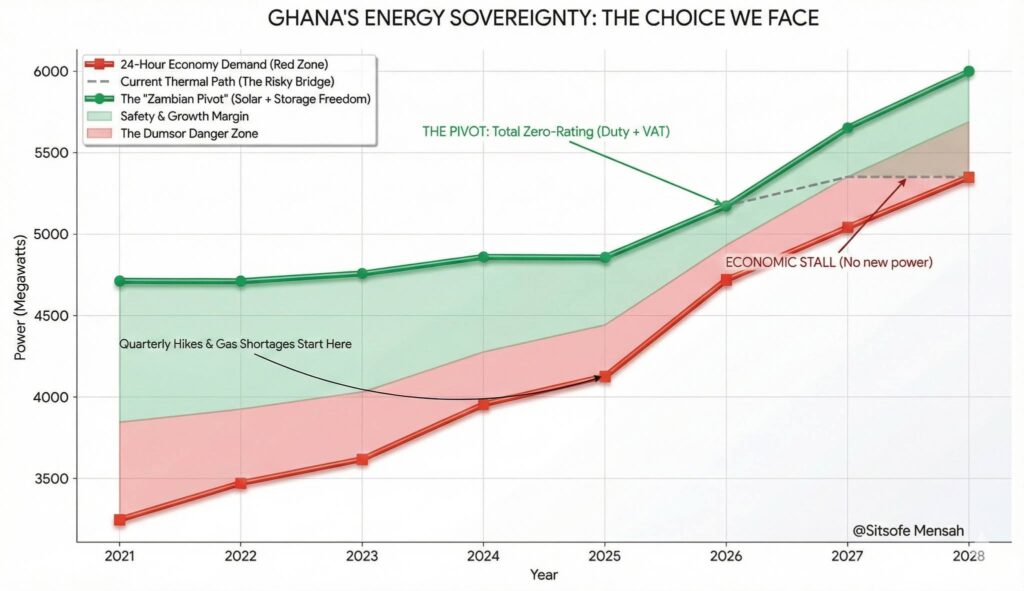
According to the analyst, Ghana’s current energy system is under siege from rising demand and structural weaknesses. He notes that for years, the country leaned on thermal power plants as a “risky bridge” to meet demand, a strategy now showing cracks as the economy expands.
Mensah highlights that most of Ghana’s thermal plants rely on gas priced in United States dollars, exposing consumers and businesses to exchange rate volatility.
“Every exchange rate fluctuation is a tax on your home and business,” he argues, warning that periodic tariff reviews often translate into higher electricity bills.
He further cautions that if current trends persist, Ghana could face a return to power shortages.
Projections cited in the manifesto suggest that by the end of 2027, national electricity demand could exceed dependable capacity, pushing the country into what he terms a “Dumsor danger zone” that risks economic stagnation.
Lessons from the African Energy Trilemma
Drawing on regional comparisons, Mensah contrasts Ghana’s situation with that of other African countries navigating what analysts describe as the energy trilemma of access, affordability and sustainability.
While Ghana has made notable gains in electricity access, he argues that affordability has become its weakest link.
He points to Zambia as a key case study, noting that despite global energy price shocks, Zambia managed to keep tariffs relatively low through strategic policy choices.
“We cannot grow a 24-hour economy on 20-cent electricity when our competitors are paying half that,” Mensah states, arguing that high energy costs undermine Ghana’s ability to compete in manufacturing and exports.
At the heart of the manifesto is what Mensah calls the “Zambian Pivot,” a proposal for a decisive shift toward decentralized renewable energy, particularly solar power combined with battery storage.
Rather than focusing solely on large, state-led power projects, he urges policymakers to empower households and businesses to generate their own electricity.
He advocates for zero-rating import duties and value-added tax on the entire solar ecosystem, including panels, inverters and high-capacity batteries. Such a move, he argues, would accelerate adoption and reduce reliance on imported fuels.
“A factory in Tema can deploy rooftop solar in 90 days. A thermal plant takes 1,000 days of debt and negotiation,” Mensah notes, emphasizing speed, cost efficiency and currency stability as major advantages of the approach.
Benefits for Government and Consumers

Mensah insists the proposed shift would ease fiscal pressure on the state while delivering tangible benefits to consumers. By reducing dependence on dollar-denominated fuel purchases, Ghana could shield the cedi from persistent depreciation linked to energy imports.
For households and businesses, solar adoption offers predictability. “Once you install a solar-storage system, your fuel cost is GHS 0.00,” he writes, arguing that fixed-cost energy would protect consumers from inflation and quarterly tariff hikes.
The analyst also links renewable energy expansion to job creation, saying a decentralized grid would support installers, technicians and local manufacturing, turning citizens from “grid victims” into “energy partners.”
Rather than sidelining existing utilities, Mensah envisions a hybrid grid where the national utility evolves into a facilitator of distributed generation.
Under a strengthened net-metering framework, homes and factories would feed excess solar power back into the grid, improving resilience and reducing debt burdens on the state.
“The plots are clear.
“We can fall into the red zone of economic stall, or we can ride the green line of sovereignty.”
Policy Analyst Sitsofe Mensah
As Ghana debates how best to power its 24-hour economy, Mensah’s manifesto adds urgency to calls for reforms that prioritize affordability, resilience and local control over energy production.
READ ALSO: China Backs Lai’s Sentencing, Warns Against Interference