

The African Director of the National Resource Governance Institute (NRGI), Nafi Chinery, has urged policymakers to tread cautiously as debate intensifies over proposed reforms to the Ghana Heritage Fund.
Speaking at a Technical Roundtable on government plans to access the Ghana Heritage Fund, Ms. Chinery cautioned that expanding the investment mandate of Ghana’s petroleum funds raises fundamental concerns about trust, governance and intergenerational equity. She stressed that any shift in policy must be anchored in discipline, transparency and clear safeguards.
Ms. Chinery framed the discussion as one that goes beyond partisan politics. According to her, the issue speaks directly to the relationship between leaders and citizens and the promises embedded in Ghana’s petroleum revenue management framework.
“This is a conversation about trust, trust between decision-makers and citizens,” she said, emphasising that petroleum funds are “not just fiscal instruments but they are promises” to manage oil revenues with foresight and fairness for both present and future generations.
Ghana established the Heritage Fund alongside the Stabilisation Fund to cushion the national budget against oil price volatility and to save a portion of petroleum revenues for posterity. Over the years, the funds have been viewed as pillars of fiscal resilience, particularly during periods of economic stress.
However, proposals now under consideration seek to broaden the funds’ investment mandates, potentially allowing savings to be channelled into domestic energy infrastructure and other strategic projects.
Inflection Point for Petroleum Funds
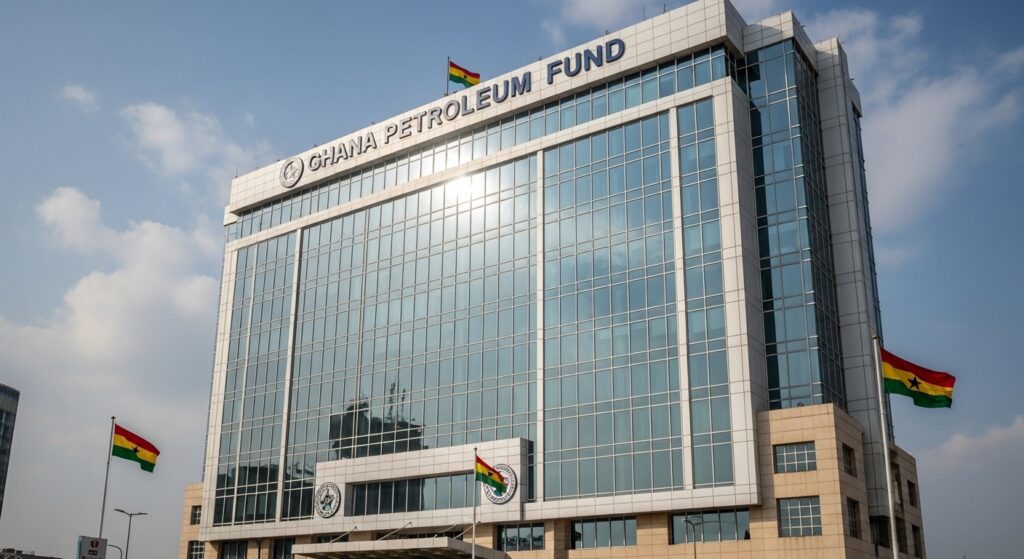
Ms. Chinery described the current moment as an inflection point. With petroleum reserves standing at approximately US$1.46 billion as of February 2026, policymakers are weighing options to secure higher returns than those currently generated under existing investment strategies.
While acknowledging concerns about relatively modest returns, she warned that altering the mandate is “not a trivial adjustment” but “a consequential policy shift.”
Such a move, she argued, would rebalance the trade-offs between risk and security, immediate gains and long-term insurance, as well as political discretion and rule-based governance.
Civil society organisations have also raised transparency concerns, particularly amid reports that Parliament has passed amendments enabling such changes. These developments have heightened calls for public dialogue and careful evaluation.
Risks of Concentration and Reduced Buffers

Drawing on NRGI’s global experience with sovereign wealth funds, Ms. Chinery noted that failures often arise not from spending itself but from spending without credible rules, oversight and public trust.
She acknowledged that domestic investments could potentially generate higher returns and accelerate development objectives.
However, she cautioned that concentrating petroleum savings within the domestic economy could amplify economic, physical and political risks at a time when diversification remains critical.
Using Heritage Fund savings to finance energy infrastructure, she warned, risks blurring the core purpose of the fund. It could weaken stabilisation buffers and reduce the state’s capacity to shield citizens from future economic shocks.
“Liquidity, clarity of purpose, transparency, and strong technical rules are lifelines in times of crisis,” she stressed, referencing lessons drawn from NRGI’s analysis of sovereign funds during global crises, including the COVID-19 pandemic.
Lessons from Global Sovereign Funds

NRGI’s research indicates that governments tend to withdraw far less from sovereign funds when clear rules exist and mandates are unambiguous. Funds perform most effectively when they remain liquid and when oversight structures are robust.
Well-governed funds, Ms. Chinery explained, can stabilise budgets and protect vulnerable populations during downturns. In contrast, poorly governed funds risk erosion of value, politicisation and loss of credibility—outcomes that can undermine public confidence and fiscal sustainability.
These global lessons, she suggested, offer important guidance as Ghana considers potential reforms.
Ms. Chinery called for reinforcing existing governance frameworks, including Parliament’s oversight responsibilities and the role of institutions such as the Public Interest and Accountability Committee. She also highlighted the importance of transparent and citizen-friendly reporting by the central bank.
Any additional qualifying investment instruments, she said, should be narrowly defined, independently risk-rated, transparently priced and rigorously evaluated. Above all, the funds must remain liquid, diversified and auditable.
“These are not constraints; they are safeguards,” she emphasised, underscoring that robust governance does not hinder development but rather secures it.
Charting a Responsible Path Forward
Concluding her remarks, Ms. Chinery outlined three desired outcomes from the ongoing engagement. First, she called for a shared, evidence-based consensus on the core purpose of Ghana’s petroleum funds and the criteria for any policy adjustments.
Second, she advocated agreement on a practical governance framework to assess new investment proposals. Third, she urged a clear roadmap to strengthen oversight, disclosure and accountability mechanisms.
As Ghana weighs the future direction of its petroleum savings, the debate over Ghana Heritage Fund reform highlights a broader challenge facing resource-rich nations: how to balance urgent development demands with long-term fiscal stability and intergenerational justice.
For Ms. Chinery and NRGI, the message is clear, any reform must preserve trust, safeguard resilience and ensure that the promise of Ghana’s oil wealth endures for generations to come.
READ ALSO: Tarique Rahman Sworn In As Bangladesh’s Prime Minister