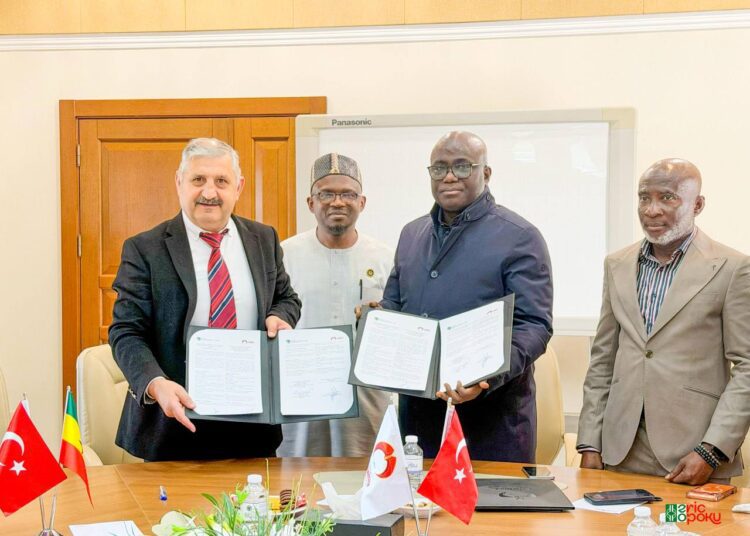
In a strategic move to fortify the human capital of Ghana’s agro-industrial sector, the Minister for Food and Agriculture, Hon. Eric Opoku has signed a transformative Memorandum of Understanding (MoU) with GIDA VE TARIM University in Turkey.
On behalf of President John Dramani Mahama, the Minister formalized the agreement aimed at providing specialized academic and professional training for Ghanaian students, noting that the partnership is designed to bridge the technical skills gap that has historically hindered the full modernization of Ghana’s agricultural value chain.
“GIDA VE TARIM University, a renowned institution in agricultural studies, will offer scholarships for various agriculture-related programs, focusing on strengthening capacity and skills development within Ghana’s agricultural sector”
Hon. Eric Opoku, Minister for Food and Agriculture
Hon Opoku added that the selection of GIDA VE TARIM University as a partner is a deliberate choice. As a world-renowned specialized institution in agriculture and food sciences, the university offers cutting-edge research and training in areas critical to Ghana’s current economic goals, including agricultural biotechnology, food engineering, and sustainable plant production.

By securing these scholarships, the government is ensuring that the next generation of Ghanaian agricultural leaders is exposed to global best practices and high-skilled technologies.
The scholarship program is a core component of the Ministry of Food and Agriculture’s (MoFA) broader agenda to transition from subsistence farming to a structured, industrialized economy. Hon. Eric Opoku emphasized that this MoU represents more than just educational access; it is a “boon for the growth of the agro-industrial sector.”
By training students in advanced practices – such as precision irrigation and molecular biology for plant protection – the MoFA aims to build a local talent pool capable of managing large-scale, tech-driven agricultural enterprises.
Hon. Opoku highlighted that the government’s commitment to investing in human resources is the most sustainable way to reduce post-harvest losses and improve the global competitiveness of Ghanaian products.

Strengthening Global Partnerships
This Turkey-Ghana alliance signals a shift toward evidence-based and technical diplomacy. Rather than focusing solely on equipment imports, the government is prioritizing the “soft” infrastructure of knowledge transfer.
Through this MoU, Hon. Opoku explained, the Ministry will facilitate the placement of students into programs that align with Ghana’s priority crops, such as cocoa, cashew, and shea, while also exploring new frontiers in food safety and quality management. He noted that this is especially important, since the country has decided to stop exporting some of these crops.
The synergy between the two nations is expected to result in a “brain gain,” for the Ghanaian economy as returning scholars will act as technical leads in the Ministry’s new agricultural enclaves, serving as consultants for local farmers and processors.
The final objective of this partnership, beyond the advanced training of Ghanaian students in highly skilled agricultural practices, is the seamless integration of returned graduates into the national economy to build local capacity.

As Ghana charts a course toward becoming a manufacturing hub under the AfCFTA, the need for highly skilled agricultural professionals has never been more urgent. Hon. Eric Opoku concluded that this strategic reset is about creating confidence for both local stakeholders and international investors.
READ ALSO: BoG Orders Banks to Brace for Shocks