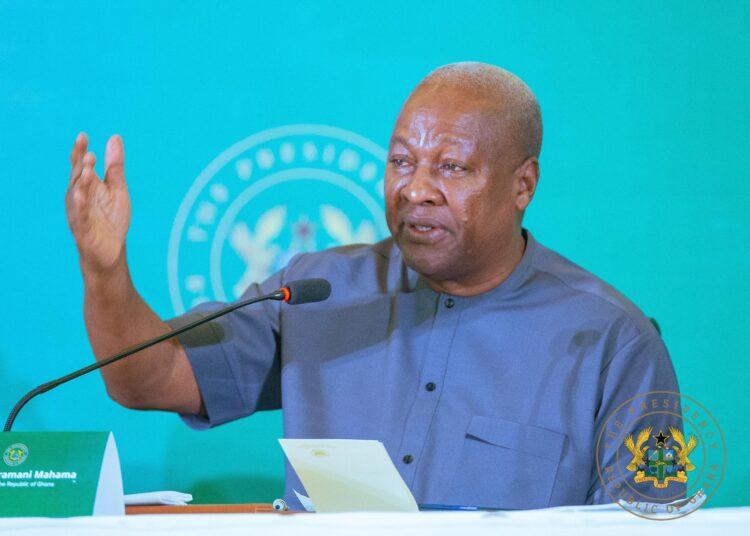
In a high-stakes encounter at the Presidential Dialogue with the Private Sector, President John Dramani Mahama has set an ambitious national target of increasing manufacturing’s contribution to GDP from its stagnant 50-year average of 10% to at least 15% by the year 2030.
Addressing an assembly of captains of industry, business executives, and members of the Council of State, the President moved beyond the rhetoric of stabilization to outline a definitive roadmap for industrial sovereignty, issuing a clarion call for a radical structural shift in the Ghanaian economy.
“I have convened this presidential dialogue with the private sector because I hold a simple but firm conviction that Ghana’s economic transformation is a joint enterprise. The government cannot achieve it alone, and equally the private sector cannot thrive without a government that listens, reforms, and creates an enabling environment for businesses to thrive”
President John Dramani Mahama
This “defining conversation,” as the President described it, was the fulfillment of a 2024 campaign promise to hold annual, candid engagements with the private sector. He noted that the dialogue comes at a critical juncture where the administration’s fiscal consolidation efforts are beginning to bear fruit, marked by a stabilizing Cedi and renewed investor confidence.
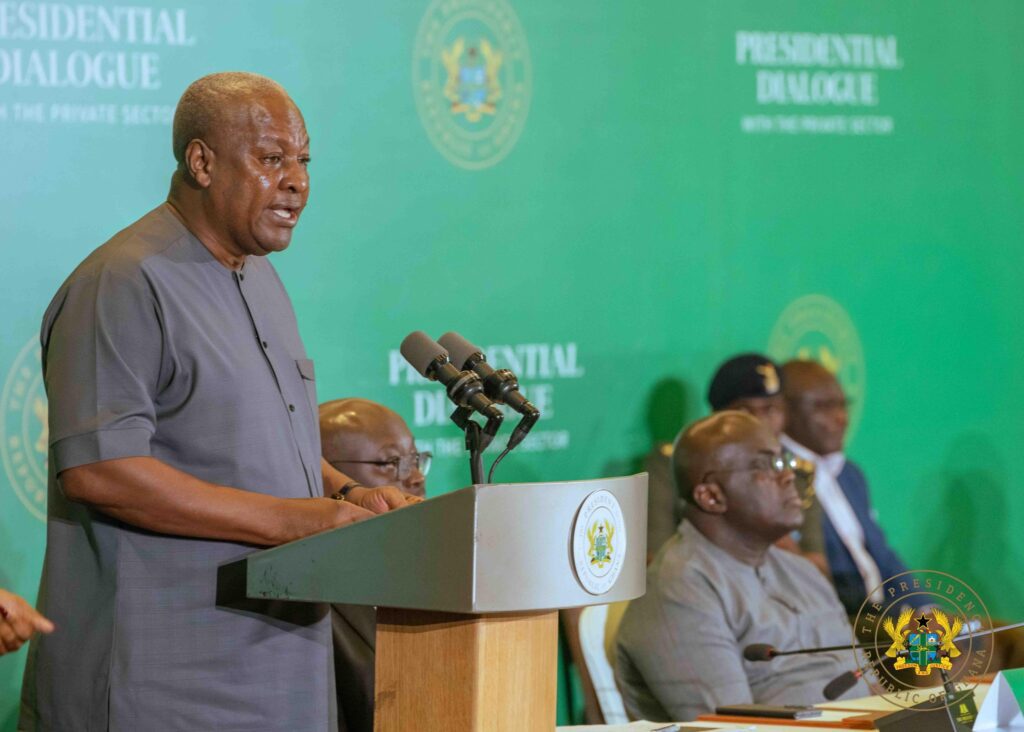
However, President Mahama was quick to warn that “stabilization is not equal to transformation,” signaling that the government is now pivoting toward aggressive industrial growth and the creation of 500,000 new quality industrial jobs.
The President’s speech highlighted a stark reality: while Ghana has maintained a 10% manufacturing-to-GDP ratio for over five decades, emerging Asian economies – which started from similar economic baselines – have surged to shares of 20% to 30%, thereby creating mass employment and export competitiveness.
“And so we need to change our trajectory. I have therefore set a national target. Manufacturing must contribute at least 15% of GDP by the year 2030. Tonight is about resetting the partnership between government and the private sector, and we must do this candidly, substantively, and with mutual accountability”
President John Dramani Mahama
President Mahama emphasized that the nation requires “structural reform and not incremental adjustments.” This sentiment aligns with the recent passage of the 24-Hour Economy Authority Act, which provides the legislative muscle for tax rebates and off-peak electricity tariffs to support multi-shift manufacturing.
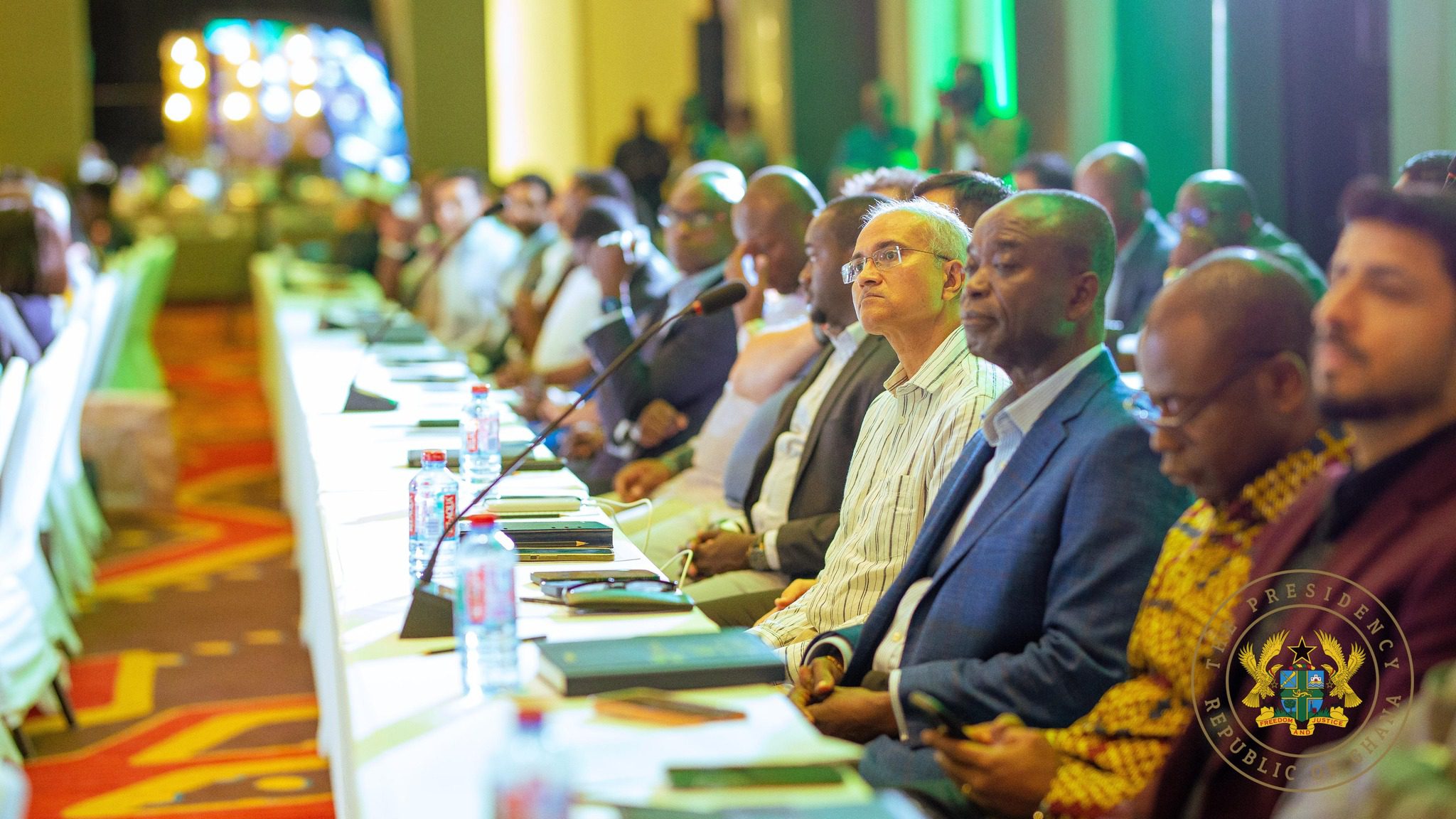
The Regional Competitiveness Gap
A sobering moment in the dialogue came when the President addressed the Ghana Chamber of Mines report, which indicates that Ghana is losing its competitive edge to regional neighbors.
As Benin, Côte d’Ivoire, and Nigeria aggressively court industrial capital, the President stressed that Ghana’s “reset” must include making the business environment more attractive than those of its peers.
The strategy involves not just policy incentives but a “joint enterprise” where the government listens and reforms in real-time. By targeting a 15% manufacturing share, the administration intends to pivot the economy from a heavy reliance on raw material exports toward a high-value, export-competitive manufacturing hub.
The administration’s “Progress Report” included a focus on the 500,000 industrial jobs targeted by 2030. These are not merely employment statistics but are envisioned as quality roles in processing and manufacturing that will absorb the youth and reduce the national unemployment rate.
The President noted that a focus on macroeconomic credibility is the foundation for attracting the private capital necessary to fuel these factories.
As the session progressed, the message to the “captains of industry,” was one of cautious optimism. The President’s acknowledgement of the private sector as a co-equal partner in the “joint enterprise” of nation-building suggests a departure from the top-down economic management of the past.

The President also acknowledged the “practical reality,” grounded in the extensive sector engagements led by the Minister for Trade, Agribusiness, and Industry, Hon. Elizabeth Ofosu-Adjare.
These consultations, ranging from exporters’ roundtables to factory floor visits, have reportedly informed a policy direction focused on the removal of “distortionary levies” and the rationalization of value-added tax to lower the cost of doing business.
With the 24-hour economy infrastructure now legally in place and a clear GDP target set, the Mahama administration has placed the ball firmly in the court of the private sector to lead the next phase of Ghana’s industrial evolution.
READ ALSO: Ghana, Japan Seal $20m Grant to Boost Northern Healthcare Delivery