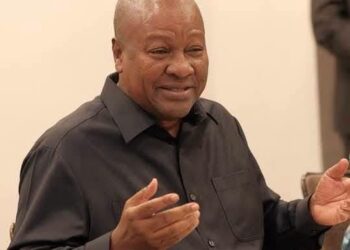
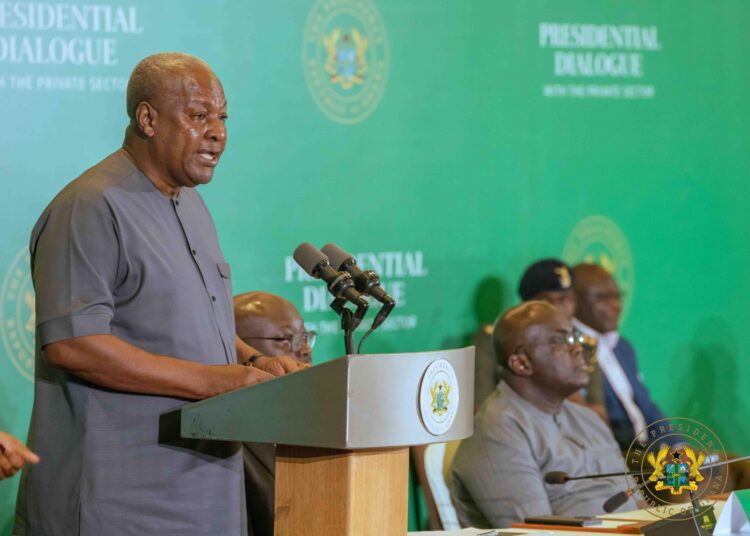
President John Dramani Mahama has unveiled a sweeping “Combat Plan,” to dismantle the structural barriers crippling Ghana’s private sector.
Speaking at the Presidential Dialogue with the Private Sector, the President moved from broad economic targets to a granular, sector-by-sector strategy aimed at slashing production costs and protecting local industries from what he termed “economic sabotage.”
At the heart of this intervention is a radical overhaul of the nation’s energy pricing, with a commitment to introduce differentiated off-peak industrial tariffs to ensure Ghana remains competitive against its regional peers.
“There are many areas we need to look at. Areas like corporate taxation, electricity tariffs and stable power, duties on machinery and equipment, and several other factors. And across every sub-sector represented here tonight, one constraint dominates. That is the cost of energy and reliability of power”
President John Dramani Mahama
By identifying the high cost of energy and the unreliability of power as the dominant constraints across every manufacturing sub-sector, President Mahama argued that no industrial nation can thrive under structurally high power costs, particularly when neighbors like Benin, Côte d’Ivoire, and Nigeria offer more attractive utility regimes.
He revealed that his administration’s plan to resolve the issue involves accelerating energy sector debt restructuring, expanding generation capacity – specifically in renewables – improving transmission efficiency, and promoting embedded generation within industrial enclaves.
Breaking the Interest Rate Barrier
The President also noted that while interest rates have fallen significantly from their previous highs of 38%, the current 18% to 20% rates are insufficient for an industrial takeoff. To resolve this, the government is moving to establish dedicated financing windows for manufacturing.
“Access to affordable patient capital will be treated as a structural reform priority by this government,” President Mahama stated.
He explained that by partnering with the Bank of Ghana (BoG) and development finance institutions, the administration aims to deploy special purpose vehicles (SPVs) for SME expansion and expand credit guarantee schemes.
This shift toward “patient capital,” is designed to provide the long-term funding necessary for complex manufacturing cycles, moving away from the short-term lending turnovers that currently stifle growth.
The President emphasized that without affordable financing, the goal of a 15% manufacturing GDP contribution would remain out of reach.
Zero Tolerance for Sabotage
In one of the most forceful segments of his address, President Mahama reclassified trade infractions – such as smuggling, under-declaration, and the re-bagging of inferior products – as acts of economic sabotage.
He signaled a departure from lenient penalties, promising to treat these infractions as economic crimes. This “hardline” approach includes the dismissal and prosecution of public officers found to be complicit in border crimes.

To support this enforcement, the President revealed that the government will deploy technology-driven customs surveillance and rigorously enforce product standards. He made it clear that “protecting Ghanaian enterprises,” is a non-negotiable prerequisite for industrial growth.
Sector-Specific Mandates
The dialogue also outlined a roadmap for specific industries, ranging from textiles to automotive.
For the cement industry, the focus is on the enforcement of LI 2491 and resolving port logistical constraints that have delayed clinker discharge. In the iron and steel sector, the President announced a strict ban on the export of both ferrous and non-ferrous scrap material to ensure local furnaces have a consistent supply of raw materials.
Crucially, the President linked industrialization to land tenure reform, noting that his administration is moving to create litigation-free industrial land banks and reform tenure systems to support commercial contract farming.
This is coupled with a “strengthened action,” against illegal mining and sand-winning, which continue to threaten agricultural resources essential for the agri-processing sector.
“Industrialization requires secure land tenure and protection of agricultural resources. Land reform is absolutely essential for our economic transformation”
President John Dramani Mahama

For the pharmaceutical sector, the President highlighted that the focus is on local Active Pharmaceutical Ingredient (API) production, while the automotive industry will see new affordable vehicle financing schemes to drive domestic demand.
The President reiterated that these reforms are not optional but foundational. By addressing energy, finance, and trade enforcement simultaneously, the government hopes to create a “joint enterprise” where the private sector can lead Ghana into its next phase of industrial sovereignty.
READ ALSO: CalBank Raises GH₵1.16bn, Lending Ban Lifted